
Pulp Fiction, 1906 · page 106 of 248
The Argosy, October 1906 — page 106: what you’re looking at
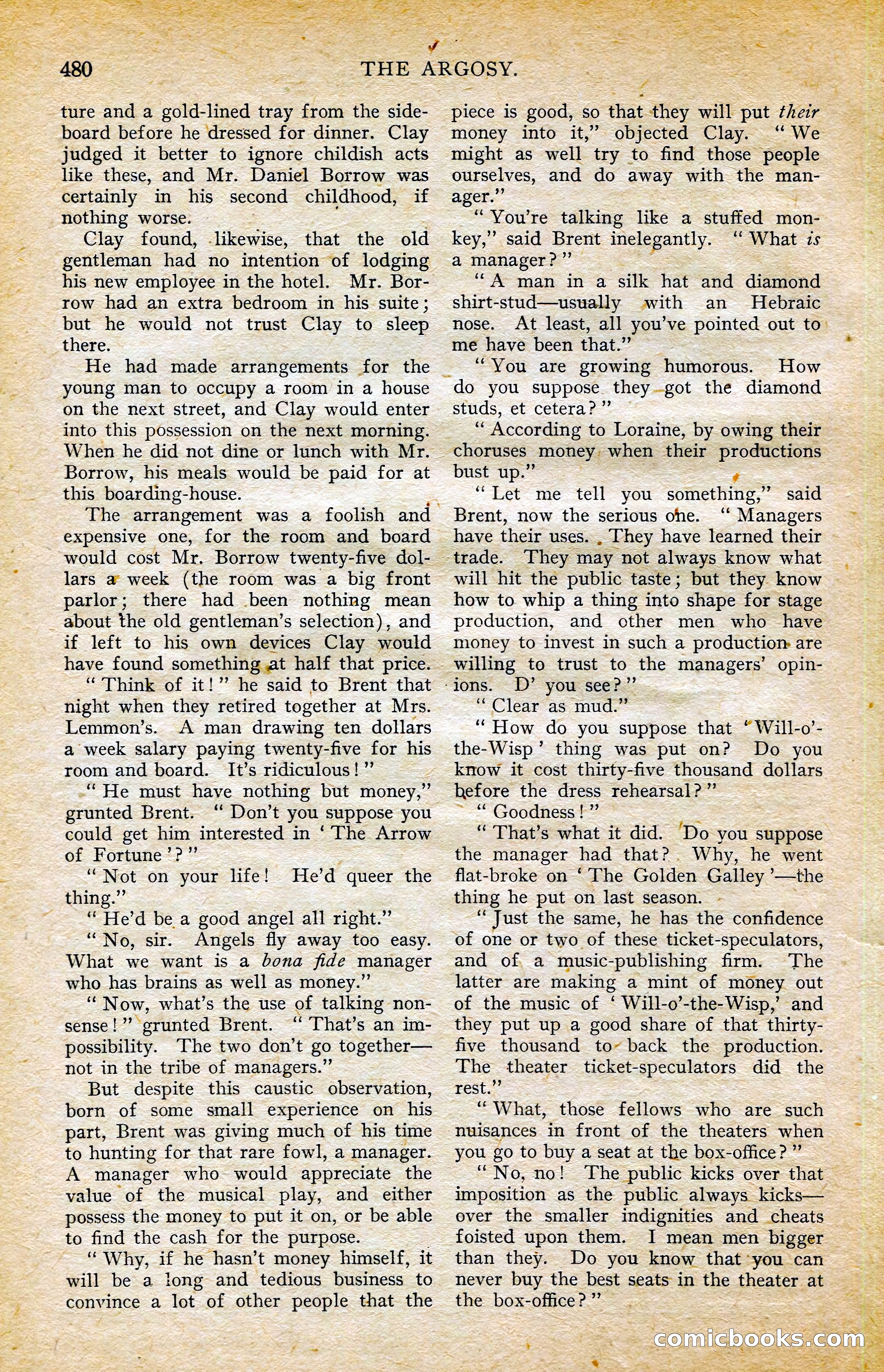
A restored page from Pulp Fiction, 1906. Page through the whole issue in the reader above.
📄 Transcribed text from this page (OCR, searchable)
Machine-transcribed from the original scan — historical spelling and the odd misread are preserved.
\ 480 ee ST ARGOSY. go ee ee ture and a gold-lined fay from the side: board before he dressed for dinner. Clay judged it better to ignore childish acts like these, and Mr. Daniel Borrow was certainly in his second childhood, if nothing worse. | - Clay found, -likewise, that the old gentleman had no intention of lodging his new employee in the hotel. Mr. Bor- row had an extra bedroom in his suite; but he would not trust Clay to sleep there. He had made arrangements for the young man to occupy a room in a house on the next street, and Clay would enter into this possession on the next morning. When he did not dine or lunch with Mr. Borrow, his meals would be paid for at this boarding- house. The arrangement was a foolish and expensive one, for the room and board would cost Mr. Borrow twenty-five dol- — lars a week (the room was a big front parlor; there had been nothing mean _ about the old gentleman’s selection), and if left to his own devices Clay would have found something at half that price. “Think of it!” he said to Brent that night when they retired together at Mrs. Lemmon’s. A man drawing ten dollars a week salary paying twenty-five for his room and board. It’s ridiculous!” “He must have nothing but money,” grunted Brent. could get him interested in ‘ The Arrow of Fortune’? ”’ “Not on your life! thing.” ‘““ He’d be a good angel all right.” “No, sir. Angels fly away too easy. What we want is a bona fide manager who has brains as well as money.” ‘Now, what’s the use of talking non- sense!” grunted Brent. “ That’s an im- possibility. The two don’t go together— not in the tribe of managers.”’ But despite this caustic observation, born of some small experience on his bat Brent was giving much of his time to hunting for that rare fowl, a manager. A manager who would appreciate the value of the musical play, and either possess the money to put it on, or be able to find the cash for the purpose. “Why, if he hasn’t money himself, it will be a long and tedious business to convince a lot of other people that the He’d queer the -trade. “Don’t you suppose you ‘piece is good, so ‘that they ware put their money into it,” objected Clay. might as well. try to find those ‘people ourselves, and do away with the man- ager.’ j “ You're talking like a shufied mon- key,” said Brent inelegantly. “© what 1s a manager?” “A man in a silk hat and aimaond shirt-stud—usualy with an Hebraic nose. me have been that.” “You are growing humorous. How do you suppose. they got the diamond studs, et cetera?” — S According to Loraine, by owing their choruses “money: when their productions bust up.” ¢ “Let me tell you something,” said Brent, now the serious one. ‘“ Managers have their uses. , They have learned their ‘They may not always know what will hit the public taste; but they know how to whip a thing into shape for stage production, and other men who have money to invest in such a production are willing to trust to the managers’ opin- ‘ions. D’ you see?”’ “Clear as mud.” ‘“How do you suppose that “ Will-o’- the-Wisp’ thing was put on? Do you know it cost thirty-five thousand dollars before the dress rehearsal?” ~ “ Goodness!” : “ That’s what it did. ‘Do you suppose the manager had that? Why, he went flat-broke on ‘The Golden Galley —the thing he put on last season. - ust the same, he has the confidence of one or two of these ticket-speculators, and of. a music-publishing firm. The latter are making a mint of money out of the music of ‘ Will-o’-the-Wisp,’ and they put up a good share of that thirty- five thousand to~ back the production. The theater ticket-speculators did the rest.” “What, those fellows who are such nuisances in front of the theaters when you go to buy a seat at the box-office? ” ‘““No, no! The public kicks over that imposition as the public always kicks— ever the smaller indignities and cheats foisted upon them. I mean men bigger than they. Do you know that you can never buy the best seats in the theater at the box-office? ” “We At least, all you’ve pointed out to: : S.C OI Se * > ae ee he gee 3