
Pulp Fiction, 1906 · page 99 of 230
The Argosy, January 1906 — page 99: what you’re looking at
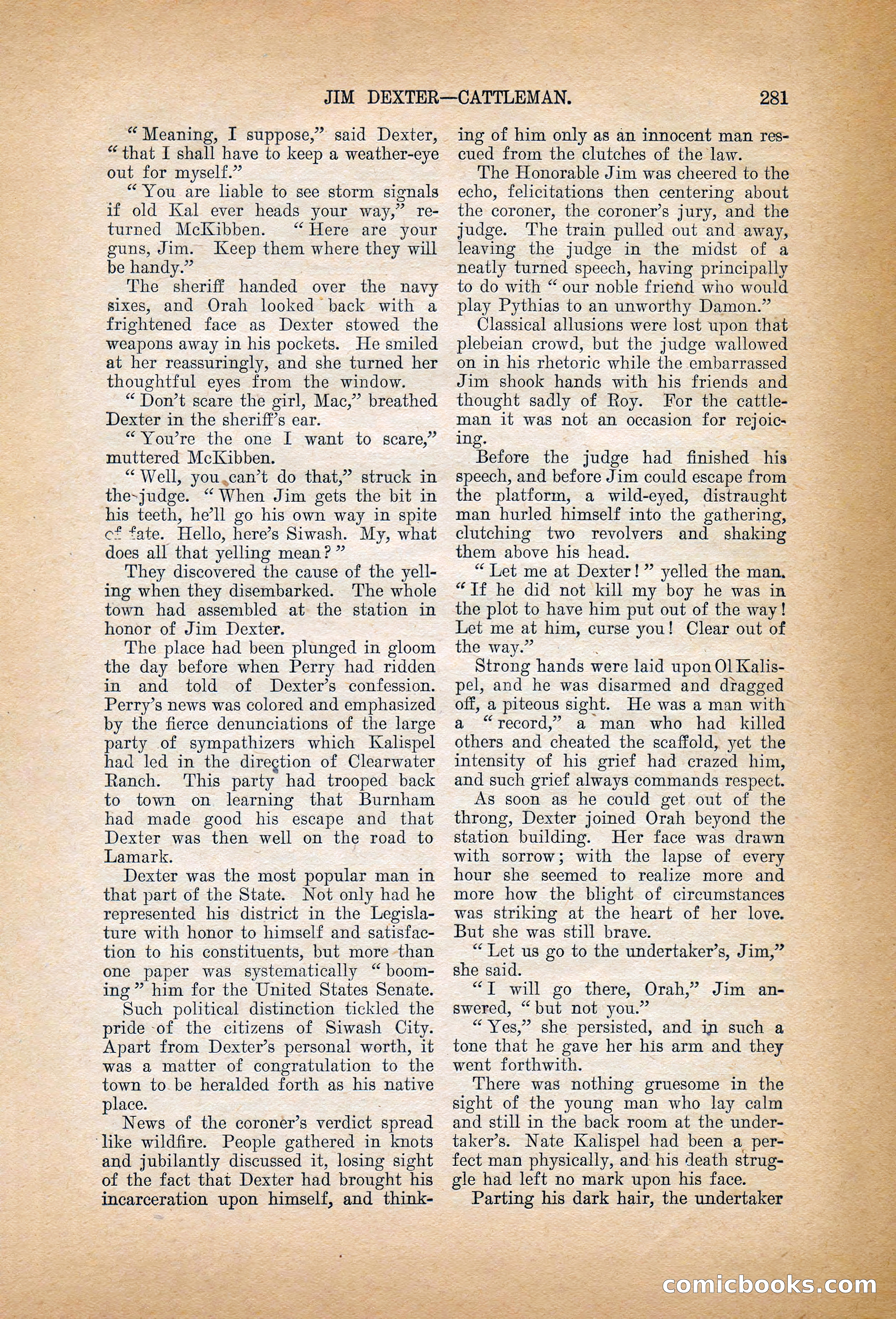
A restored page from Pulp Fiction, 1906. Page through the whole issue in the reader above.
📄 Transcribed text from this page (OCR, searchable)
Machine-transcribed from the original scan — historical spelling and the odd misread are preserved.
JIM DEXTER—CATTLEMAN. “Meaning, I suppose,” said Dexter, “that I shall have to keep a weather-eye out for myself.” “You are liable to see storm os if old Kal ever heads your way,” re- turned McKibben. ‘“ Here are Font guns, Jim. Keep them where they will be handy.” The sheriff handed over the navy sixes, and Orah looked back with a frightened face as Dexter stowed the weapons away in his pockets. He smiled at her reassuringly, and she turned her thoughtful eyes from the window. “ Don’t scare the girl, Mac,” breathed Dexter in the sheriff’s ear. “Youre the one I want to scare,” muttered McKibben. “Well, you.can’t do that,” struck in the-judge. “When Jim sets the bit in his teeth, he'll go his own way in spite c= tate. Hello, here’s Siwash. My, what does all that yelling mean? ” They discovered the cause of the yell- ing when they disembarked. The whole town had assembled at the station in honor of Jim Dexter. The place had been plunged in gloom the day before when Perry had ridden in and told of Dexter’s confession. Perry’s news was colored and emphasized by the fierce denunciations of the large party of sympathizers which Kalispel had led in the diregtion of Clearwater Ranch. This party had trooped back to town on learning that Burnham had made good his escape and that Dexter was then well on the road to Lamark. Dexter was the most popular man in that part of the State. Not only had he represented his district in the Legisla- ture with honor to himself and satisfac- tion to his constituents, but more than one paper was systematically “ boom- ing” him for the United States Senate. Such political distinction tickled the pride -of the citizens of Siwash City. Apart from Dexter’s personal worth, it was a matter of congratulation to the town to be heralded forth as his native place. News of the coroner’s verdict spread ‘like wildfire. People gathered in knots and jubilantly discussed it, losing sight of the fact that Dexter had brought his incarceration upon himself, and think- 281 ing of him only as an innocent man res- cued from the clutches of the law. The Honorable Jim was cheered to the echo, felicitations then centering about the coroner, the coroner’s jury, and the judge. The train pulled out and away, leaving the judge in the midst of a neatly turned speech, having principally to do with “ our noble friend who would play Pythias to an unworthy Damon.” Classical allusions were lost upon that plebeian crowd, but the judge wallowed on in his rhetoric while the embarrassed Jim shook hands with his friends and thought sadly of Roy. For the cattle- man it was not an occasion for rejoic- ing. Before the judge had finished his speech, and before Jim could escape from the platform, a wild-eyed, distraught man hurled himself into the gathering, clutching two revolvers and shaking them above his head. “Let me at Dexter!” yelled the man. “Tf he did not kill my boy he was in the plot to have him put out of the way! Let me at him, curse you! Clear out of the way.” Strong hands were laid upon Ol Kalis- pel, and he was disarmed and dragged off, a piteous sight. He was a man with a “record,’? a man who had killed others and cheated the scaffold, yet the intensity of his grief had crazed him, and such grief always commands respect. As soon as he could get out of the throng, Dexter joined Orah beyond the station building. Her face was drawn with sorrow; with the lapse of every hour she seemed to realize more and more how the blight of circumstances was striking at the heart of her love. But she was still brave. “Let us go to the undertaker’s, Jim,” she said. “T will go there, Orah,” Jim an- swered, “but not you.” “Yes,” she persisted, and in such a tone that he gave her his arm and they went forthwith. There was nothing gruesome in the sight of the young man who lay calm and still in the back room at the under- taker’s. Nate Kalispel had been a per- fect man physically, and his death strug- gle had left no mark upon his face. Parting his dark hair, the undertaker com (@) book (ef 0)