
Pulp Fiction, 1906 · page 92 of 230
The Argosy, January 1906 — page 92: what you’re looking at
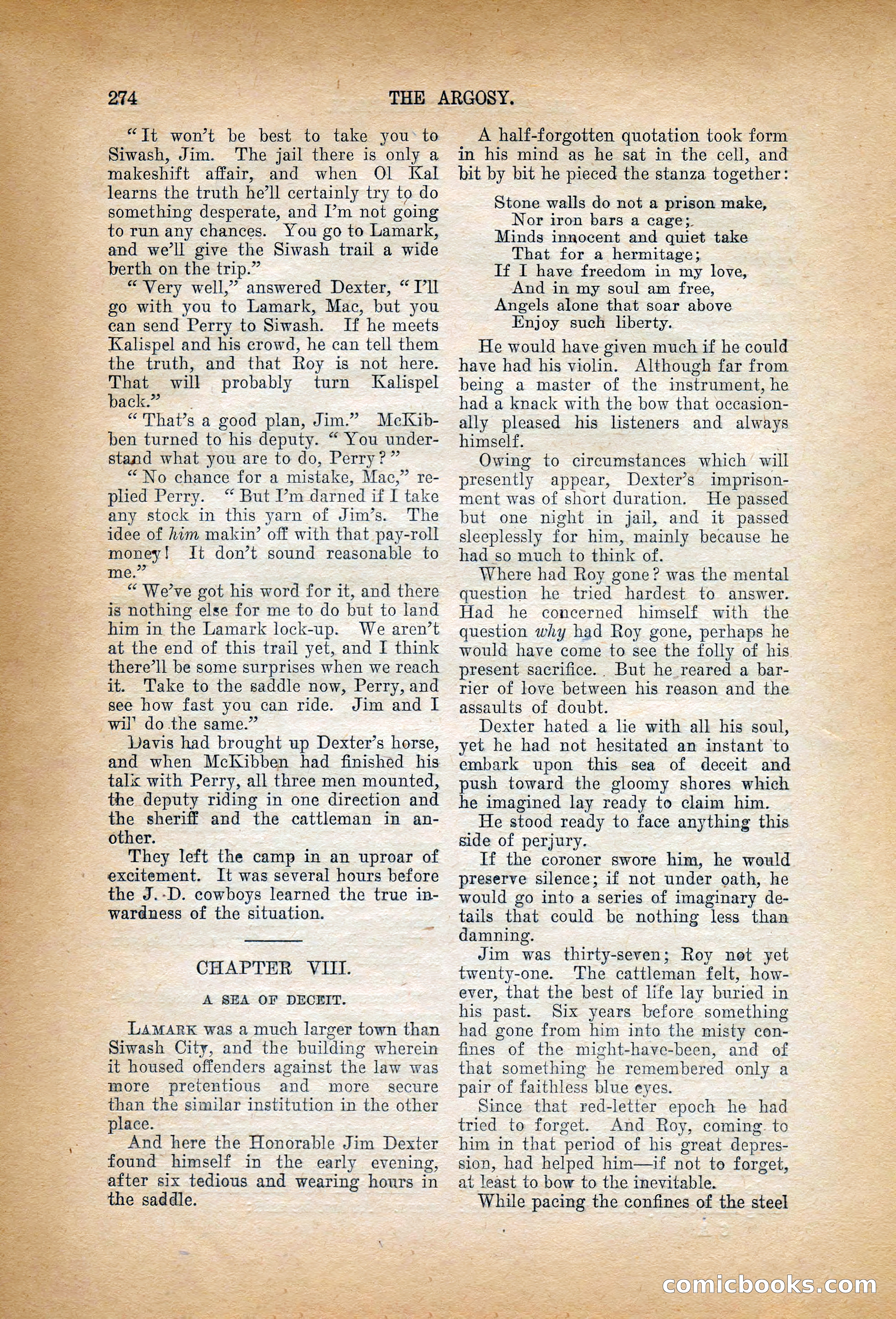
A restored page from Pulp Fiction, 1906. Page through the whole issue in the reader above.
📄 Transcribed text from this page (OCR, searchable)
Machine-transcribed from the original scan — historical spelling and the odd misread are preserved.
204 “It won’t be best to take you to Siwash, Jim. The jail there is only a makeshift affair, and when Ol Kal learns the truth he’ll certainly try to do something desperate, and ’m not going to run any chances. You go to Lamark, and we'll give the Siwash trail a wide berth on the trip.” “Very well,” answered Dexter, “ Pll go with you to Lamark, Mac, but you can send Perry to Siwash. If he meets Kalispel and his crowd, he can tell them the truth, and that Roy is not here. That will probably turn Kalispel pack 2 “'That’s a good plan, Jim.” MckKib- ben turned to his deputy. “ You under- stand what you are to do, Perry?” “No chance for a mistake, Mac,” re- plied Perry. “ But I’m darned if I take any stock in this yarn of Jim’s. The idee of him makin’ off with that pay-roll money! It don’t sound reasonable to me.” “We've got his word for it, and there is nothing else for me to do but to land him in the Lamark lock-up. We aren’t at the end of this trail yet, and I think there’ll be some surprises when we reach it. Take to the saddle now, Perry, and see how fast you can ride. Jim and I wil’ do the same.” Davis had brought up Dexter’s horse, and when McKibben had finished his talx with Perry, all three men mounted, the deputy riding in one direction and the sheriff and the cattleman in an- other. They left the camp in an uproar of excitement. It was several hours before the J.-D. cowboys learned the true in- wardness of the situation. CHAPTER VIII. A SEA OF DECEIT. LAMARK was a much larger town than Siwash City, and the building wherein it housed offenders against the law was more pretentious and more secure than the similar institution in the other place. And here the Honorable Jim Dexter found himself in the early evening, aiter six tedious and wearing hours in the saddle. THE ARGOSY. A half-forgotten quotation took form in his mind as he sat in the cell, and bit by bit he pieced the stanza together: Stone walls do not a prison make, Nor iron bars a cage;. Minds innocent and quiet take That for a hermitage;, If I have freedom in my love, And in my soul am free, Angels alone that soar above Enjoy such liberty. He would have given much if he could have had his violin. Although far from being a master of the instrument, he had a knack with the bow that occasion- ally pleased his listeners and always himself. Owing to circumstances which will presently appear, Dexter’s imprison- ment was of short duration. He passed but one night in jail, and it passed sleeplessly for him, mainly because he had so much to think of. Where had Roy gone? was the mental question he tried hardest to answer. Had he concerned himself with the question why had Roy gone, perhaps he would have come to see the folly of his present sacrifice.. But he reared a bar- rier of love between his reason and the assaults of doubt. Dexter hated a lie with all his soul, yet he had not hesitated an instant to embark upon this sea of deceit and push toward the gloomy shores which he imagined lay ready to claim him. He stood ready to face anything this side of perjury. If the coroner swore him, he would preserve silence; if not under oath, he would go into a series of imaginary de- tails that could be nothing less than damning. Jim was thirty-seven; Roy not yet twenty-one. ‘The cattleman felt, how- ever, that the best of life lay buried in his past. Six years before something had gone from him into the misty con- fines of the might-have-been, and of that something he remembered only a pair of faithless blue eyes. Since that red-letter epoch he had tried to forget. And Roy, coming. to him in that period of his great depres- sion, had helped him—if not to forget, at least to bow to the inevitable. While pacing the confines of the steel com chook (E(0) im