
Pulp Fiction, 1906 · page 75 of 230
The Argosy, January 1906 — page 75: what you’re looking at
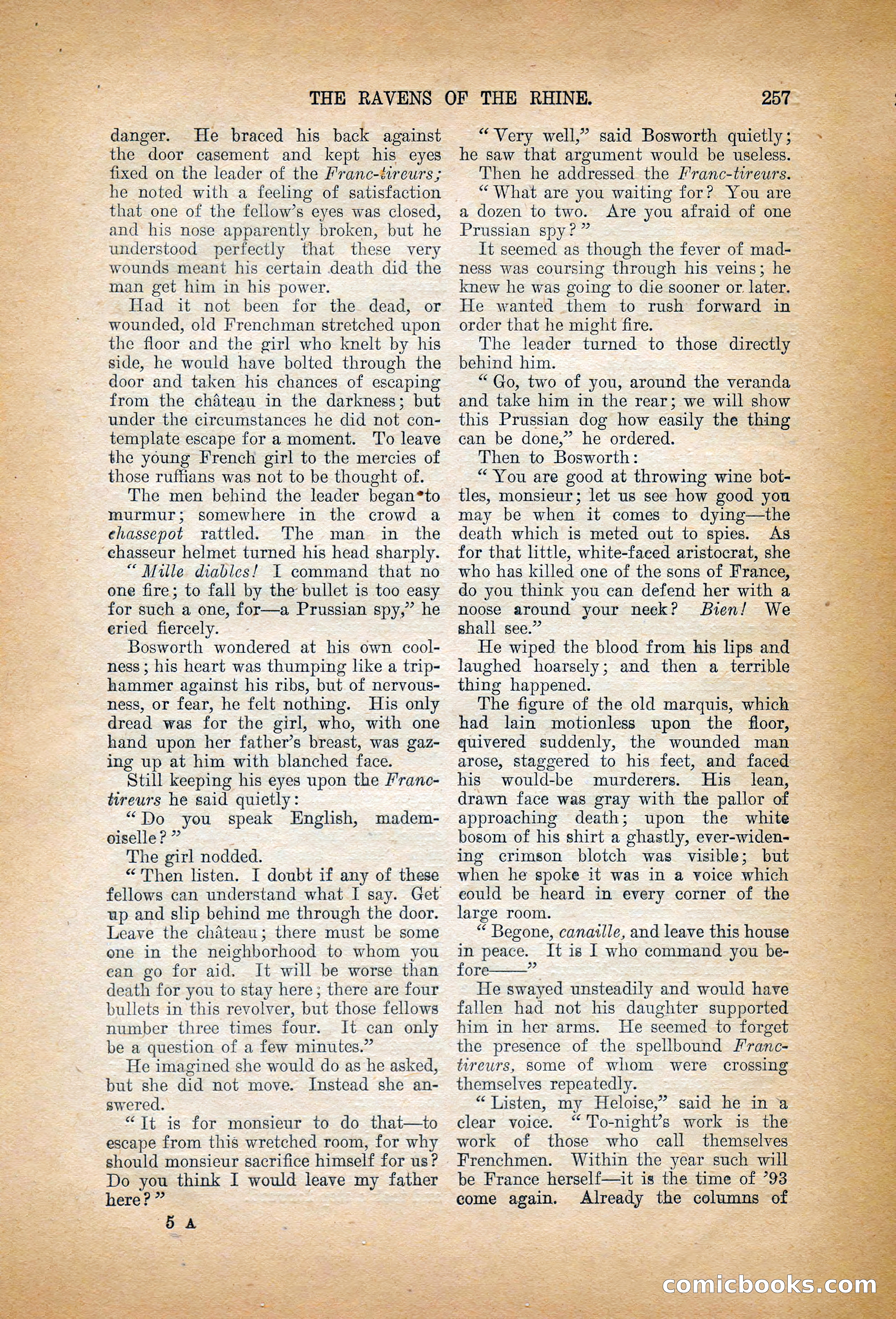
A restored page from Pulp Fiction, 1906. Page through the whole issue in the reader above.
📄 Transcribed text from this page (OCR, searchable)
Machine-transcribed from the original scan — historical spelling and the odd misread are preserved.
THE RAVENS OF THE RHINE. danger. He braced his back against the door casement and kept his eyes fixed on the leader of the Franc-tireurs; he noted with a feeling of satisfaction that one of the fellow’s eyes was closed, and his nose apparently broken, but he understood perfectly that these very wounds meant his certain death did the man get him in his power. Had it not been for the dead, or wounded, old Frenchman stretched upon the floor and the girl who knelt by his side, he would have bolted through the door and taken his chances of escaping from the chateau in the darkness; but under the circumstances he did not con- template escape for a moment. 'T’o leave the young French girl to the mercies of those ruffians was not to be thought of. The men behind the leader began*to murmur; somewhere in the crowd a chassepot rattled. The man in the -ehasseur helmet turned his head sharply. “ Mulle diables! L command that no one fire; to fall by the bullet is too easy for such a one, for—a Prussian spy,’ he eried fiercely. Bosworth wondered at his own cool- ness ; his heart was thumping like a trip- hammer against his ribs, but of nervous- ness, or fear, he felt nothing. His only dread was for the girl, who, with one hand upon her father’s breast, was gaz- ing up at him with blanched face. Still keeping his eyes upon the Franec- tureurs he said quietly: “Do you speak English, madem- oiselle? ” The girl nodded. “Then listen. I doubt if any of these fellows can understand what I say. Get up and slip behind me through the door. Leave the chateau; there must be some one in the neighborhood to whom you ean go for aid. It will be worse than death for you to stay here; there are four bullets in this revolver, but those fellows number three times four. It can only be a question of a few minutes.” He imagined she would do as he asked, but she did not move. Instead she an- swered. “jt is for monsieur to do that—to escape from this wretched room, for why should monsieur sacrifice himself for us? Do you think I would leave my father here?” Sb A 207 “Very well,” said Bosworth quietly; he saw that argument would be useless. Then he addressed the Franc-tireurs. “What are you waiting for? You are a dozen to two. Are you afraid of one Prussian spy?” It seemed as though the fever of mad- ness was coursing through his veins; he knew he was going to die sooner or. later. He wanted them to rush forward in order that he might fire. The leader turned to those directly behind him. “Go, two of you, around the veranda and take him in the rear; we will show this Prussian dog how easily the thing can be done,” he ordered. Then to Bosworth: “You are good at throwing wine bot- tles, monsieur; let us see how good you may be when it comes to dying—the death which is meted out to spies. As for that little, white-faced aristocrat, she — who has killed one of the sons of France, do you think you can defend her with a noose around your neek? Bien! We shall see.” He wiped the blood from his lips and laughed hoarsely; and then a terrible thing happened. The figure of the old marquis, which had lain motionless upon the floor, quivered suddenly, the wounded man arose, staggered to his feet, and faced his would-be murderers. His lean, drawn face was gray with the pallor of approaching death; upon the white bosom of his shirt a ghastly, ever-widen- ing crimson blotch was visible; but when he spoke it was in a yoice which eould be heard in every corner of the large room. “‘ Begone, canaille, and leave this house in peace. It is I who command you be- fore——” He swayed unsteadily and would have fallen had not his daughter supported him in her arms. He seemed to forget the presence of the spellbound F'ranc- tireurs, some of whom were crossing themselves repeatedly. “Listen, my Heloise,” said he in a clear voice. “ To-night’s work is the work of those who call themselves Frenchmen. Within the year such will be France herself—it is the time of °93 come again. Already the columns of com chook com —