
Pulp Fiction, 1906 · page 72 of 230
The Argosy, January 1906 — page 72: what you’re looking at
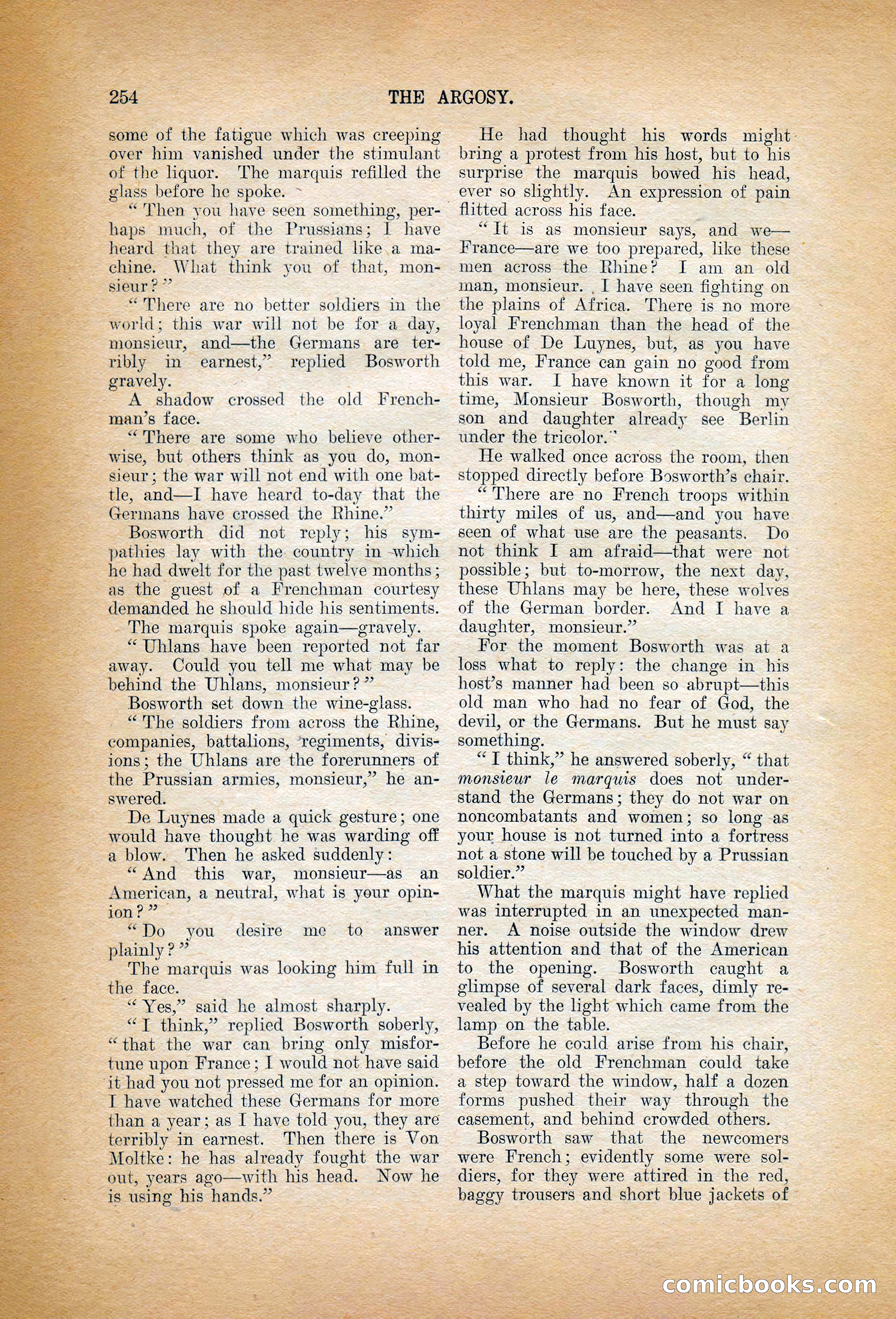
A restored page from Pulp Fiction, 1906. Page through the whole issue in the reader above.
📄 Transcribed text from this page (OCR, searchable)
Machine-transcribed from the original scan — historical spelling and the odd misread are preserved.
: 7 ¥ rl 204 some of the fatigue which was creeping over him vanished under the stimulant of the hquor. The marquis refilled the glass before he spoke. > “Phen you have seen something, per-— haps much, of the Prussians; I have heard that they are trained hke.a ma- chine. What think you of that, mon- sieur? ” “There are no better soldiers in the world; this war will not be for a day, monsieur, and—the Germans are ter- ribly in earnest,” replied Bosworth gravely. A shadow man’s face. “There are some who believe other- wise, but others think as you do, mon- sieur; the war will not end with one bat- tle, and—I have heard to-day that the Germans have crossed the Rhine.” Bosworth did not reply; his sym- pathies lay with the country in -which he had dwelt for the past twelve months ; as the guest of a Frenchman courtesy demanded he should hide his sentiments. The marquis spoke again—gravely. “Uhlans have been reported not far away. Could you tell me what may be behind the Uhlans, monsieur? ” Bosworth set down the wine-glass. “The soldiers from across the Rhine, companies, battalions, ‘regiments, divis- ions ; the Uhlans are the forerunners of the Prussian armies, monsieur,” he an- swered. De Luynes made a quick gesture; one would have thought he was warding off a blow. Then he asked suddenly: “And this war, monsieur—as an American, a neutral, what is your opin- ion?” “Do you plainly?” The marquis was looking him full in the face. “Yes,” said he almost sharply. “T think,” replied Bosworth soberly, “that the war can bring only misfor- tune upon France; I would not have said erossed the old French- desire me to answer ‘it had you not pressed me for an opinion. I have watched these Germans for more than a year; as I have told you, they are terribly in earnest. Then there is Von Moltke: he has already fought the war out, years ago—with his head. Now he is using his hands.” THE ARGOSY. He had thought his words might: bring a protest from his host, but to his surprise the marquis bowed his head, ever so slightly. An expression of pain flitted across his face. “It is as monsieur says, and we— France—are we too prepared, like these men across the Rhine? J am an old man, monsieur. , | have seen fighting on the plains of Africa. There is no more loyal Frenchman than the head of the house of De Luynes, but, as you have told me, France can gain no good from this war. I have known it for a long time, Monsieur Bosworth, though my son and daughter already see Berlin under the tricolor.” He walked once across the room, then stopped directly before Bosworth’s chair. “There are no French troops within thirty miles of us, and—and you have seen of what use are the peasants. Do not think I am afraid—that were not possible; but to-morrow, the next day, these Uhlans may be here, these wolves of the German border. And I have a daughter, monsieur.” For the moment Bosworth was at a loss what to reply: the change in his host’s manner had been so abrupt—this old man who had no fear of God, the devil, or the Germans. But he must say something. “I think,” he answered soberly, “ that monsieur le marquis does not under- stand the Germans; they do not war on noncombatants and women; so long as your house is not turned into a fortress not a stone will be touched by a Prussian soldier.” What the marquis might have replied was interrupted in an unexpected man- ner. A noise outside the window drew his attention and that of the American to the opening. Bosworth caught a glimpse of several dark faces, dimly re- vealed by the hight which came from the lamp on the table. Before he could arise from his chair, before the old Frenchman could take a step toward the window, half a dozen forms pushed their way through the casement, and behind crowded others. Bosworth saw that the newcomers were French; evidently some were sol- diers, for they were attired in the red, baggy trousers and short blue jackets of EComichoo (E(0)