
Pulp Fiction, 1906 · page 70 of 230
The Argosy, January 1906 — page 70: what you’re looking at
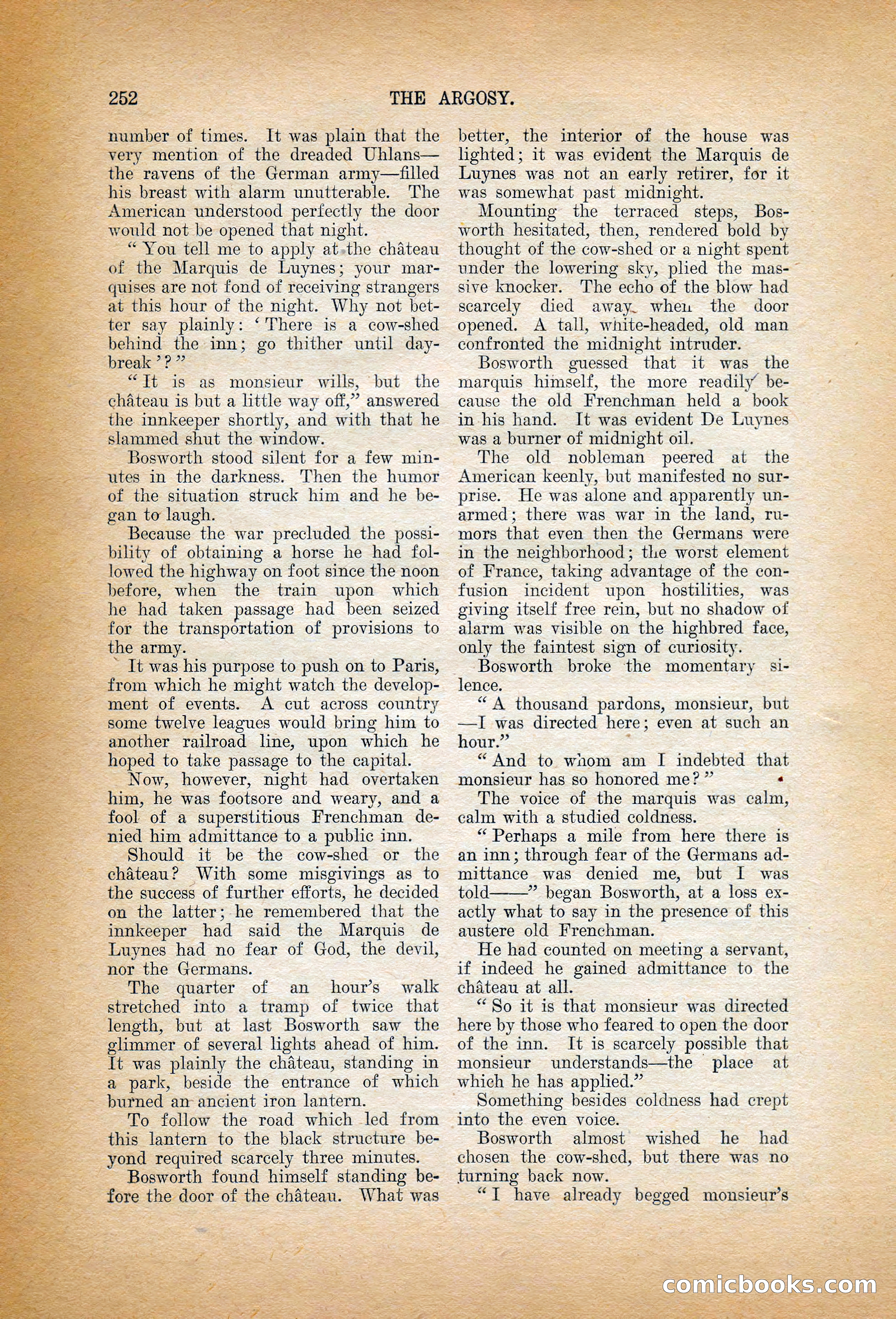
A restored page from Pulp Fiction, 1906. Page through the whole issue in the reader above.
📄 Transcribed text from this page (OCR, searchable)
Machine-transcribed from the original scan — historical spelling and the odd misread are preserved.
252 number of times. It was plain that the very mention of the dreaded Uhlans— the ravens of the German army—filled his breast with alarm unutterable. The American understood perfectly the door would not be opened that night. “You tell me to apply at.the chateau of the Marquis de Luynes; your mar- quises are not fond of receiving strangers at this hour of the night. Why not bet- ter say plainly: ‘There is a cow-shed behind the inn; go thither until day- break ’? ” “Tt is as monsieur wills, but the chateau is but a little way off,” answered the innkeeper shortly, and with that he slammed shut the window. Bosworth stood silent for a few min- utes in the darkness. Then the humor of the situation struck him and he be- gan to laugh. Because the war precluded the possi- bility of obtaining a horse he had fol- lowed the highway on foot since the noon before, when the train upon which he had taken passage had been seized for the transportation of provisions to the army. ~ It was his purpose to push on to Paris, from which he might watch the develop- ment of events. A cut across country some twelve leagues would bring him to another railroad line, upon which he hoped to take passage to the capital. Now, however, night had overtaken him, he was footsore and weary, and a fool of a superstitious Frenchman de- nied him admittance to a public inn. Should it be the cow-shed or the chateau? With some misgivings as to the success of further efforts, he decided ou the latter; he remembered that the innkeeper had said the Marquis de Luynes had no fear of God, the devil, nor the Germans. The quarter of an hour’s walk stretched into a tramp of twice that length, but at last Bosworth saw the glimmer of several lights ahead of him. It was plainly the chateau, standing in a park, beside the entrance of which burned an ancient iron lantern. To follow the road which led from this lantern to the black structure be- yond required scarcely three minutes. Bosworth found himself standing be- fore the door of the chateau. What was THE ARGOSY. better, the interior of the house was lighted; it was evident the Marquis de Luynes was not an early retirer, for it was somewhat past midnight. Mounting the terraced steps, Bos- worth hesitated, then, rendered bold by thought of the cow-shed or a night spent under the lowering sky, plied the mas- sive knocker. The echo of the blow had scarcely died away. wheu the door opened. A tall, white-headed, old man confronted the midnight intruder. Bosworth guessed that it was the marquis himself, the more readily be- cause the old Frenchman held a book in-his hand. It was evident De Luynes was a burner of midnight oil. The old nobleman peered at the American keenly, but manifested no sur- prise. He was alone and apparently un- armed; there was war in the land, ru- mors that even then the Germans were in the neighborhood; the worst element of France, taking advantage of the con- fusion incident upon hostilities, was giving itself free rein, but no shadow of alarm was visible on the highbred face, only the faintest sign of curiosity. ‘Bosworth broke the momentary si- lence. “A thousand pardons, monsieur, but —TI was directed here; even at such an hour.” “ And to wnom am I indebted that monsieur has so honored me? ” ‘ The voice of the marquis was calm, calm with a studied coldness. “Perhaps a mile from here there is an inn; through fear of the Germans ad- mittance was denied me, but I was told ” began Bosworth, at a loss ex- actly what to say in the presence of this austere old Frenchman. He had counted on meeting a servant, if indeed he gained admittance to the chateau at all. “So it is that monsieur was directed here by those who feared to open the door of the inn. It is scarcely possible that monsieur understands—the place at which he has applied.” Something besides coldness had crept into the even voice. Bosworth almost wished he had chosen the cow-shed, but there was no turning back now. “T have already begged monsieur’s ecom chook (Ef)