
Pulp Fiction, 1906 · page 68 of 230
The Argosy, January 1906 — page 68: what you’re looking at
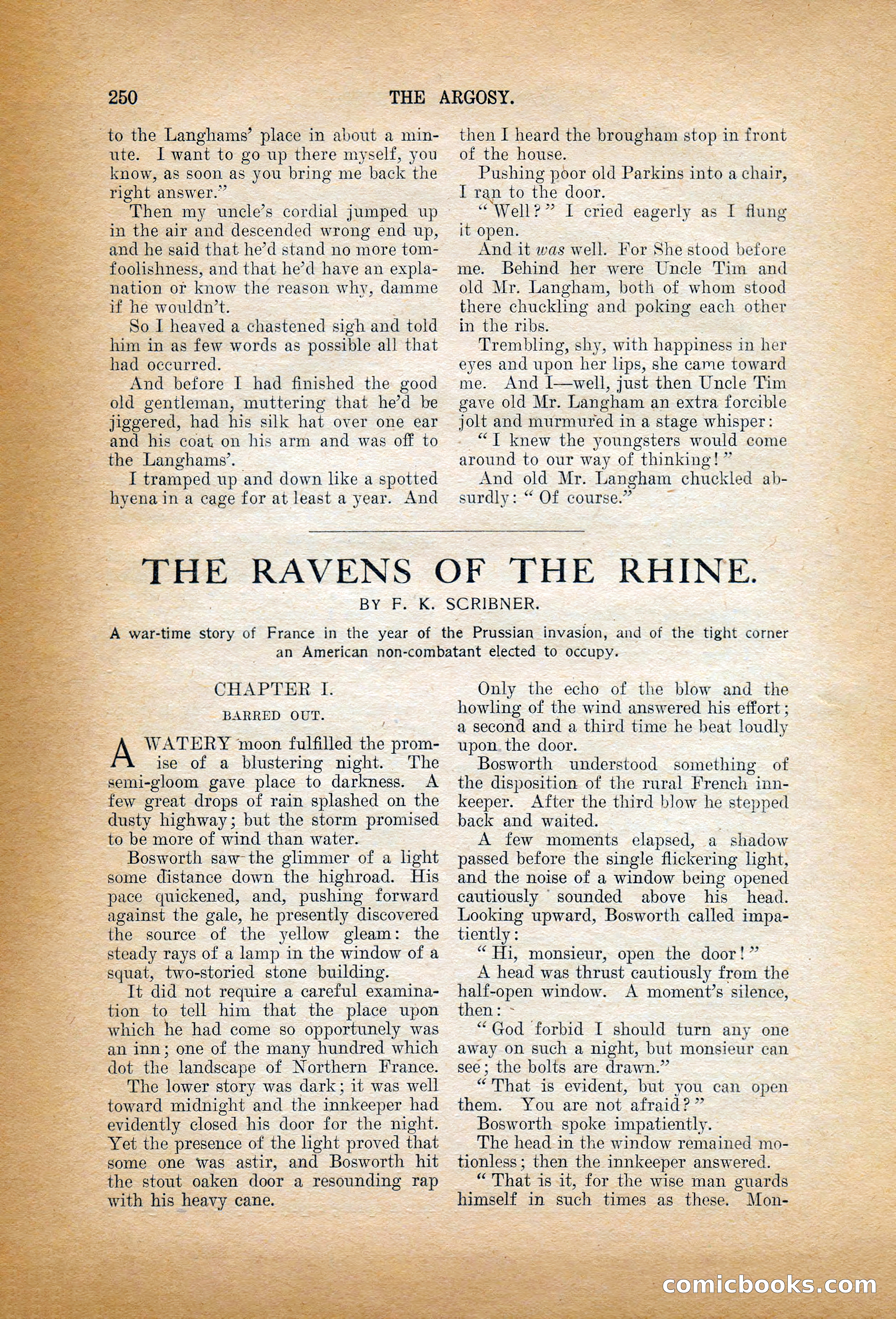
A restored page from Pulp Fiction, 1906. Page through the whole issue in the reader above.
📄 Transcribed text from this page (OCR, searchable)
Machine-transcribed from the original scan — historical spelling and the odd misread are preserved.
Ae Aes) Tddlwhir ey 6 ey! CA VO 250 to the Langhams’ place in about a min- ute. J want to go up there myself, you know, as soon as you bring me back the right answer.” Then my uncle’s cordial jumped up in the air and descended wrong end up, and he said that he’d stand no more tom- foolishness, and that he’d have an expla- nation or know the reason why, damme if he wouldn’t. So I heaved a chastened sigh and told him in as few words as possible all that had occurred. And before I had finished the good old gentleman, muttering that he’d be jiggered, had his silk hat over one ear and his coat on his arm and was off to the Langhams’. I tramped up and down like a spotted hyena in a cage for at least a year. And THE ARGOSY. then I heard the brougham stop in front of the house. Pushing poor old Parkins into a chair, I ran to the door. “Well?” I cried eagerly as I flung it open. And it was well. For She stood before me. Behind her were Uncle Tim and old Mr. Langham, both of whom stood there chuckling and poking each other in the ribs. Trembling, shy, with happiness in her eyes and upon her lips, she came toward me. And [—well, just then Uncle Tim gave old Mr. Langham an extra forcible jolt and murmured in a stage whisper: “TY knew the youngsters would come around to our way of thinking!” And old Mr. Langham chuckled ab surdly: “ Of course.’ EAE RAVENS OF THE RHINE. BY F. K. SCRIBNER. A war-time story of France in the year of the Prussian invasion, and of the tight corner an American non-combatant elected to occupy. CHAPTER I. BARRED OUT. WATERY ‘moon fulfilled the prom- ise of a blustering night. The semi-gloom gave place to darkness. A few great drops of rain splashed on the dusty highway; but the storm promised to be more of wind than water. Bosworth saw-the glimmer of a light some distance down the highroad. His pace quickened, and, pushing forward against the gale, he presently discovered the source of the yellow gleam: the steady rays of a lamp in the window of a squat, two-storied stone building. Tt did not require a careful examina- tion to tell him that the place upon which he had come so opportunely was an inn; one of the many hundred which dot the landscape of Northern France. The lower story was dark; it was well toward midnight and the innkeeper had evidently closed his door for the night. Yet the presence of the light proved that Some one was astir, and Bosworth hit the stout oaken door a resounding rap with his heavy cane. Only the echo of the blow and the howling of the wind answered his effort ; a second and a third time he beat loudly upon. the door. Bosworth understood something of the disposition of the rural French inn- keeper. After the third blow he stepped back and waited. | A few moments elapsed, a shadow passed before the single flickering light, and the noise of a window being opened cautiously sounded above his head. Looking upward, Bosworth called impa- tiently : “Hi, monsieur, open the door!” A head was thrust cautiously from the half-open window. A moment’s silence, then: “God forbid I should turn any one away on such a night, but monsieur can see; the bolts are drawn.” “That is evident, but you can open them. You are not afraid?” Bosworth spoke impatiently. The headin the window remained mo- tionless; then the innkeeper answered. “That is it, for the wise man guards himself in such times as these. Mon- ~comicbook (Efe)