
Pulp Fiction, 1906 · page 63 of 230
The Argosy, January 1906 — page 63: what you’re looking at
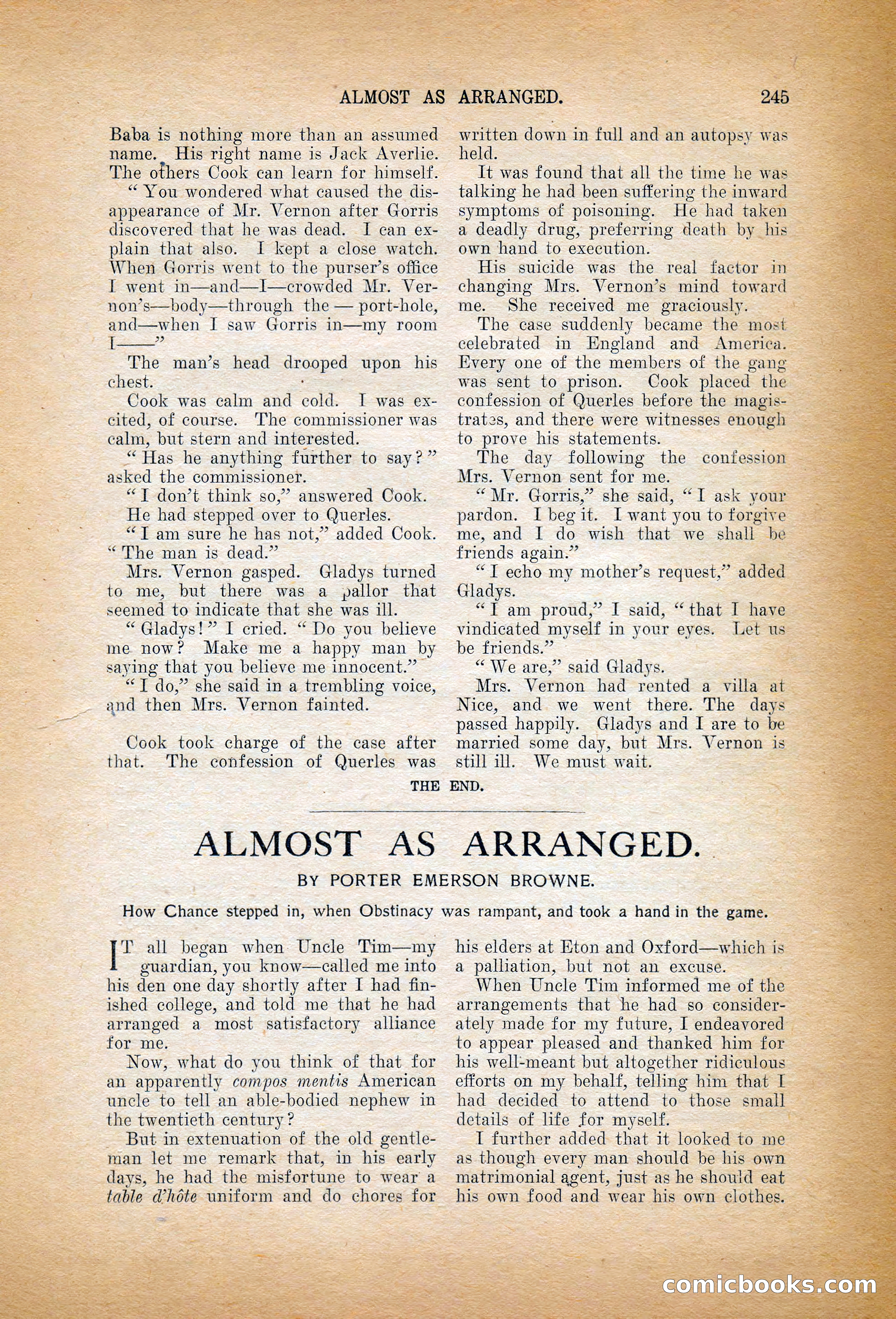
A restored page from Pulp Fiction, 1906. Page through the whole issue in the reader above.
📄 Transcribed text from this page (OCR, searchable)
Machine-transcribed from the original scan — historical spelling and the odd misread are preserved.
ALMOST AS Baba is nothing more than an assumed name. His right name is Jack Averlie. The others Cook can learn for himself. “You wondered what caused the dis- appearance of Mr. Vernon after Gorris discovered that he was dead. I can ex- plain that also. I kept a close watch. When Gorris went to the purser’s office . went in—and—I—crowded Mr. Ver- non’s—body—through the — port-hole, and—when I saw Gorris in—my room j See The man’s head drooped upon his chest. : Cook was calm and cold. I was ex- cited, of course. ‘The commissioner was calm, but stern and interested. “Has he anything further to say?” asked the commissioner. “1 don’t think so,” answered Cook. He had stepped over to Querles. “IT am sure he has not,” added Cook. “The man is dead.” Mrs. Vernon gasped. Gladys turned to me, but there was a yjallor that seemed to indicate that she was ill. “Gladys!” I cried. “ Do you believe me now? Make me a happy man by saying that you believe me innocent.” “1 do,” she said in a trembling voice, and then Mrs. Vernon fainted. Cook took charge of the case after that. ‘The confession of Querles was ARRANGED. 245 written down in full and an autopsy was held. It was found that all the time he was talking he had been suffering the inward symptoms of poisoning. He had taken a deadly drug, preferring death by his own hand to execution. His suicide was the real factor in changing Mrs. Vernon’s mind toward me. She received me graciously. The case suddenly became the most celebrated in England and America. Every one of the members of the gang was sent to prison. Cook placed the confession of Querles before the magis- trates, and there were witnesses enough to prove his statements. The day following the confession Mrs. Vernon sent for me. “Mr. Gorris,” she said, “I ask your pardon. I beg it. I want you to forgive me, and I do wish that we shall be friends again.” “T echo my mother’s request,” added Gladys. “JT am proud,” I said, “that I have vindicated myself in your eyes. Let us be friends.” “ We are,’ said Gladys. Mrs. Vernon had rented a villa at Nice, and we went there. The days passed happily. Gladys and I are to be married some day, but Mrs. Vernon is still ill. We must wait. THE END. ALMOST AS ARRANGED. BY PORTER EMERSON BROWNE. How Chance stepped in, when Obstinacy was rampant, and took a hand in the game. = all began when Uncle Tim—my guardian, you know—called me into his den one day shortly after I had fin- ished college, and told me that he had arranged a most satisfactory alliance for me. Now, what do you think of that for an apparently compos mentis American uncle to tell an able-bodied nephew in the twentieth century? But in extenuation of the old gentle- man let me remark that, in his early days, he had the misfortune to wear a table @héte uniform and do chores for his elders at Eton and Oxford—which is a palliation, but not an excuse. When Uncle Tim informed me of the arrangements that he had so consider- ately made for my future, I endeavored to appear pleased and thanked him for his well-meant but altogether ridiculous efforts on my behalf, telling him that I had decided to attend to those small details of life for myself. I further added that it looked to me as though every man should be his own matrimonial agent, just as he should eat his own food and wear his own clothes. ecom chook