
Pulp Fiction, 1906 · page 148 of 230
The Argosy, January 1906 — page 148: what you’re looking at
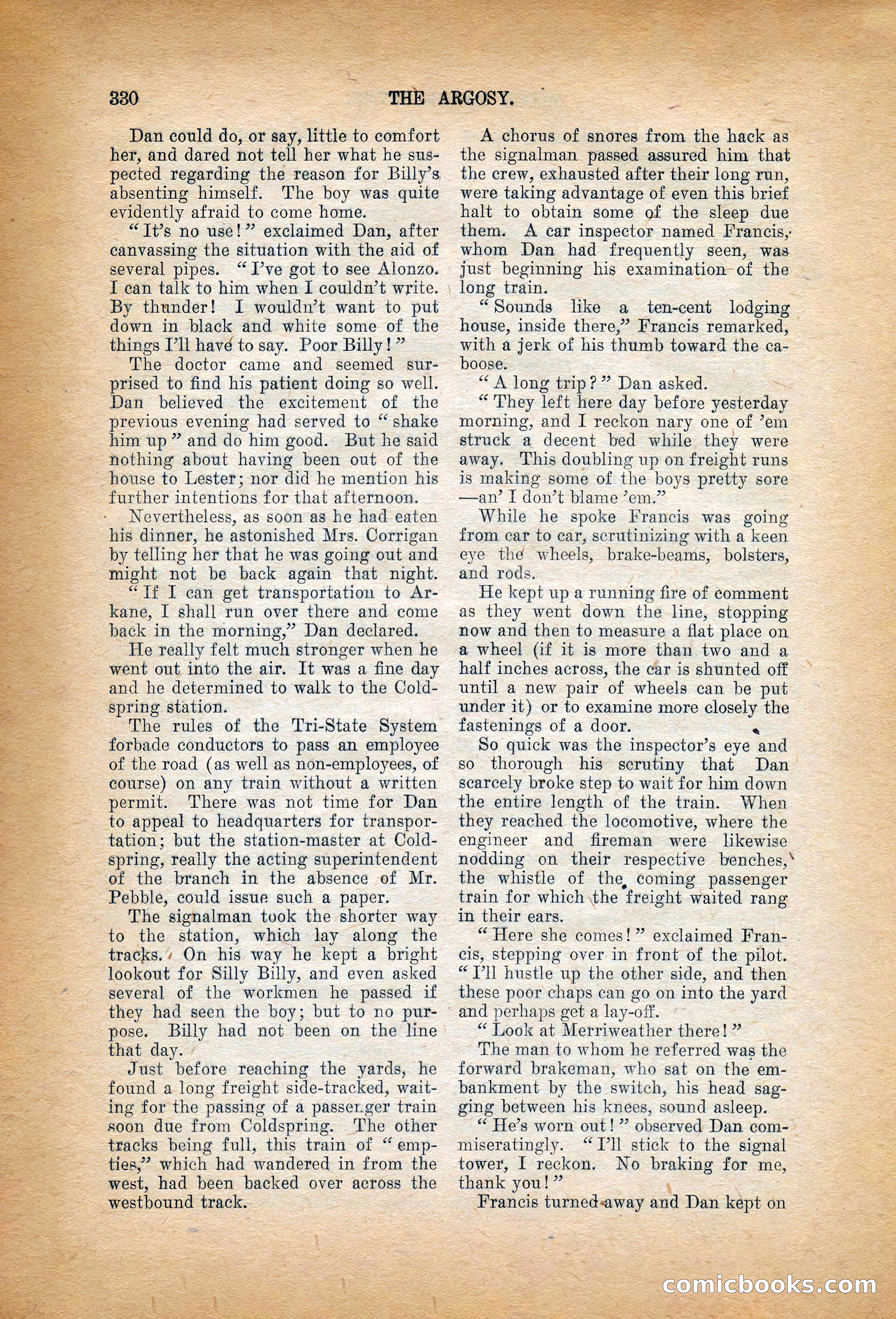
A restored page from Pulp Fiction, 1906. Page through the whole issue in the reader above.
📄 Transcribed text from this page (OCR, searchable)
Machine-transcribed from the original scan — historical spelling and the odd misread are preserved.
830 Dan could do, or say, little to comfort her, and dared not tell her what he sus- pected regarding the reason for Billy’s absenting himself. The boy was quite evidently afraid to come home. “It’s no use!” exclaimed Dan, after canvassing the situation with the aid of several pipes. “lve got to see Alonzo. I ean talk to him when I couldn’t write. By thunder! I wouldn’t want to put down in black and white some of the things I’ll have to say. Poor Billy!” The doctor came and seemed sur- prised to find his patient doing so well. Dan believed the excitement of the previous evening had served to “ shake him up ” and do him good. But he said nothing about having been out of the house to Lester; nor did he mention his further intentions for that afternoon. Nevertheless, as soon as he had eaten his dinner, he astonished Mrs. Corrigan by telling her that he was going out and might not be back again that night. “Tf I can get transportation to Ar- kane, I shall run over there and come back in the morning,” Dan declared. He really felt much stronger when he went out into the air. It was a fine day and he determined to walk to the Cold- spring station. The rules of the Tri-State System forbade conductors to pass an employee of the road (as well as non-employees, of course) on any train without a written permit. There was not time for Dan to appeal to headquarters for transpor- tation; but the station-master at Cold- spring, really the acting superintendent of the branch in the absence of Mr. Pebble, could issue such a paper. The signalman took the shorter way to the station, which lay along the tracks. On his way he kept a bright lookout for Silly Billy, and even asked several of the workmen he passed if they had seen the boy; but to no pur- pose. Billy had not been on the line that day. Just before reaching the yards, he found a long freight side-tracked, wait- ing for the passing of a passer.ger train soon due from Coldspring. The other tracks being full, this train of “ emp- ties’ which had wandered in from the west, had been backed over across the westbound track. THE ARGOSY. A chorus of snores from the hack as the signalman passed assured him that the crew, exhausted after their long run, were taking advantage of even this brief halt to obtain some of the sleep due them. A car inspector named Francis,: whom Dan had frequently seen, was just beginning his examination of the long train. “Sounds like a ten-cent lodging house, inside there,” Francis remarked, with a jerk of his thumb toward the ca- boose. “A long trip? ” Dan asked. “They left here day before yesterday morning, and I reckon nary one of ’em struck a decent bed while they were away. ‘This doubling up on freight runs is making some of the boys pretty sore —an’ I don’t blame ’em.” While he spoke Francis was going from car to car, scrutinizing with a keen eye the wheels, brake-beams, bolsters, and rods. He kept up a running fire of comment as they went down the line, stopping now and then to measure a flat place on a wheel (if it is more than two and a half inches across, the car is shunted off until a new pair ‘of wheels can be put under it) or to examine more closely the fastenings of a door. So quick was the inspector’s eye ‘and so thorough his serutiny that Dan scarcely broke step to wait for him down the entire length of the train. When they reached the locomotive, where the engineer and fireman were likewise nodding on their respective benches,‘ the whistle of the, coming passenger train for which the “freight waited rang in their ears. “Here she comes!” exclaimed Fran- cis, stepping over in front of the pilot. “Tl hustle up the other side, and then these poor chaps can go on into the yard ‘and perhaps get a lay-off. “ Look at Merriweather there! ” The man to whom he referred was the forward brakeman, who sat on the em- bankment by the switch, his head sag- ging between his knees, sound asleep. “Hes worn out!” observed Dan com- miseratingly. “Tl stick to the signal tower, I reckon. No braking for me, thank you!” Francis turned-away and Dan kept on Eomicboo Ss (ef 0)