
Pulp Fiction, 1906 · page 144 of 230
The Argosy, January 1906 — page 144: what you’re looking at
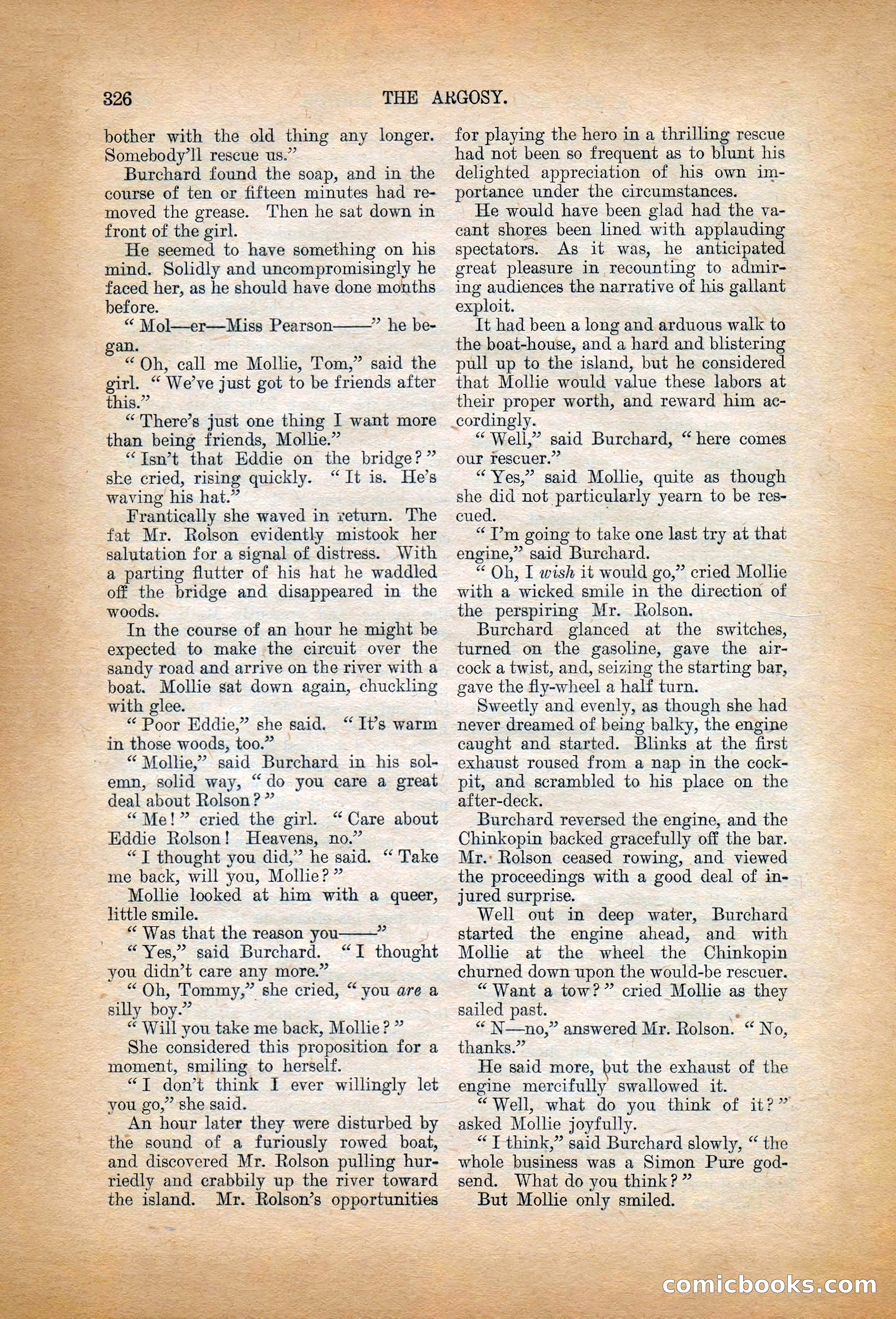
A restored page from Pulp Fiction, 1906. Page through the whole issue in the reader above.
📄 Transcribed text from this page (OCR, searchable)
Machine-transcribed from the original scan — historical spelling and the odd misread are preserved.
326 bother with the old thing any longer. Somebody’ll rescue us.” Burchard found the soap, and in the course of ten or fifteen minutes had re- moved the grease. ‘Then he sat down in front of the girl. He seemed to have something on his mind. Solidly and uncompromisingly he faced her, as he should have done months before. “ Mol—er—Miss Pearson ” he be- an. one Oh, call me Mollie, Tom,” said the girl. “ We’ve just got to be friends after this.” “'There’s just one thing I want more than being friends, Mollie.” “Jsn’t that Eddie on the bridge?” ske cried, rising quickly. “It is. He’s waving his hat.” Frantically she waved in return. The fat Mr. Rolson evidently mistook her salutation for a signal of distress. With a parting flutter of his hat he waddled off the bridge and disappeared in the woods. In the course of an hour he might be expected to make the circuit over the sandy road and arrive on the river with a boat. Mollie sat down again, chuckling with glee. “Poor Eddie,” she said. in those woods, too.” “ Mollie,” said Burchard in his sol- emn, solid way, “do you care a great deal about Rolson?” “Me!” eried the girl. “Care about Eddie Rolson! Heavens, no.” “JT thought you did,” he said. “ Take me back, will you, Mollie?” Mollie looked at him with a queer, little smile. “ Was that the reason you “Yes,” said Burchard. you didn’t care any more.” “Oh, Tommy,” she cried, “ you are a silly boy.” “ Will you take me back, Mollie? ” She considered this proposition for a moment, smiling to herself. “YT don’t think I ever willingly let you go,” she said. An hour later they were disturbed by the sound of a furiously rowed boat, and discovered Mr. Rolson pulling hur- riedly and ecrabbily up the river toward the island. Mr. Rolson’s opportunities “Its warm 32 “T thought THE ARGOSY. for playing the hero in a thrilling rescue had not been so frequent as to blunt his delighted appreciation of his own im- portance under the circumstances. He would have been glad had the va- cant shores been lined with applauding spectators. As it was, he anticipated great pleasure in recounting to admir- ing audiences the narrative of his gallant exploit. It had been a long and arduous walk to the boat-house, and a hard and blistering pull up to the island, but he considered that Mollie would value these labors at their proper worth, and reward him ac- cordingly. “ Well,” said Burchard, “ here comes our rescuer.” “Yes,” said Mollie, quite as though she did not particularly yearn to be res- cued. “T’m going to take one last try at that engine,” said Burchard. “ Oh, I wish it would go,” cried Mollie with a wicked smile in the direction of the perspiring Mr. Rolson. Burchard glanced at the switches, : turned on the gasoline, gave the air- cock a twist, and, seizing the starting bar, gave the fly-wheel a half turn. Sweetly and evenly, as though she had never dreamed of being balky, the engine caught and started. Blinks at the first exhaust roused from a nap in the cock- pit, and scrambled to his place on the after-deck. Burchard reversed the engine, and the Chinkopin backed gracefully off the bar. Mr.: Rolson ceased rowing, and viewed the proceedings with a good deal of in- jured surprise. Well out in deep water, Burchard started the engine ahead, and with Mollie at the wheel the Chinkopin churned down upon the would-be rescuer. “Want a tow?” cried Mollie as they sailed past. = ** N—no,” answered Mr. Rolson. “ No, thanks.” He said more, but the exhaust of the engine mercifully swallowed it. “Well, what do you think of it?” asked Mollie joyfully. “T think,” said Burchard slowly, “ the whole business was a Simon Pure god- send. What do you think? ” But Mollie only smiled. comicbook Eco