
Pulp Fiction, 1906 · page 137 of 230
The Argosy, January 1906 — page 137: what you’re looking at
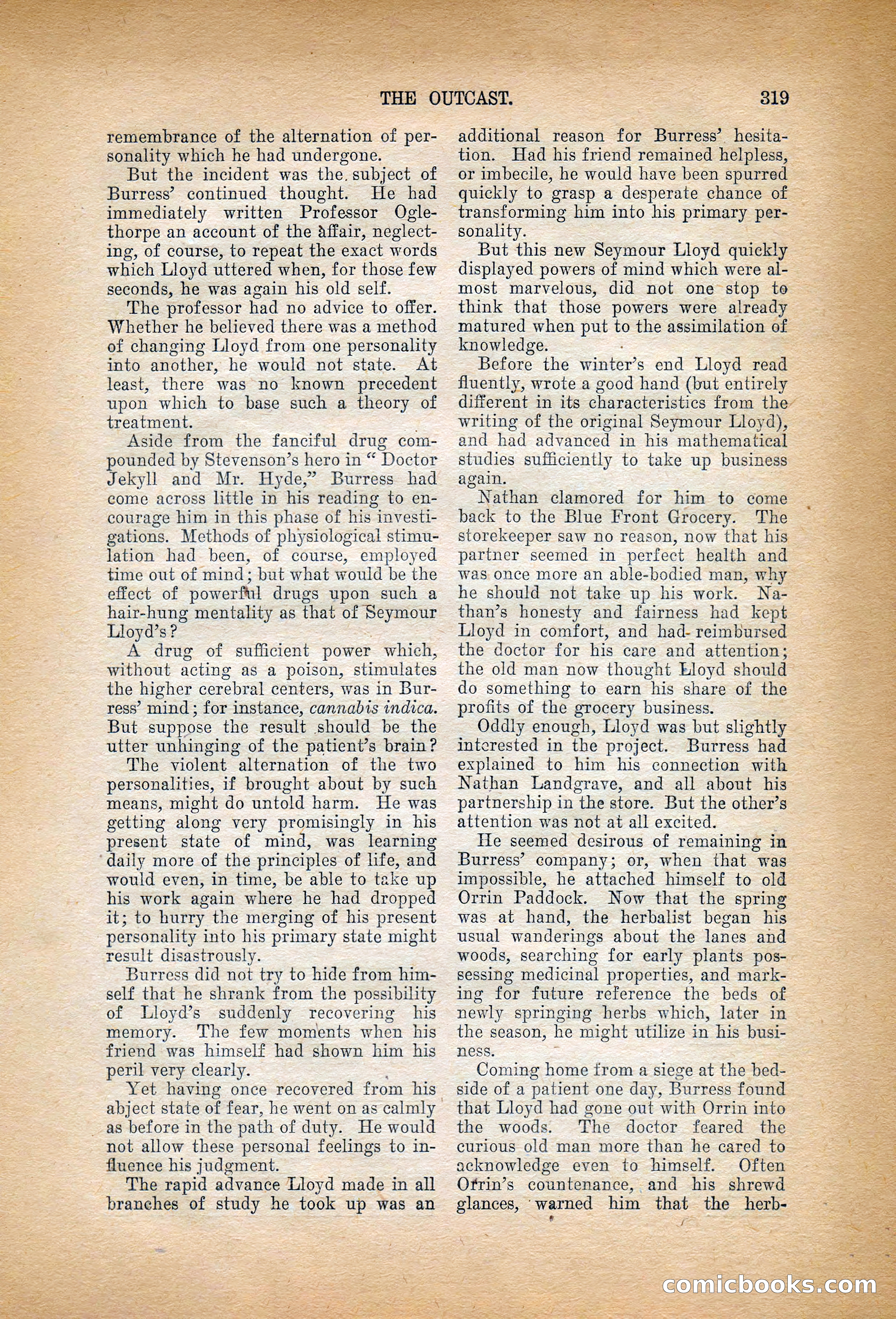
A restored page from Pulp Fiction, 1906. Page through the whole issue in the reader above.
📄 Transcribed text from this page (OCR, searchable)
Machine-transcribed from the original scan — historical spelling and the odd misread are preserved.
THE OUTCAST. remembrance of the alternation of per- sonality which he had undergone. But the incident was the. subject of Burress’ continued thought. He had immediately written Professor Ogle- thorpe an account of the Affair, neglect- ing, of course, to repeat the exact words which Lloyd uttered when, for those few seconds, he was again his old self. The professor had no advice to offer. Whether he believed there was a method of changing Lloyd from one personality into another, he would not state. At least, there was no known precedent upon which to base such a theory of treatment. . Aside from the fanciful drug com- pounded by Stevenson’s hero in “ Doctor Jekyll and Mr. Hyde,” Burress had come across little in his reading to en- courage him in this phase of his investi- gations. Methods of physiological stimu- lation had been, of course, employed time out of mind; but what would be the effect of powerful drugs upon such a hair-hung mentality as that of Seymour Lloyd’s? A drug of sufficient power which, without acting as a poison, stimulates the higher cerebral centers, was in Bur- ress’ mind; for instance, cannabis indica. But suppose the result should be the utter unhinging of the patient’s brain? The violent alternation of the two personalities, if brought about by such means, might do untold harm. He was getting along very promisingly in his present state of mind, was learning ‘daily more of the principles of life, and would even, in time, be able to take up his work again where he had dropped it; to hurry the merging of his present personality into his primary state might result disastrously. Burress did not try to hide from him- self that he shrank from the possibility of lLloyd’s suddenly recovering his memory. The few moments when his friend was himself had shown him his peril very clearly. Yet having once recovered from his abject state of fear, he went on as calmly as before in the path of duty. He would not allow these personal feelings to in- fluence his judgment. The rapid advance Lloyd made in all branches of study he took up was an 319 additional reason for Burress’ hesita- tion. Had his friend remained helpless, or imbecile, he would have been spurred quickly to grasp a desperate chance of transforming him into his primary per- sonality. But this new Seymour Lloyd quickly displayed powers of mind which were al- most marvelous, did not one stop to think that those powers were already matured when put to the assimilation of knowledge. Before the winter's end Lloyd read fluently, wrote a good hand (but entirely different in its characteristics from the writing of the original Seymour Lloyd), and had advanced in his mathematical studies sufficiently to take up business again. Nathan clamored for him to come back to the Blue Front Grocery. The storekeeper saw no reason, now that his partner seemed in perfect health and was once more an able-bodied man, why he should not take up his work. Na- than’s honesty and fairness had kept Lloyd in comfort, and had- reimbursed the doctor for his care and attention; the old man now thought Lloyd should do something to earn his share of the profits of the grocery business. Oddly enough, Lloyd was but slightly interested in the project. Burress had explained to him his connection with Nathan Landgraye, and all about his partnership in the store. But the other’s attention was not at all excited. He seemed desirous of remaining in Burress’ company; or, when that was impossible, he attached himself to old Orrin Paddock. Now that the spring was at hand, the herbalist began his usual wanderings about the lanes and woods, searching for early plants pos- sessing medicinal properties, and mark- ing for future reference the beds of newly springing herbs which, later in the season, he might utilize in his busi- ness. Coming home from a siege at the bed- side of a patient one day, Burress found that Lloyd had gone out with Orrin into the woods. The doctor feared the curious old man more than he cared to acknowledge even to himself. Often Ofrin’s countenance, and his shrewd glances, ‘warned him that the herb- com chook (ef 0) LP \. JE i AN ny ites _ EAs Sep? Aw) ay be Vy