
Pulp Fiction, 1906 · page 106 of 230
The Argosy, January 1906 — page 106: what you’re looking at
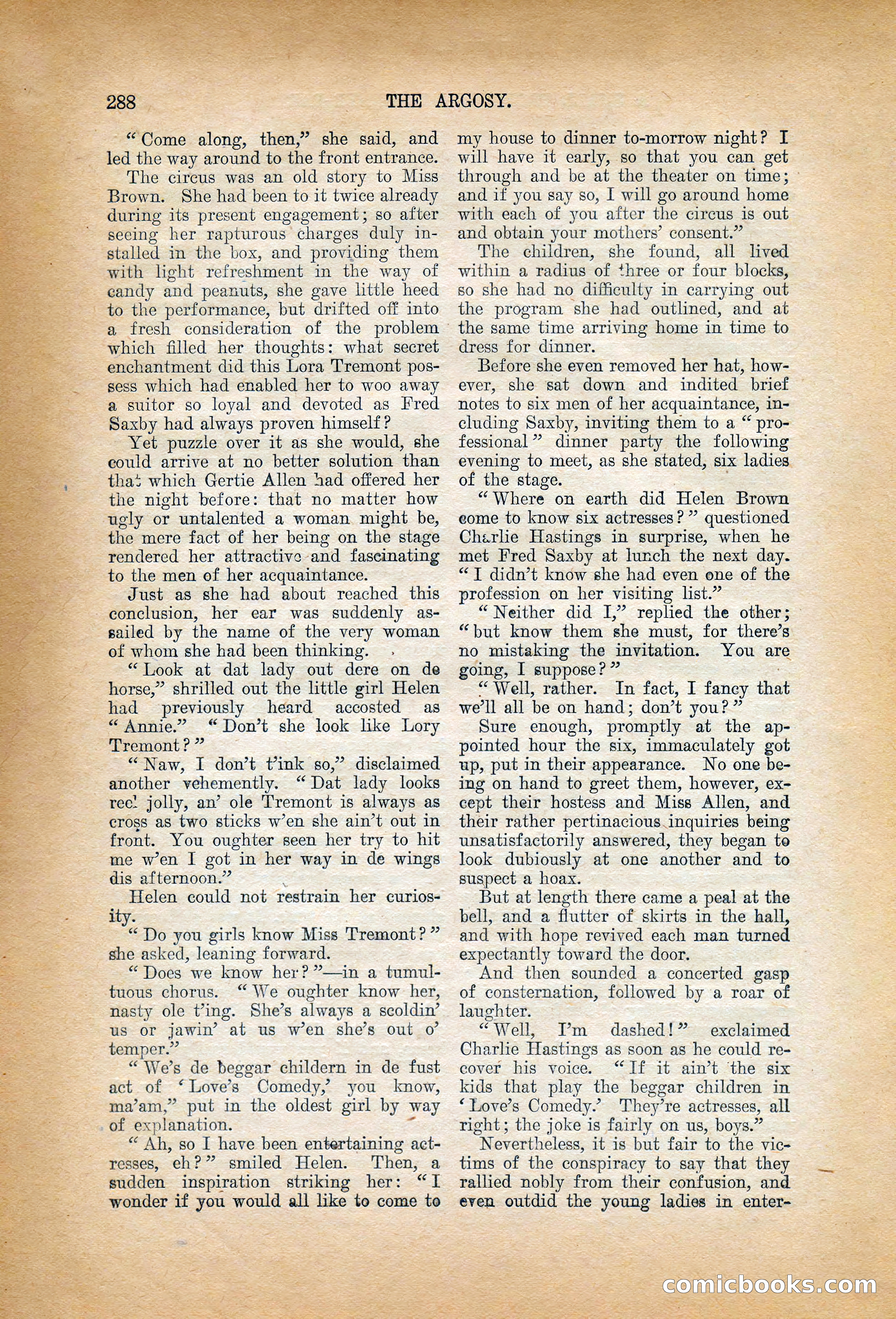
A restored page from Pulp Fiction, 1906. Page through the whole issue in the reader above.
📄 Transcribed text from this page (OCR, searchable)
Machine-transcribed from the original scan — historical spelling and the odd misread are preserved.
288 “Come along, then,” she said, and led the way around to the front entrance. The cireus was an old story to Miss Brown. She had been to it twice already during its present engagement; so alter seeing her rapturous charges duly in- stalled in the box, and providing them with light refreshment in the way of eandy and peanuts, she gave little heed to the performance, but drifted off into a fresh consideration of the problem —~ which filled her thoughts: what secret enchantment did this Lora Tremont pos- sess which had enabled her to woo away a suitor so loyal and devoted as Fred Saxby had always proven himself? Yet puzzle over it as she would, she could arrive at no better solution than that which Gertie Allen had offered her the night before: that no matter how ugly or untalented a woman might be, the mere fact of her being on the stage rendered her attractive and fascinating to the men of her acquaintance. Just as she had about reached this conclusion, her ear was suddenly as- sailed by the name of the very woman of whom she had been thinking. “Look at dat lady out dere on de horse,” shrilled out the little girl Helen had previously heard accosted as “ Annie.” “ Don’t she look like Lory Tremont ? ” “Naw, I don’t tink so,” disclaimed another vehemently. “ Dat lady looks ree. jolly, an’ ole Tremont is always as cross as two sticks w’en she ain’t out in front. You oughter seen her try to hit me wen | got in her way in de wings dis afternoon.” Helen could not restrain her curios- ity. oe Do you girls know Miss Tremont?” she asked, leaning forward. “Does we know her? ”—in a tumul- tuous chorus. “ We oughter know her, nasty ole ting. She’s always a scoldin’ us or jawin’ at us wen she’s out 0’ temper.” “We’s de beggar childern in de fust act. of _ Love’ s Comedy, you know, ma’am,” put in the oldest girl by way of explanation. 5 Ah, so I have been entertaining act- Tesses, “ch?” smiled Helen. Then, a sudden inspiration striking her: “I wonder if you would all like to come to THE ARGOSY. my house to dinner to-morrow night? I will have it early, so that you can get through and be at the theater on time; and if you say so, I will go around home with each of you after the circus is out and obtain your mothers’ consent.” The children, she found, all lived within a radius of three or four blocks, so she had no difficulty in carrying out the program she had outlined, and at the same time arriving home in time to dress for dinner. Before she even removed her hat, how- ever, she sat down and indited brief notes to six men of her acquaintance, in- cluding Saxby, inviting them to a “ pro- fessional” dinner party the following evening to meet, as she stated, six ladies of the “stage. “Where on earth did Helen Brown eome to know six actresses? ” questioned Charlie Hastings in surprise, when he met Fred Saxby at lunch the next day. “1 didn’t know she had even one of the profession on her visiting list.” “Neither did I,” replied the other; “but know them she must, for there’s no mistaking the invitation. You are going, I suppose?” “Well, rather. In fact, I fancy that we'll all be on hand ; don’t you?” Sure enough, promptly at the ap- pointed hour the six, immaculately got up, put in their appearance. No one be- ing on hand to greet them, however, ex- cept their hostess and Miss Allen, and their rather pertinacious inquiries being unsatisfactorily answered, they began to look dubiously at one another and to suspect a hoax. But at length there came a peal at the bell, and a flutter of skirts in the hall, and with hope revived each man turned expectantly toward the door. And then sounded a concerted gasp of consternation, followed by a roar of laughter. “Well, I’m dashed!” exclaimed Charlie Hastings as soon as he could re- cover his voice. “If it ain’t the six kids that play the beggar children in “Love’s Comedy. They’re actresses, all right; the joke is fairly on us, boys.” Nevertheless, it is but fair to the vic- tims of the conspiracy to say that they rallied nobly from their confusion, and even outdid the young ladies in enter- chook (Eo) m com