
Pulp Fiction, 1905 · page 94 of 252
The Argosy, December 1905 — page 94: what you’re looking at
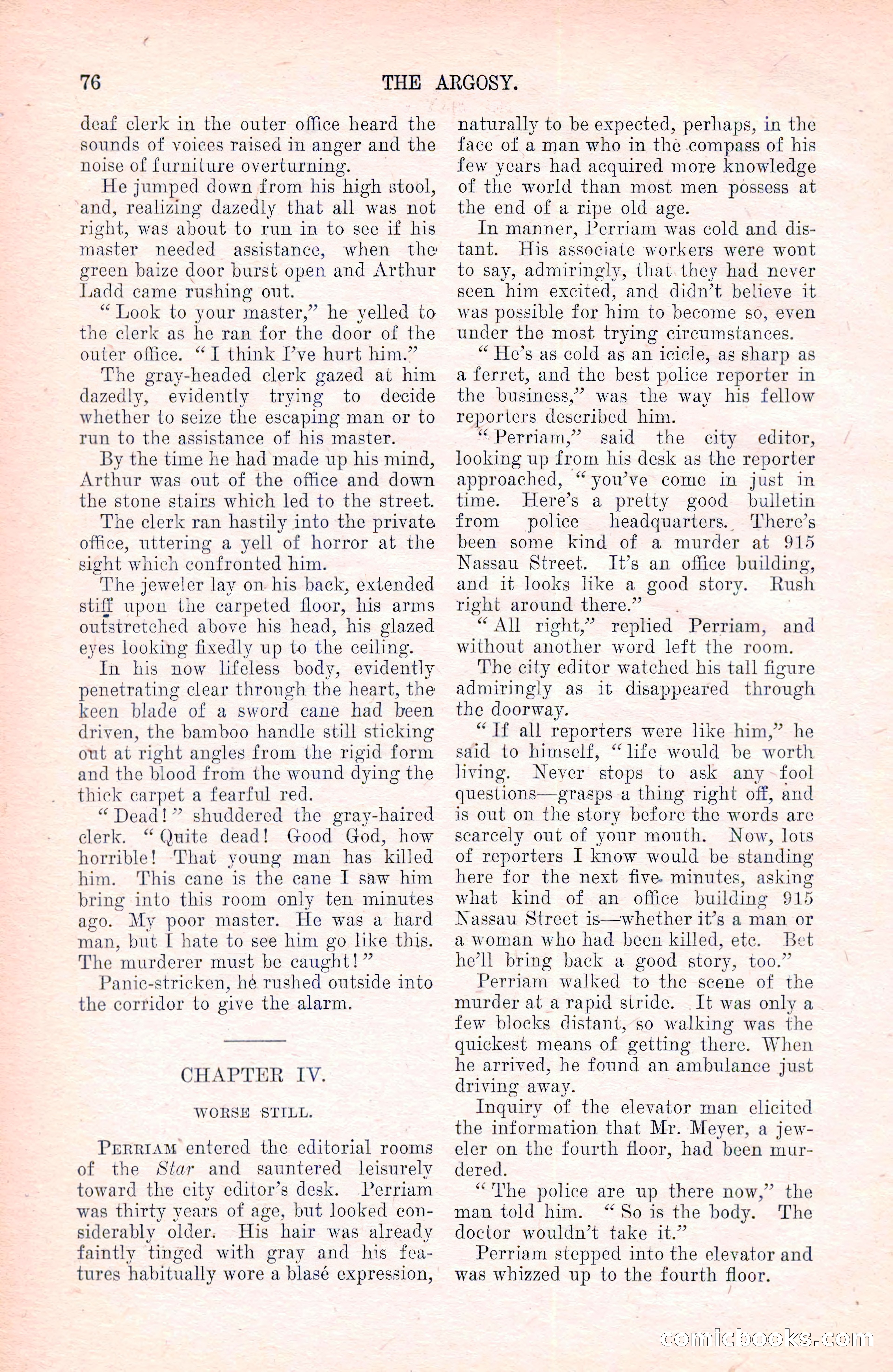
A restored page from Pulp Fiction, 1905. Page through the whole issue in the reader above.
📄 Transcribed text from this page (OCR, searchable)
Machine-transcribed from the original scan — historical spelling and the odd misread are preserved.
76 deaf clerk in the outer office heard the sounds of voices raised in anger and the noise of furniture overturning. He jumped down from his high stool, and, realizing dazedly that all was not right, was about to run in to see if his master needed assistance, green baize door burst open and Arthur Ladd came rushing out. “Look to your master,” he yelled to the clerk as he ran for the door of the outer office. “ I think I’ve hurt him.” The gray-headed clerk gazed at him dazedly, evidently trying to decide whether to seize the escaping man or to run to the assistance of his master. By the time he had made up his mind, Arthur was out of the office and down the stone stairs which led to the street. The clerk ran hastily into the private office, uttering a yell of horror at the sight which confronted him. The jeweler lay on his back, extended stiff upon the carpeted floor, his arms outstretched above his head, ‘his olazed eyes looking fixedly up to the ceiling. In his now lifeless body, evidently penetrating clear through the heart, the keen blade of a sword cane had been driven, the bamboo handle still sticking out at right angles from the rigid form and the blood from the wound dying the thick carpet a fearful red. “Dead!” shuddered the gray-haired clerk. “ Quite dead! Good God, how horrible! That young man has killed him. This cane is the cane I saw him bring into this room only ten minutes ago. My poor master. He was a hard man, but I hate to see him go like this. The murderer must be caught!” Panic-stricken, hé rushed outside into the corridor to give the alarm. ee CHAPTER IV. WORSE STILL. PERRIAM entered the editorial rooms of the Star and sauntered leisurely toward the city editor’s desk. Perriam was thirty years of age, but looked con- siderably older. His hair was already faintly tinged with gray and his fea- tures habitually wore a blasé expression, when the THE ARGOSY. naturally to be expected, perhaps, in the face of a man who in the compass of his few years had acquired more knowledge of the world than most men possess at the end of a ripe old age. In manner, Perriam was cold and dis- tant. Huis associate workers were wont to say, admiringly, that they had never seen him excited, and didn’t believe it was possible for him to become so, even under the most trying circumstances. “He’s as cold as an icicle, as sharp as a ferret, and the best police reporter in the business,” was the way his fellow reporters described him. “<Perriam,” said the city editor, looking up from his desk as the reporter approached, “you’ve come in just in time. Here’ s a pretty good bulletin from police headquarters. There’s been some kind of a murder at 915 Nassau Street. It’s an office building, and it looks like a good story. Rush right around there.” .” : “All right,” repled Perriam, and without another word left the room. The city editor watched his tall figure admiringly as it disappeared through the doorway. “Tf all reporters were like him,” he said to himself, “life would be worth hving. Never stops to ask any - fool questions—grasps a thing right off, and is out on the story before the words are scarcely out of your mouth. Now, lots of reporters I know would be standing here for the next five minutes, asking what kind of an office building 915 Nassau Street is—whether it’s a man or a woman who had been killed, etc. Bet he’ll bring back a good story, too.” Perriam walked to the scene of the murder at arapid stride. It was only a few blocks distant, so walking was the quickest means of getting there. When he arrived, he found an ambulance just driving away. Inquiry of the elevator man elicited the information that Mr. Meyer, a jew- eler on the fourth floor, had been mur- dered. “The police are up there now,” the man told him. “So is the body. The doctor wouldn’t take it.” Perriam stepped into the elevator and was whizzed up to the fourth floor. COMmicloookX (C@