
Pulp Fiction, 1905 · page 173 of 252
The Argosy, December 1905 — page 173: what you’re looking at
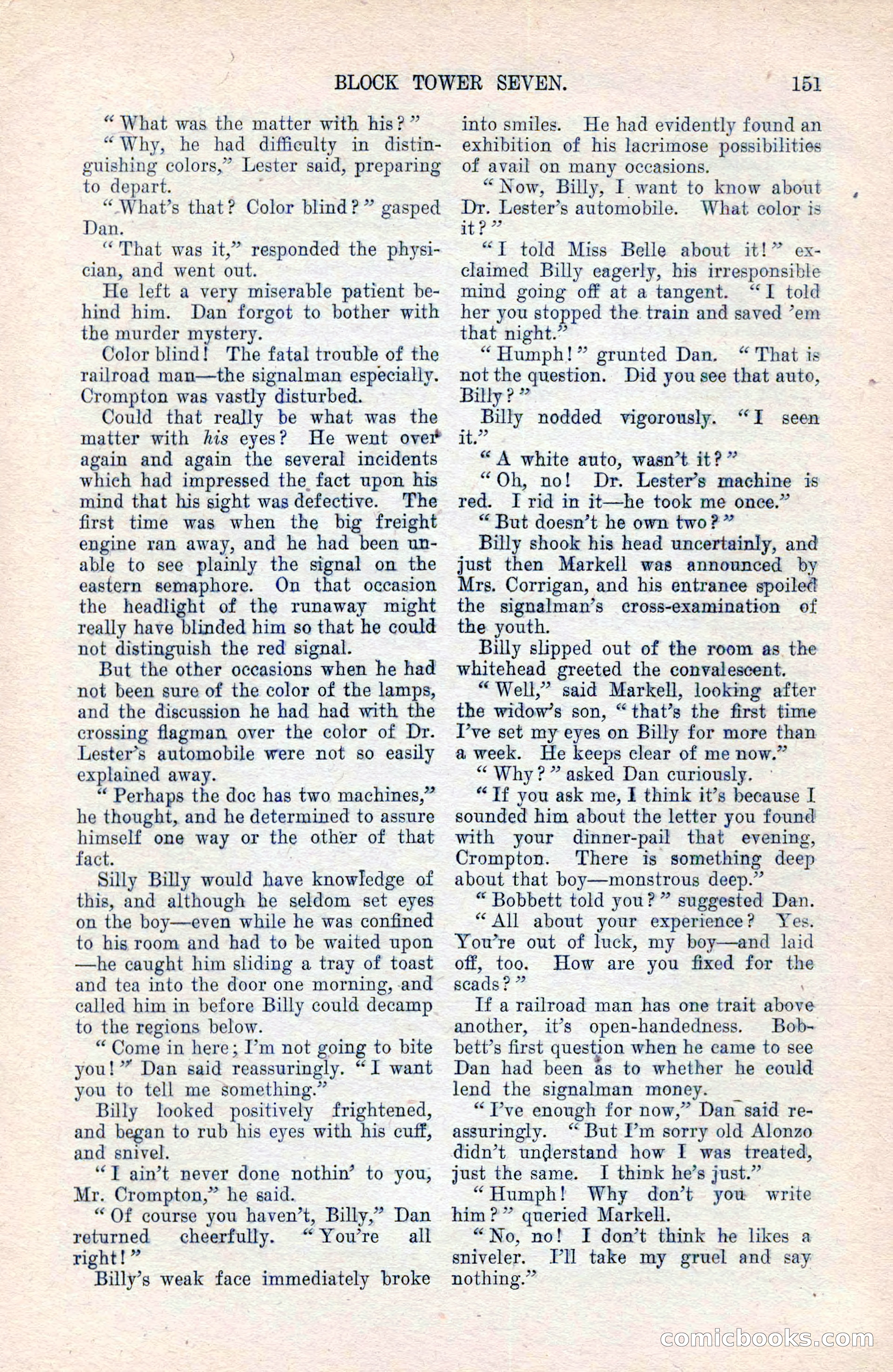
A restored page from Pulp Fiction, 1905. Page through the whole issue in the reader above.
📄 Transcribed text from this page (OCR, searchable)
Machine-transcribed from the original scan — historical spelling and the odd misread are preserved.
BLOCK TOWER SEVEN. “ What was the matter with his? ” “Why, he had difficulty in distin- guishing colors,” Lester said, preparing to depart. “ What’s that? Color blind?” gasped Dan. “That was it,” responded the physi- cian, and went out. He left a very miserable patient be- hind him. Dan forgot to bother with the murder mystery. Color blind! The fatal trouble of the railroad man—the signalman especially. Crompton was vastly disturbed. Could that really be what was the matter with his eyes? He went over again and again the several incidents which had impressed the fact upon his mind that his sight was defective. The first time was when the big freight engine ran away, and he had been un- able to see plainly the signal on the eastern semaphore. On that occasion the headlight of the runaway might really have blinded him so that he could not distinguish the red signal. But the other occasions when he had not been sure of the color of the lamps, and the discussion he had had with the crossing flagman over the color of Dr. Lester’s automobile were not so easily explained away. “Perhaps the doc has two machines,” he thought, and he determined to assure himself one way or the other of that fact. Silly Billy would have knowledge of this, and although he seldom set eyes on the boy—even while he was confined to his room and had to be waited upon —he caught him sliding a tray of toast and tea into the door one morning, -and called him in before Billy could decamp to the regions below. “Come in here; I’m not going to bite you!” Dan said reassuringly. “I want you to tell me something.” Billy looked positively frightened, and began to rub his eyes with his cuff, and snivel. ‘“‘T ain’t never done nothin’ to you, Mr. Crompton,” he said. “Of course you haven’t, Billy,” Dan returned cheerfully. “You're all right! ” Billy’s weak face immediately broke 151 into smiles. He had evidently found an exhibition of his lacrimose possibilities of avail on many occasions. “Now, Billy, | want to know about Dr. Lester’s automobile. What color is 1s ae “I told Miss Belle about it!” ex- claimed Billy eagerly, his irresponsible mind going off at a tangent. “TI told her you stopped the train and saved em that night.” “Humph!” grunted Dan. “ That is not the question. Did you see that auto, Billy?” Billy nodded vigorously. “I “A white auto, wasn’t it? ” “Oh, no! Dr. Lester’s machine is red. I rid in it—he took me once.” “ But doesn’t he own two?” Billy shook his head uncertainly, and just then Markell was announced by Mrs. Corrigan, and his entranee spoiled the signalman’s cross-examination of the youth. Billy slipped out of the room as the whitehead greeted the convalescent. “Well,” said Markell, looking after the widow’s son, “that’s the first time I’ve set my eyes on Billy for more than a week. He keeps clear of me now.” “ Why?” asked Dan curiously. “Tf you ask me, I think it’s because I sounded him about the letter you found with your dinner-pail that evening, Crompton. ‘There is something deep about that boy—monstrous deep.” “ Bobbett told you?” suggested Dan. “All about your experience? Yes. You’re out of luck, my boy—and laid off, too. How are you fixed for the scads? ” If a railroad man has one trait aboy another, it’s open-handedness. Bob- bett’s first question when he came to see Dan had been as to whether he could lend the signalman money. _ “T’ve enough for now,” Dan said re- assuringly. ‘ But P’m sorry old Alonzo didn’t understand how I was treated, just the same. I think he’s just.” “Humph! Why don’t you write him?” queried Markell. “No, no! I don’t think he likes a sniveler. Ill take my gruel and say nothing.” seen COMMICOOOKS (C@