
Pulp Fiction, 1905 · page 162 of 252
The Argosy, December 1905 — page 162: what you’re looking at
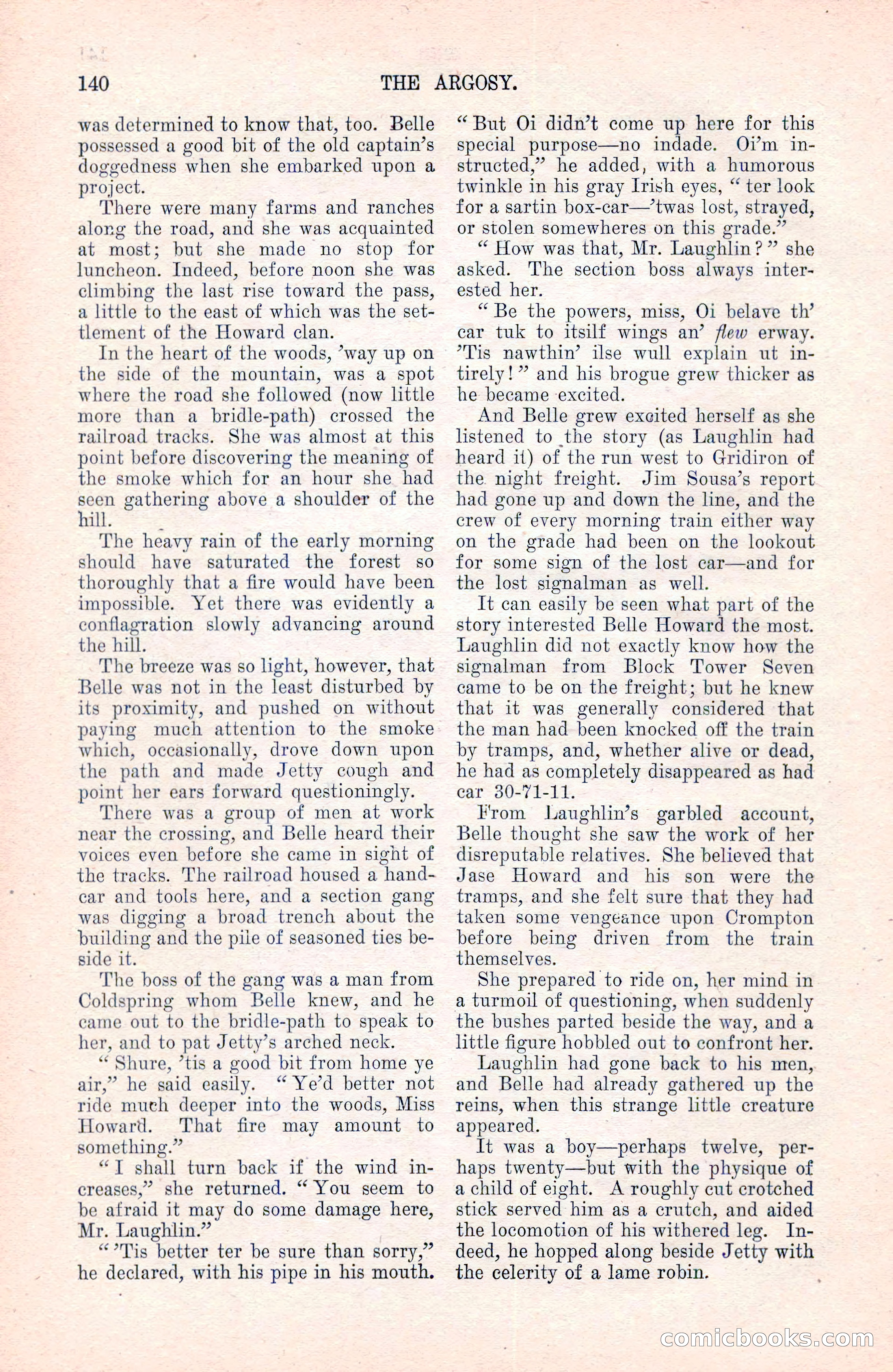
A restored page from Pulp Fiction, 1905. Page through the whole issue in the reader above.
📄 Transcribed text from this page (OCR, searchable)
Machine-transcribed from the original scan — historical spelling and the odd misread are preserved.
140 was determined to know that, too. Belle possessed a good bit of the old captain’s doggedness when she embarked upon a project. There were many farms and ranches along the road, and she was acquainted at most; but she made no stop for luncheon. Indeed, before noon she was climbing the last rise toward the pass, a little to the east of which was the set- tlement of the Howard clan. In the heart of the woods, ’way up on the side of the mountain, was a spot where the road she followed (now little more than a bridle-path) crossed the railroad tracks. She was almost at this point before discovering the meaning of the smoke which for an hour she had seen gathering above a shoulder of the hill. The heavy rain of the early morning should have saturated the forest so thoroughly that a fire would have been impossible. Yet there was evidently a conflagration slowly advancing around the hill. The breeze was so light, however, that Belle was not in the least disturbed by its proximity, and pushed on without paying much attention to the smoke which, occasionally, drove down upon the path and made Jetty cough and point her ears forward questioningly. There was a group of men at work near the crossing, and Belle heard their voices even before she came in sight of the tracks. The railroad housed a hand- car and tools here, and a section gang was digging a broad trench about the building and the pile of seasoned ties be- side it. The boss of the gang was a man from Coldspring whom Belle knew, and he came out to the bridle-path to speak to her, and to pat Jetty’s arched neck. “Shure, *tis a good bit from home ye air,” he said easily. “ Ye’d better not ride muth deeper into the woods, Miss Howard. That fire may amount to something.” “J shall turn back if the wind in- creases,” she returned. “ You seem to be afraid it may do some damage here, Mr. Laughlin.” “?Tis better ter be sure than sorry,” he declared, with his pipe in his mouth. THE ARGOSY. “But O1 didn’t come up here for this special purpose—no indade. Oi’m in- structed,” he added, with a humorous twinkle in his gray Irish eyes, “ ter look for a sartin box-car—twas lost, strayed, or stolen somewheres on this grade.” “ How was that, Mr. Laughlin?” she asked. The section boss always inter- ested her. “Be the powers, miss, Oi belave th’ car tuk to itsilf wings an’ flew erway. °Tis nawthin’ ilse wull explain ut in- tirely!” and his brogue grew thicker as he became excited. And Belle grew excited herself as she listened to the story (as Laughlin had heard it) of the run west to Gridiron of the night freight. Jim Sousa’s report had gone up and down the line, and the crew of every morning train either way on the grade had been on the lookout for some sign of the lost car—and for the lost signalman as well. It can easily be seen what part of the story interested Belle Howard the most. Laughlin did not exactly know how the signalman from Block Tower Seven came to be on the freight; but he knew that it was generally considered that the man had been knocked off the train by tramps, and, whether alive or dead, he had as completely disappeared as had ear 30-71-11. rom Laughlin’s garbled account, Belle thought she saw the work of her disreputable relatives. She believed that Jase Howard and his son were the tramps, and she felt sure that they had taken some vengeance upon Crompton before being driven from the train themselves. She prepared to ride on, her mind in a turmoil of questioning, when suddenly the bushes parted beside the way, and a little figure hobbled out to confront her. Laughlin had gone back to his men, and Belle had already gathered up the reins, when this strange little creature appeared. It was a boy—perhaps twelve, per- haps twenty—but with the physique of a child of eight. A roughly cut crotched stick served him as a crutch, and aided the locomotion of his withered leg. In- deed, he hopped along beside Jetty with the celerity of a lame robin. COMmMiCcloookX (C@