
Pulp Fiction, 1905 · page 127 of 252
The Argosy, December 1905 — page 127: what you’re looking at
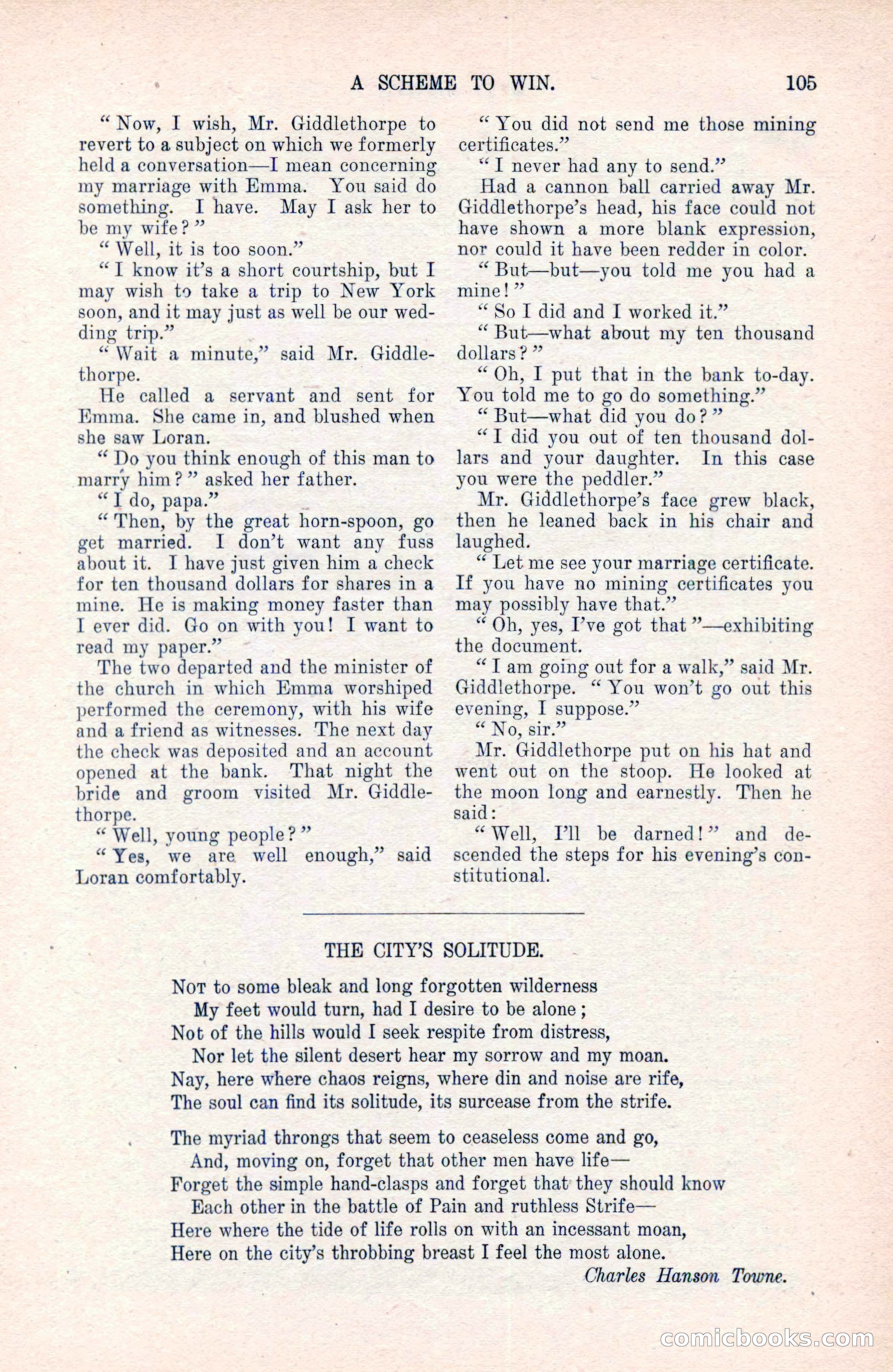
A restored page from Pulp Fiction, 1905. Page through the whole issue in the reader above.
📄 Transcribed text from this page (OCR, searchable)
Machine-transcribed from the original scan — historical spelling and the odd misread are preserved.
A SCHEME TO WIN. “Now, I wish, Mr. Giddlethorpe to revert to a subject on which we formerly held a conversation—I mean concerning my marriage with Emma. You said do something. I have. May I ask her to be my wife?” “ Well, it is too soon.” “J know it’s a short courtship, but I may wish to take a trip to New York soon, and it may just as well be our wed- ding trip.” “Wait a minute,” said Mr. Giddle- thorpe. | He called a servant and sent for Kmma. She came in, and blushed when she saw Loran. “ Do you think enough of this man to marry him?” asked her father. “I do, papa.” : “Then, by the great horn-spoon, go get married. I don’t want any fuss about it. I have just given him a check for ten thousand dollars for shares in a mine. He is making money faster than I ever did. Go on with you! I want to read my paper.” The two departed and the minister of the church in which Emma worshiped performed the ceremony, with his wife and a friend as witnesses. The next day the check was deposited and an account opened at the bank. That night the bride and groom visited Mr. Giddle- thorpe. “ Well, young people?” “Yes, we are well enough,” said Loran comfortably. 105 “You did not send me those mining certificates.” *“T never had any to send.” Had a cannon ball carried away Mr. Giddlethorpe’s head, his face could not have shown a more blank expression, nor could it have been redder in color. “ But—but—you told me you had a mine!” ‘““So I did and I worked it.” “ But—what about my ten thousand dollars? ” “Oh, I put that in the bank to-day. You told me to go do something.” “ But—what did you do?” “T did you out of ten thousand dol- lars and your daughter. In this case you were the peddler.” Mr. Giddlethorpe’s face grew black, then he leaned back in his chair and laughed. “ Let me see your marriage certificate. If you have no mining certificates you may possibly have that.” “Oh, yes, ’ve got that ”—exhibiting the document. “Tam going out for a walk,” said Mr. Giddlethorpe. “ You won’t go out this evening, I suppose.” “No; 61” Mr. Giddlethorpe put on his hat and went out on the stoop. He looked at the moon long and earnestly. Then he said : : Well, Vl be darned!” and de- scended the steps for his evening’s con- stitutional. THE CITY’S SOLITUDE. Not to some bleak and long forgotten wilderness My feet would turn, had I desire to be alone ; Not of the hills would I seek respite from distress, Nor let the silent desert hear my sorrow and my moan. Nay, here where chaos reigns, where din and noise are rife, The soul can find its solitude, its surcease from the strife. The myriad throngs that seem to ceaseless come and go, And, moving on, forget that other men have life— Forget the simple hand-clasps and forget that’ they should know Each other in the battle of Pain and ruthless Strife— Here where the tide of life rolls on with an incessant moan, Here on the city’s throbbing breast I feel the most alone. Charles Hanson Towne. COMmiclboookX (C@