
Pulp Fiction, 1905 · page 124 of 252
The Argosy, December 1905 — page 124: what you’re looking at
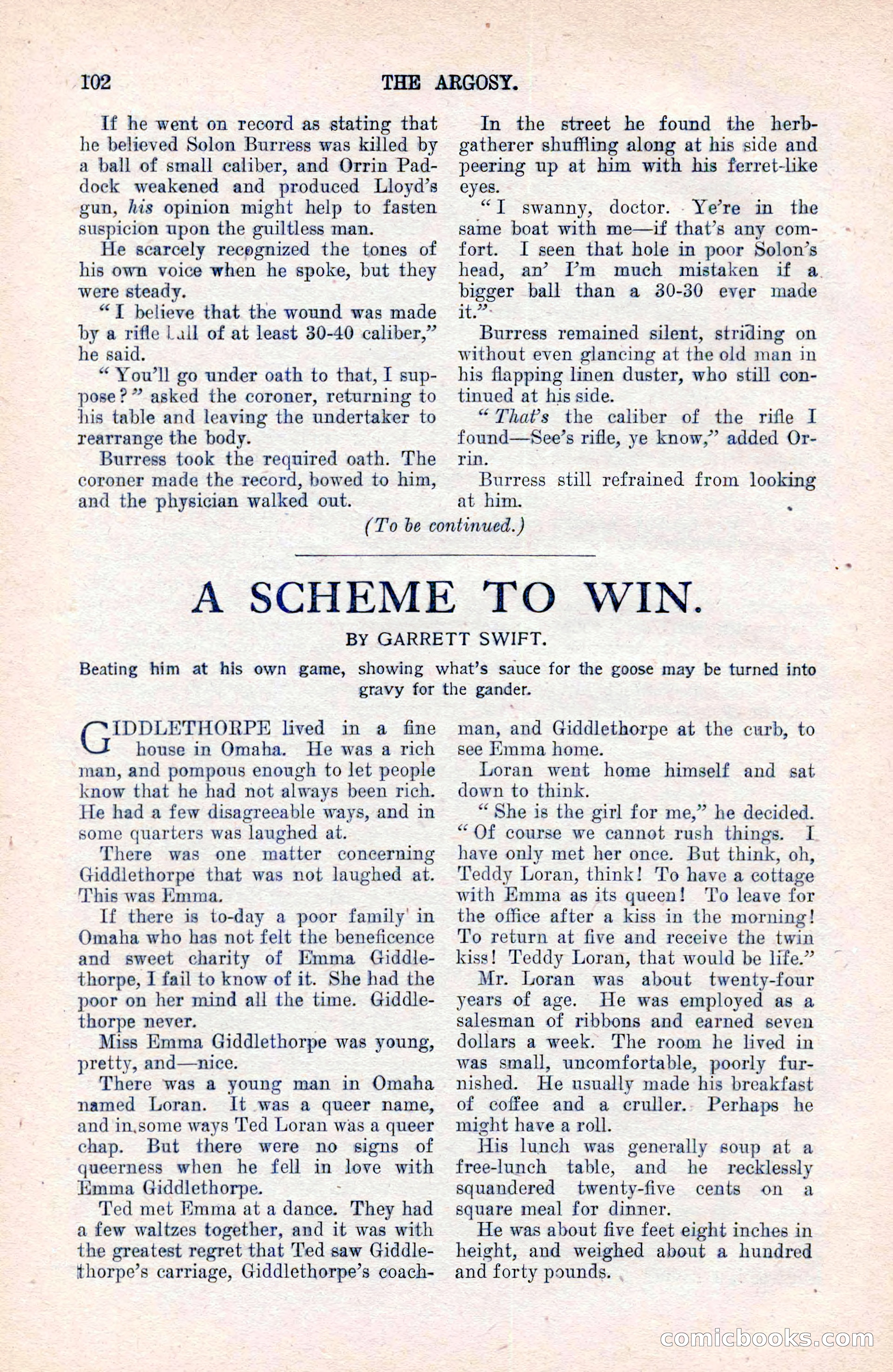
A restored page from Pulp Fiction, 1905. Page through the whole issue in the reader above.
📄 Transcribed text from this page (OCR, searchable)
Machine-transcribed from the original scan — historical spelling and the odd misread are preserved.
102 If he went on record as stating that he believed Solon Burress was killed by a ball of small caliber, and Orrin Pad- dock weakened and produced Lloyd’s gun, his opinion might help to fasten suspicion upon the guiltless man. He scarcely recognized the tones of his own voice when he spoke, but they were steady. “T believe that the wound was made by a rifle Lall of at least 30-40 caliber,” he said. “ You'll go under oath to that, I sup- pose?” asked the coroner, returning to his table and leaving the undertaker to rearrange the body. Burress took the required oath. The coroner made the record, bowed to him, and the physician walked out. THE ARGOSY. In the street he found the herb- gatherer shuffling along at his side and peering up at him with his ferret-like eyes. “JT swanny, doctor. -Ye’re in the same boat with me—if that’s any com- fort. I seen that hole in poor Solon’s head, an’ I’m much mistaken if a. bigger ball than a 30-30 ever made it. Burress remained silent, striding on without even glancing at the old man in his flapping linen duster, who still con- tinued at his side. “Thats the caliber of the rifle I found—See’s rifle, ye know,” added Or- rin. Burress still refrained from looking at him. s (To be continued.) A SCHEME TO WIN. BY GARRETT SWIFT. Beating him at his own game, showing what’s sauce for the goose may be turned into gravy for the gander. IDDLETHORPE lived in a fine house in Omaha. He was a rich man, and pompous enough to let people know that he had not always been rich. He had a few disagreeable ways, and in some quarters was laughed at. There was one matter concerning Giddlethorpe that was not laughed at. This was Emma. If there is to-day a poor family’ in Omaha who has not felt the beneficence and sweet charity of Emma Giddle- thorpe, I fail to know of it. She had the _ poor on her mind all the time. Giddle- thorpe never. Miss Emma Giddlethorpe was young, pretty, and—nice. There was a young man in Omaha named Loran. It was a queer name, and in,some ways Ted Loran was a queer chap. But there were no signs of queerness when he fell in love with Emma Giddlethorpe. Ted met Emma at a jem They had a few waltzes together, and it was with the greatest regret that Ted saw Giddle- thorpe’s carriage, Giddlethorpe’s coach- man, and Giddlethorpe at the curb, to see Kmma home. Loran went home himself and sat down to think. “She is the girl for me,” he decided. “ Of course we cannot rush things. I have only met her once. But think, oh, Teddy Loran, think! To have a cottage with Emma as its queen! ‘To leave for the office after a kiss in the morning! To return at five and receive the twin kiss! Teddy Loran, that would be life.” Mr. Loran was about twenty-four years of age. He was employed as a salesman of ribbons and earned seven dollars a week. The room he lived in was small, uncomfortable, poorly fur- nished. He usually made his breakfast of coffee and a cruller.. Perhaps he might have a roll. His lunch was generally soup at a free-lunch table, and he _ recklessly squandered twenty-five cents on a square meal for dinner. He was about five feet eight inches in height, and weighed about a hundred and forty pounds. COMmicloooks (C@