
Pulp Fiction, 1905 · page 117 of 252
The Argosy, December 1905 — page 117: what you’re looking at
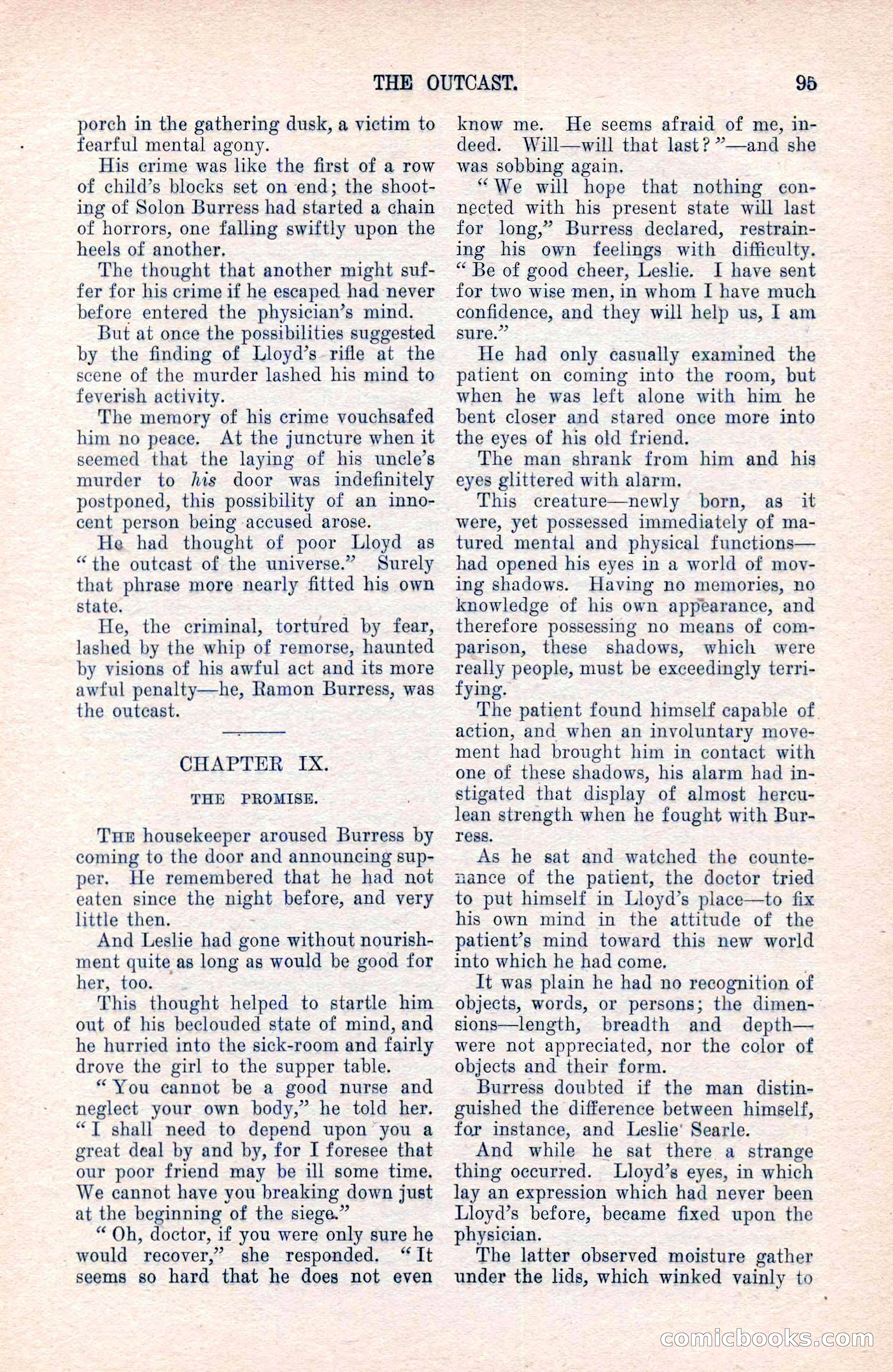
A restored page from Pulp Fiction, 1905. Page through the whole issue in the reader above.
📄 Transcribed text from this page (OCR, searchable)
Machine-transcribed from the original scan — historical spelling and the odd misread are preserved.
THE OUTCAST. porch in the gathering dusk, a victim to fearful mental agony. His crime was like the first of a row of child’s blocks set on end; the shoot- ing of Solon Burress had started a chain of horrors, one falling swiftly upon the heels of another. The thought that another might suf- fer for his crime if he escaped had never before entered the physician’s mind. But at once the possibilities suggested by the finding of Lloyd’s rifle at the scene of the murder lashed his mind to feverish activity. The memory of his crime vouchsafed him no peace. At the juncture when it seemed that the laying of his uncle’s murder to his door was indefinitely postponed, this possibility of an inno- cent person being accused arose. He had thought of poor Lloyd as “the outcast of the universe.” Surely that phrase more nearly fitted his own state. . He, the criminal, tortured by fear, lashed by the whip of remorse, haunted by visions of his awful act and its more awful penalty—he, Ramon Burress, was the outcast. CHAPTER IX. THE PROMISE. Tne housekeeper aroused Burress by coming to the door and announcing sup- per. He remembered that he had not eaten since the night before, and very little then. And Leslie had gone without nourish- ment quite as long as would be good for her, too. This thought helped to startle him out of his beclouded state of mind, and he hurried into the sick-room and fairly drove the girl to the supper table. “You cannot be a good nurse and neglect your own body,” he told her. “| shall need to depend upon you a great deal by and by, for I foresee that our poor friend may be ill some time. We cannot have you breaking down just at the beginning of the siege.” “ Oh, doctor, if you were only sure he would recover,” she responded. “It seems so hard that he does not even 95 know me. He seems afraid of me, in- deed. Will—will that last? *—and she was sobbing again. “We will hope that nothing con- nected with his present state will last for long,” Burress declared, restrain- ing his own feelings with difficulty. “ Be of good cheer, Leslie. I have sent for two wise men, in whom I have much confidence, and they will help us, I am sure.” He had only casually examined the patient on coming into the room, but when he was left alone with him he bent closer and stared once more into the eyes of his old friend. The man shrank from him and his eyes glittered with alarm, This creature—newly born, as it were, yet possessed immediately of ma- tured mental and physical functions— had opened his eyes in a world of moy- ing shadows. Having no memories, no knowledge of his own appearance, and therefore possessing no means of com- parison, these shadows, which were really people, must be exceedingly terri- fying. The patient found himself capable of. action, and when an involuntary move- ment had brought him in contact with one of these shadows, his alarm had in- stigated that display of almost hercu- lean strength when he fought with Bur- Tress. As he sat and watched the counte- nance of the patient, the doctor tried to put himself in Lloyd’s place—to fix his own mind in the attitude of the patient’s mind toward this new world into which he had come. 3 Tt was plain he had no recognition of objects, words, or persons; the dimen- sions—length, breadth and depth— were not appreciated, nor the color of objects and their form. Burress doubted if the man distin- guished the difference between himself, for instance, and Leslie’ Searle. And while he sat there a strange thing occurred. Lloyd’s eyes, in which lay an expression which had never been Lloyd’s before, became fixed upon the physician. The latter observed moisture gather under the lids, which winked vainly to COmICLOOokKS (C@