
Pulp Fiction, 1905 · page 109 of 252
The Argosy, December 1905 — page 109: what you’re looking at
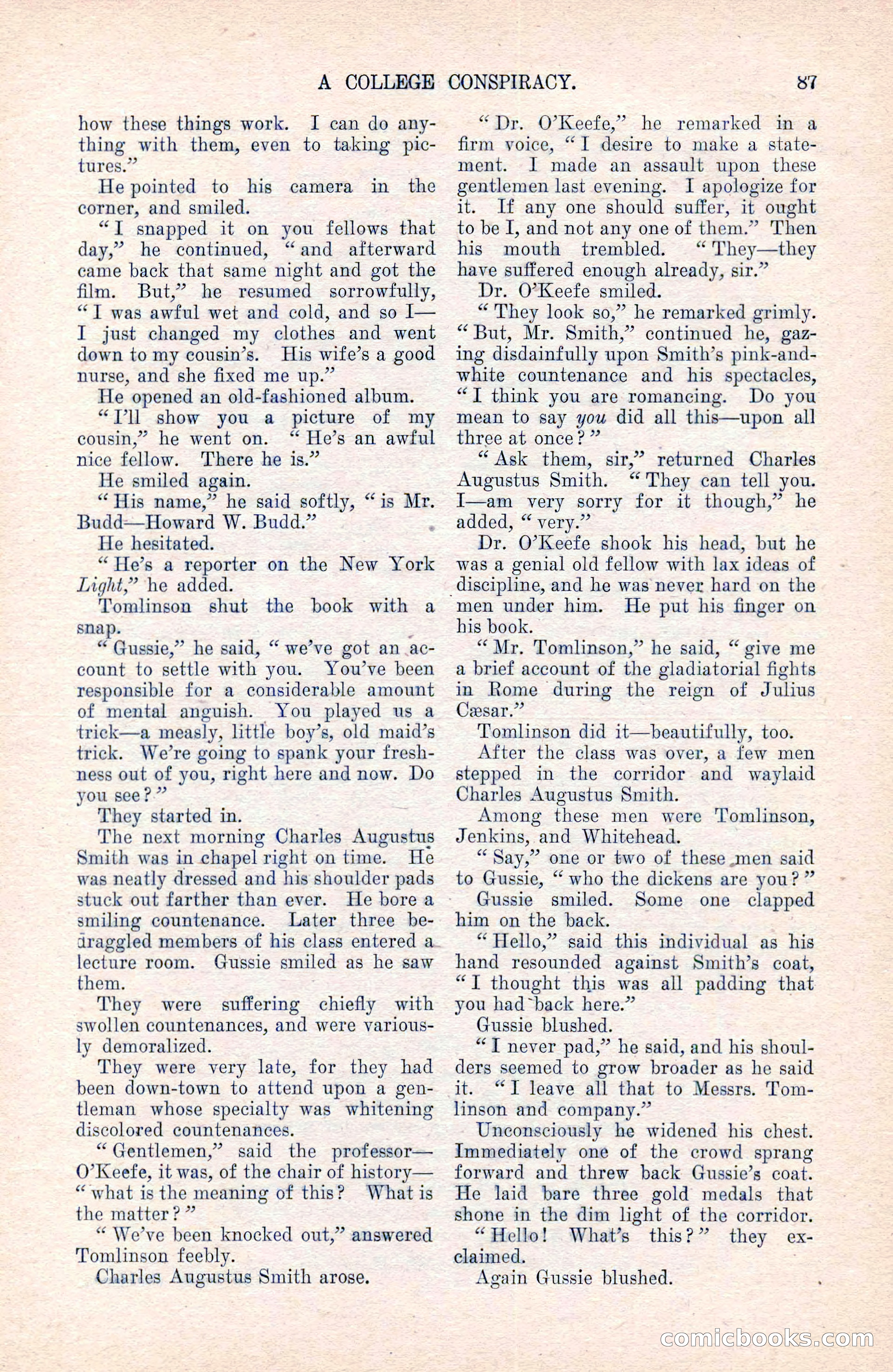
A restored page from Pulp Fiction, 1905. Page through the whole issue in the reader above.
📄 Transcribed text from this page (OCR, searchable)
Machine-transcribed from the original scan — historical spelling and the odd misread are preserved.
A COLLEGE how these things work. I can do any- thing with them, even to taking pic- tures.” He pointed to his camera in the corner, and smiled. “J snapped it on you fellows that day,” he continued, “and afterward came back that same night and got the film. But,’ he resumed sorrowfully, “1 was awful wet and cold, and so I— I just changed my clothes and went down to my cousin’s. His wife’s a good nurse, and she fixed me up.” He opened an old-fashioned album. “Tl show you a picture of my cousin,” he went on. “ He’s an awful nice fellow. There he is.” He smiled again. “His name,” he said softly, Budd—Howard W. Budd.” He hesitated. “ He’s a reporter on the New York Inght,” he added. Tomlinson shut the book with a snap. “ Gussie,” he said, “ we’ve got an .ac- count to settle with you. You’ve been responsible for a considerable amount of mental anguish. You played us a trick—a measly, little boy’s, old maid’s trick. We’re going to spank your fresh- ness out of you, right here and now. Do you see?.”” They started in. The next morning Charles Augustus Smith was in chapel right on time. He was neatly dressed and his shoulder pads stuck out farther than ever. smiling countenance. Later three be- draggled members of his class entered a lecture room. Gussie smiled as he saw them. They were suffering chiefly with swollen countenances, and were various- ly demoralized. They were very late, for they had been down-town to attend upon a gen- tleman whose specialty was whitening discolored countenances. “Gentlemen,” said the professor— O’ Keefe, it was, of the chair of history— “what is the meaning of this? What is the matter? ” “ We’ve been knocked out,” answered Tomlinson feebly. Charles Augustus Smith arose. “is Mr. CONSPIRACY. He bore a - OF “Dr. O'Keefe,” he remarked in a firm voice, “I desire to make a state- ment. J made an assault upon these gentlemen last evening. I apologize for it. If any one should suffer, it ought to be I, and not any one of them.” Then his mouth trembled. “'They—they have suffered enough already, sir.” Dr. O’Keefe smiled. “ They look so,” he remarked grimly. “But, Mr. Smith,” continued he, gaz- ing disdainfully upon Smith’s pink-and- white countenance and his spectacles, “JT think you are romancing. Do you mean to say you did all this—upon all three at once?” | “Ask them, sir,” returned Charles Augustus Smith. “They can tell you. I—am very sorry for it though,” he added, “ very.” Dr. O’Keefe shook his head, but he was a genial old fellow with lax ideas of discipline, and he was never hard on the men under him. He put his finger on his book. “Mr. Tomlinson,” he said, “ give me a brief account of the gladiatorial fights in Rome during the reign of Julius Cesar.” Tomlinson did it—beautifully, too. After the class was over, a few men stepped in the corridor and waylaid Charles Augustus Smith. Among these men were 'l'’omlinson, Jenkins, and Whitehead. “Say,” one or two of these men said to Gussie, “ who the dickens are you?” Gussie smiled. Some one clapped him on the back. “ Hello,” said this individual as his hand resounded against Smith’s coat, “I thought this was all padding that you had “back here.” Gussie blushed. “TI never pad,” he said, and his shoul- ders seemed to grow broader as he said it. “IJ leave all that to Messrs. Tom- linson and company.” Unconsciously he widened his chest. Immediately one of the crowd sprang forward and threw back Gussie’s coat. He laid bare three gold medals that shone in the dim light of the corridor. “Hello! What’s this?” they ex- claimed. | Again Gussie blushed. COnmicoooks (C@)