
Pulp Fiction, 1891 · page 10 of 20
The Argosy, Vol. XI, No. 22 — page 10: what you’re looking at
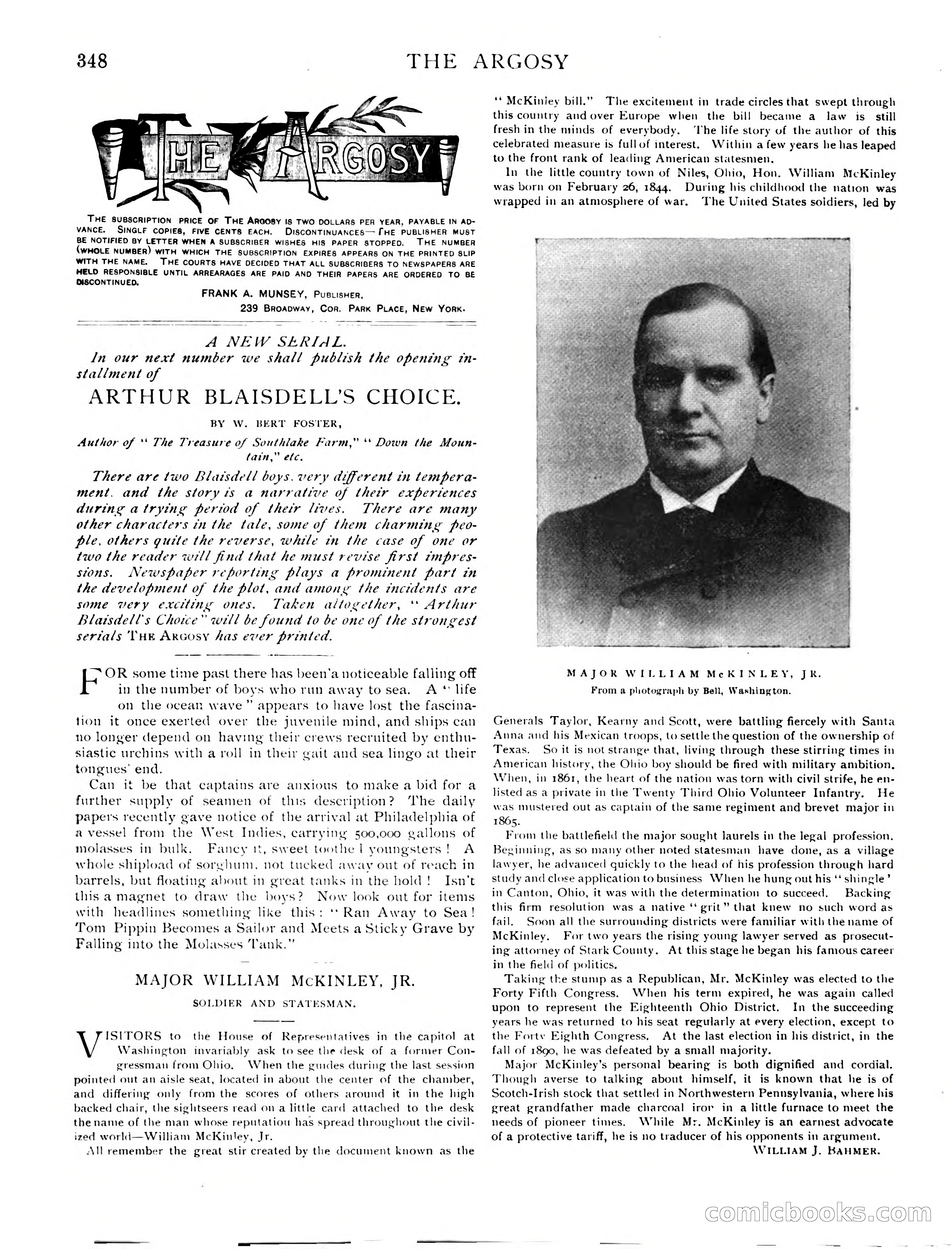
A restored page from Pulp Fiction, 1891. Page through the whole issue in the reader above.
📄 Transcribed text from this page (OCR, searchable)
Machine-transcribed from the original scan — historical spelling and the odd misread are preserved.
THE 348 THE SUBSCRIPTION PRICE OF THE ARGOSY IS TWO DOLLARS PER YEAR, PAYABLE IN AD- VANCE. SINGLF COPIES, FIVE CENTS EACH. DISCONTINUANCES— FHE PUBLISHER MUST BE NOTIFIED BY LETTER WHEN A SUBSCRIBER WISHES HIS PAPER STOPPED. THE NUMBER (WHOLE NUMBER) WITH WHICH THE SUBSCRIPTION EXPIRES APPEARS ON THE PRINTED SLIP WITH THE NAME. THE COURTS HAVE DECIDED THAT ALL SUBSCRIBERS TO NEWSPAPERS ARE HELD RESPONSIBLE UNTIL ARREARAGES ARE PAID AND THEIR PAPERS ARE ORDERED TO BE DISCONTINUED. FRANK A. MUNSEY, Pues tisHer, 239 Broapway, Cor. PARK PLACE, NEw YORK. A NEW SERIAL. ln our next number we shall publish the opening in- stallment of ARTHUR BLAISDELL’S CHOICE. BY W. BERT FOSTER, Author of ** The Treasure of Southlake Farm,” ** Down the Moun- tain,” etc. There are two Blaisdell boys. very different in tempera- ment. and the story ts a narrative of thetr expertences during atrying period of thetr lives. There are many other characters in the tate, some of them charming peo- ple, others quite the reverse, while in the case of one or two the reader will find that he must revise first zmpres- stons. Newspaper reporting plays a prominent part in the development of the plot, and among the tnerdents are some very exctting ones. Taken altogether, ** Arthur Blatsdell’'s Chowce” wtll be found to be one of the strongest sertals "THE ARGoSY has ever printed. La F OR some time past there has been’a noticeable falling off in the number of boys who run away to sea. A ‘ life on the ocean wave” appears to have lost the fascina- tion it once exerted over the juvenile mind, and ships can no longer depend on having their crews recruited by enthu- siastic urchins with a roll in their gait and sea lingo at their tongues’ end. Can it be that captains are anxious to make a bid for a further supply of seamen of this description? The daily papers recently gave notice of the arrival at Philadelphia of a vessel from the West Indies, carrying 500,000 gallons of molasses in bulk. Fancy it, sweet toothe | youngsters!) A whole shipload of sorghum, not tucked away out of reach in barrels, but floating about in great tanks in the hold! Isn't this a magnet to draw the boys? Now look out for items with headlines something like this: ‘Ran Away to Sea! Tom Pippin Becomes a Sailor and Meets a Sticky Grave by Falling into the Molasses Tank.” MAJOR WILLIAM MCKINLEY, JR. SOLDIER AND STATESMAN. ISITORS to the House of Representatives in the capitol at V Washington invariably ask to see the desk of a former Con- gressman from Ohio. When the guides during the last session pointed out an aisle seat, located in about the center of the chamber, and differing only from the scores of others around it in the high backed chair, the sightseers read on a little card attached to the desk thename of the man whose reputatiou has spread throughout the civil- ized world—William McKinley, Jr. All remember the great stir created by the document known as the ARGOSY ‘* McKinley bill.” The excitement in trade circles that swept through this country and over Europe when the bill became a law is. still fresh in the niinds of everybody. ‘lhe life story of the author of this celebrated measure is fullof interest. Within afew years he has leaped to the front rank of leading American statesmen. In the little country town of Niles, Ohio, Hon. William McKinley was born on February 26, 1844. During his childhood the nation was wrapped in an atmosphere of war. The United States soidiers, led by epee eee agg 4 wi “<) LA ef ' MAJOR WILLIAM McKINLEY, JR. From a photograph by Bell, Waxhington. Generals Taylor, Kearny and Scott, were battling fiercely with Santa Anna and his Mexican troops, to settle the question of the ownership of Texas. So it is not strange that, living through these stirring times in American history, the Olio boy should be fired with military ambition. When, in 1861, the heart of the nation was torn with civil strife, he en- listed as a private in the Twenty Third Ohio Volunteer Infantry. He was mustered out as captain of the same regiment and brevet major in 1865. From the battlefield the major sought laurels in the legal profession. Beginning, as so many other noted statesman have done, as a village lawyer, he advanced quickly to the head of his profession through hard study and close application to business When he hung out his “ shingle’ in Canton, Ohio, it was with the determination to succeed. Backing this firm resolution was a native ‘‘ grit” that knew no such word as fail. Soon all the surrounding districts were familiar with the name of McKinley. For two years the rising young lawyer served as prosecut- ing attorney of Stark County. At this stage he began his famous career in the field of politics. Taking the stump as a Republican, Mr. McKinley was elected to the Forty Fifth Congress. When his term expired, he was again called upon to represent the Eighteenth Ohio District. In the succeeding years he was returned to his seat regularly at every election, except to the Forty Eighth Congress, At the last election in his district, in the fall of 1890, he was defeated by a small majority. Major McKinley’s personal bearing is both dignified and cordial. Though averse to talking about himself, it is known that he is of Scotch-Irish stock that settled in Northwestern Pennsylvania, where his great prandfather made charcoal iror in a little furnace to meet the needs of pioneer times. While Mr. McKinley is an earnest advocate of a protective tariff, he is no traducer of his opponents in argument. WILLIAM J. KAHMER. conmnlclooolks (CO)