
Pulp Fiction, 1955 · page 83 of 148
Argosy (UK), January 1955 — page 83: what you’re looking at
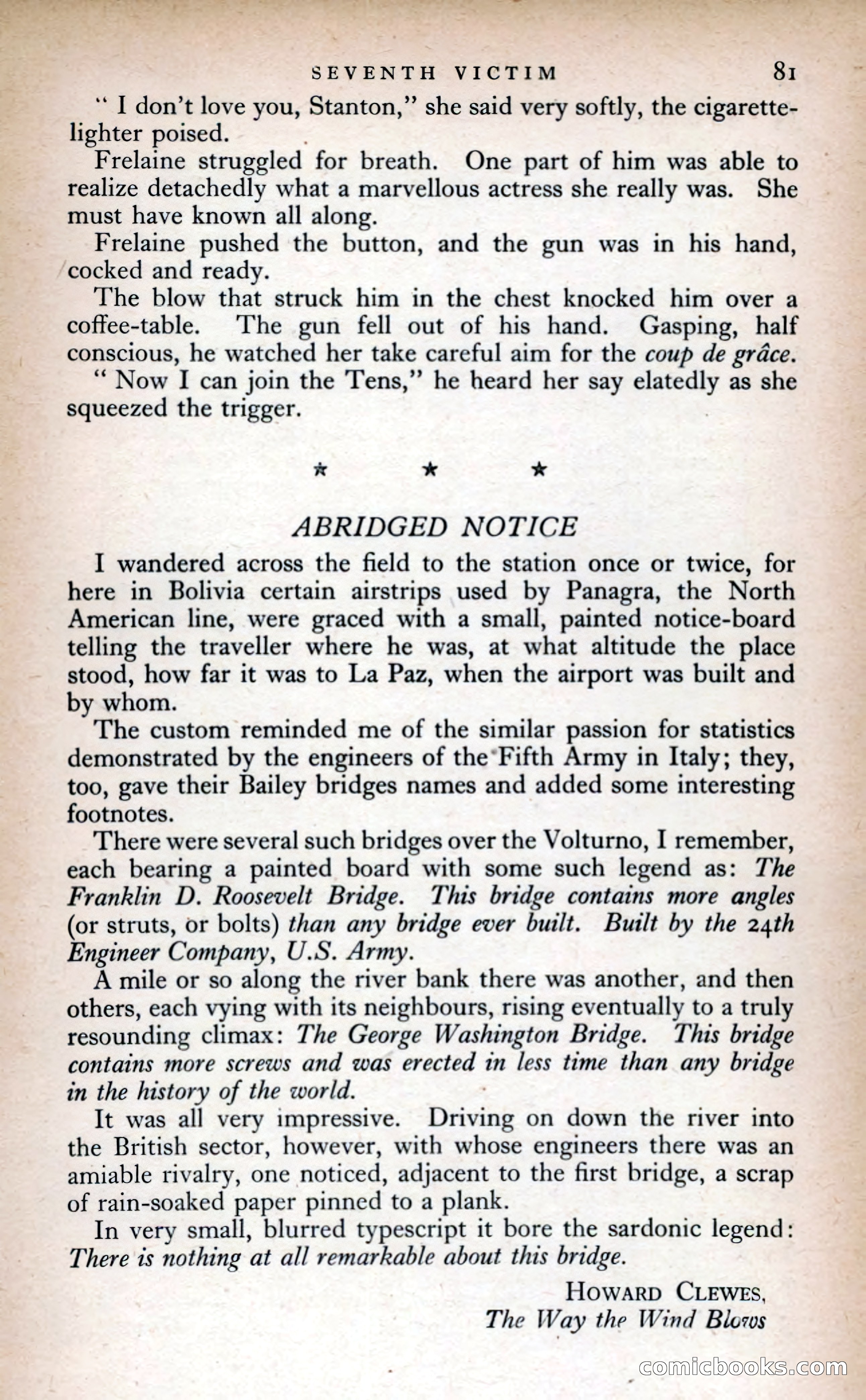
A restored page from Pulp Fiction, 1955. Page through the whole issue in the reader above.
📄 Transcribed text from this page (OCR, searchable)
Machine-transcribed from the original scan — historical spelling and the odd misread are preserved.
Be Re ee a Ee Pe ee ee ee ee SEVENTH VICTIM 81 - ‘‘ I don’t love you, Stanton,” she said very softly, the cigarette- lighter poised. Frelaine struggled for breath. One part of him was able to realize detachedly what a marvellous actress she really was. She must have known all along. Frelaine pushed the button, and the gun was in his hand, cocked and ready. The blow that struck him in the chest knocked him over a coffee-table. The gun fell out of his hand. Gasping, half conscious, he watched her take careful aim for the coup de grace. “ Now I can join the Tens,” he heard her say elatedly as she squeezed the trigger. * * * ABRIDGED NOTICE I wandered across the field to the station once or twice, for here in Bolivia certain airstrips used by Panagra, the North American line, were graced with a small, painted notice-board telling the traveller where he was, at what altitude the place stood, how far it was to La Paz, when the airport was built and by whom. The custom reminded me of the similar passion for statistics demonstrated by the engineers of the*Fifth Army in Italy; they, too, gave their Bailey bridges names and added some interesting footnotes. There were several such bridges over the Volturno, I remember, each bearing a painted board with some such legend as: The Franklin D. Roosevelt Bridge. This bridge contains more angles (or struts, or bolts) than any bridge ever built. Built by the 24th Engineer Company, U.S. Army. A mile or so along the river bank there was another, and then others, each vying with its neighbours, rising eventually to a truly resounding climax: The George Washington Bridge. This bridge contains more screws and was erected in less time than any bridge in the history of the world. It was all very impressive. Driving on down the river into the British sector, however, with whose engineers there was an amiable rivalry, one noticed, adjacent to the first bridge, a scrap of rain-soaked paper pinned to a plank. In very small, blurred typescript it bore the sardonic legend: There is nothing at all remarkable about this bridge. Howarp CLEWES, The Way the Wind Bloros —Comiciooks.com