
Pulp Fiction, 1955 · page 75 of 148
Argosy (UK), January 1955 — page 75: what you’re looking at
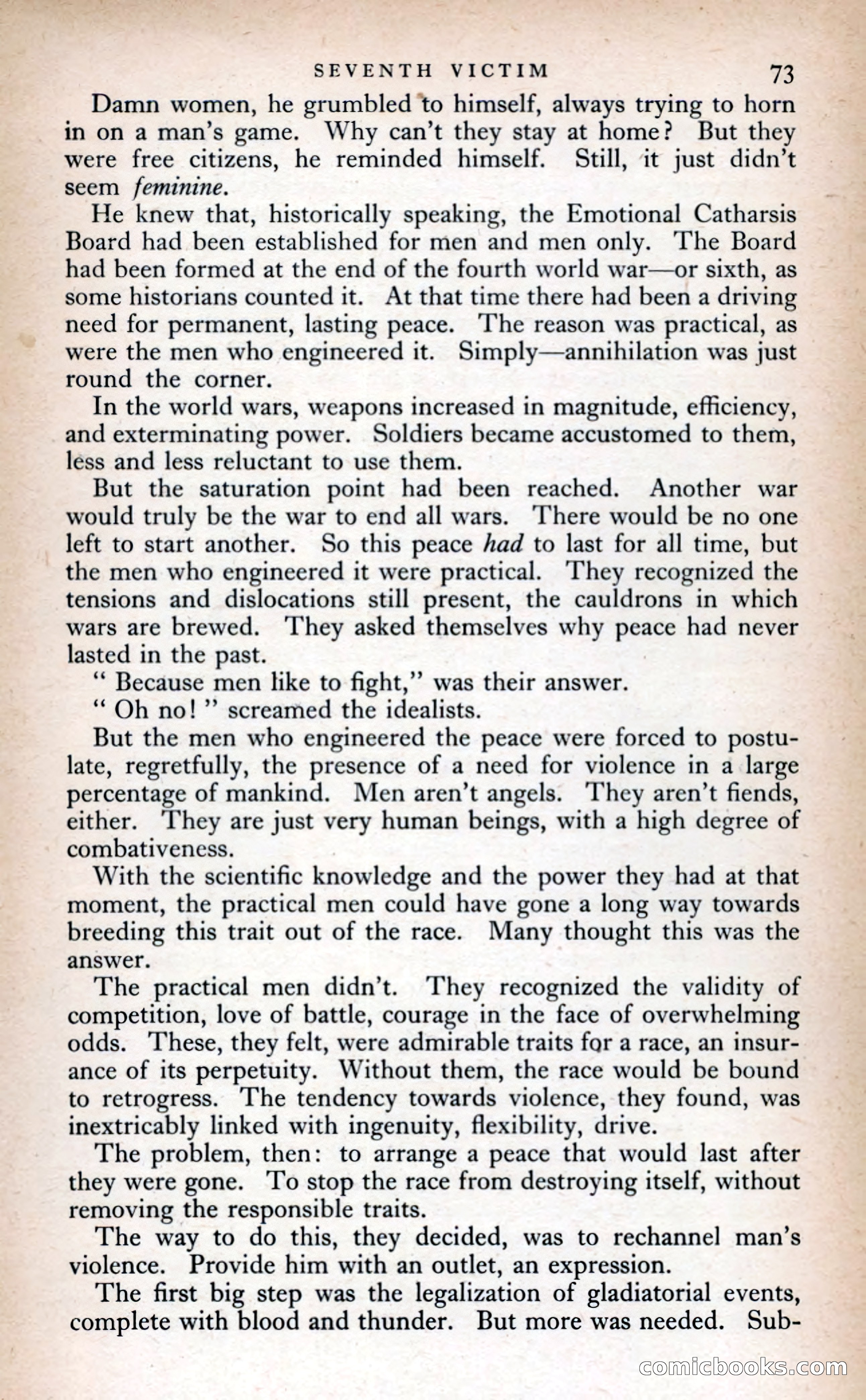
A restored page from Pulp Fiction, 1955. Page through the whole issue in the reader above.
📄 Transcribed text from this page (OCR, searchable)
Machine-transcribed from the original scan — historical spelling and the odd misread are preserved.
SEVENTH VICTIM 73 Damn women, he grumbled to himself, always trying to horn in on a man’s game. Why can’t they stay at home? But they were free citizens, he reminded himself. Still, it just didn’t seem feminine. He knew that, historically speaking, the Emotional Catharsis Board had been established for men and men only. The Board had been formed at the end of the fourth world war—or sixth, as some historians counted it. At that time there had been a driving need for permanent, lasting peace. ‘The reason was practical, as were the men who engineered it. Simply—annihilation was just round the corner. In the world wars, weapons increased in magnitude, efficiency, and exterminating power. Soldiers became accustomed to them, less and less reluctant to use them. But the saturation point had been reached. Another war would truly be the war to end all wars. There would be no one left to start another. So this peace had to last for all time, but the men who engineered it were practical. They recognized the tensions and dislocations still present, the cauldrons in which wars are brewed. ‘They asked themselves why peace had never lasted in the past. ‘“* Because men like to fight,’ was their answer. “Oh no! ”’ screamed the idealists. But the men who engineered the peace were forced to postu- late, regretfully, the presence of a need for violence in a large percentage of mankind. Men aren’t angels. ‘They aren’t fiends, either. ‘They are just very human beings, with a high degree of combativeness. With the scientific knowledge and the power they had at that moment, the practical men could have gone a long way towards breeding this trait out of the race. Many thought this was the answer. The practical men didn’t. ‘They recognized the validity of competition, love of battle, courage in the face of overwhelming odds. These, they felt, were admirable traits for a race, an insur- ance of its perpetuity. Without them, the race would be bound to retrogress. The tendency towards violence, they found, was inextricably linked with ingenuity, flexibility, drive. The problem, then: to arrange a peace that would last after they were gone. ‘To stop the race from destroying itself, without removing the responsible traits. The way to do this, they decided, was to rechannel man’s violence. Provide him with an outlet, an expression. The first big step was the legalization of gladiatorial events, complete with blood and thunder. But more was needed. Sub- comicloooks.comn)