
Pulp Fiction, 1905 · page 19 of 224
The Argosy, August 1905 — page 19: what you’re looking at
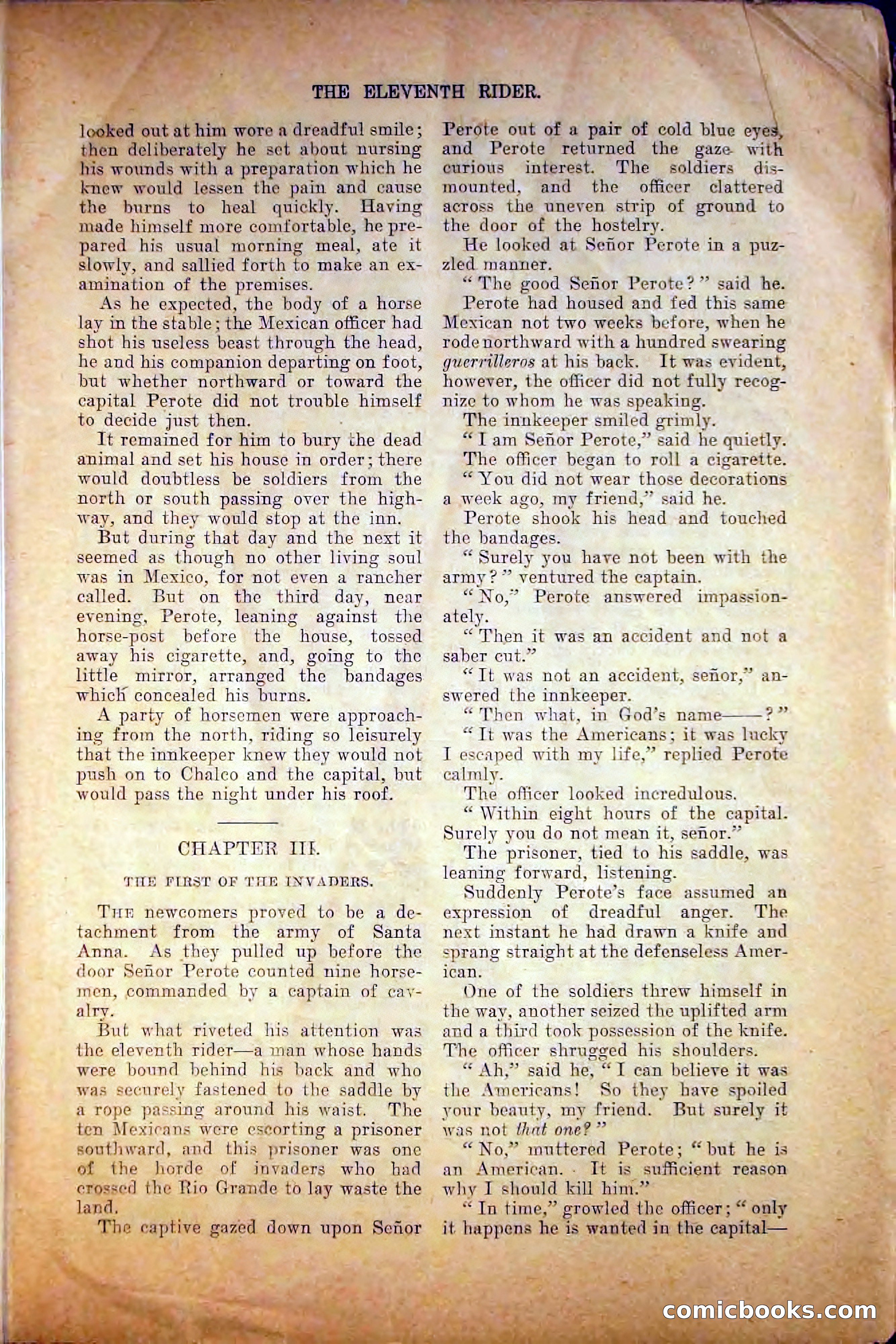
A restored page from Pulp Fiction, 1905. Page through the whole issue in the reader above.
📄 Transcribed text from this page (OCR, searchable)
Machine-transcribed from the original scan — historical spelling and the odd misread are preserved.
lees U wit aration srhich he would lessen ri pain and cause the burns to heal ately. Having made himself more comfortable, he pre- pared his usual morning meal, ate it slowly, and sallied forth to make an ex- amination of the premises. As he expected, the body of a horse lay in the stable; the Mexican officer had shot his useless beast through the head, he and his companion departing on foot, but whether northward or toward the eapital Perote did not trouble himself to decide just then. It remained for him to bury the dead animal and set his house in order; there would doubtless be soldiers from the north or south passing over the high- way, and they would stop at the inn. But during that day and the next it seemed as though no other living soul was in Mexico, for not even a rancher called. But on the third day, near evening, Perote, leaning against the horse-post before the house, tossed away his cigarette, and, going to the little mirror, arranged the bandages which concealed his burns. A party of horsemen were approach- ing from the north, riding so leisurely that the innkeeper knew they would not push on to Chalco and the capital, but would pass the night under his roof. CHAPTER ITf. THE FIRST OF THE INVADERS. Tim newcomers proved to be a de- tachment from the army of Santa Anna. <As they pulled up before the door Senor Perote counted nine horse- men, commanded by a captain of cay- alry. But what riveted his attention was the eleventh rider—a man whose hands were bound behind his back and who was securely fastened to the saddle by a rope passing around his waist. The ten Mexicans were es¢orting a prisoner southward, and this prisoner was one of the horde of invaders who had crossed the Rio Grande to lay waste the land, _ ‘The peere gazed down upon Senor it Ma Ga he is seat a I 1 RID aK. ae erdte out of at Perote returned the gaze with curious interest. The soldiers dis- mounted, and the officer clattered across the uneven strip of ground to the door of the hostelry. He looked at Sefior Perote in a puz- zled. manner. “The good Seiior Perote?” said he. Perote had housed and fed this same Mexican not two weeks before, when he rode northward with a hundred swearing guerrilleros at his back, It was evident, however, the officer did not fully recog- nize to whom he was speaking. The innkeeper smiled grimly. *“T am Senor Perote,” said he quietly. The officer began to roll a cigarette. “You did not wear those decorations a week ago, my friend,” said he. Perote shook his head and touched the bandages. * Surely you have not been with the army?” ventured the captain. “No,” Perote answered impassion- ately. “Then it was an accident and not a saber cut.” “Tt was not an accident, senor,” swered the innkeeper. “Then what, in God’s name——?” “Tt was the Americans; it was lucky I escaped with my life,” replied Perote calmly. The officer looked incredulous. “ Within eight hours of the capital. Surely you do not mean it, senor.” The prisoner, tied to his saddle, was leaning forward, listening. Suddenly Perote’s face assumed an expression of dreadful anger. The next instant he had drawn a knife and sprang straight at the defenseless Amer- ican. One of the soldiers threw himself in the way, another seized the uplifted arm and a third took possession of the knife. The officer shrugged his shoulders. * Ah,” said he, “I can believe it was the Americans! So they have spoiled your beauty, my friend. But surely it was not that one? ” * No,” muttered Perote; “but he is an American. - It is sufficient reason why I should kill him.” “Tn time,” growled ee officer; 4 oar an- ; =< 2 + , {ee a pair of cold blue ¢ oye , ae += aS ie * ll m A « we oe oe Poe Colncbeckscom