
Pulp Fiction, 1905 · page 186 of 224
The Argosy, August 1905 — page 186: what you’re looking at
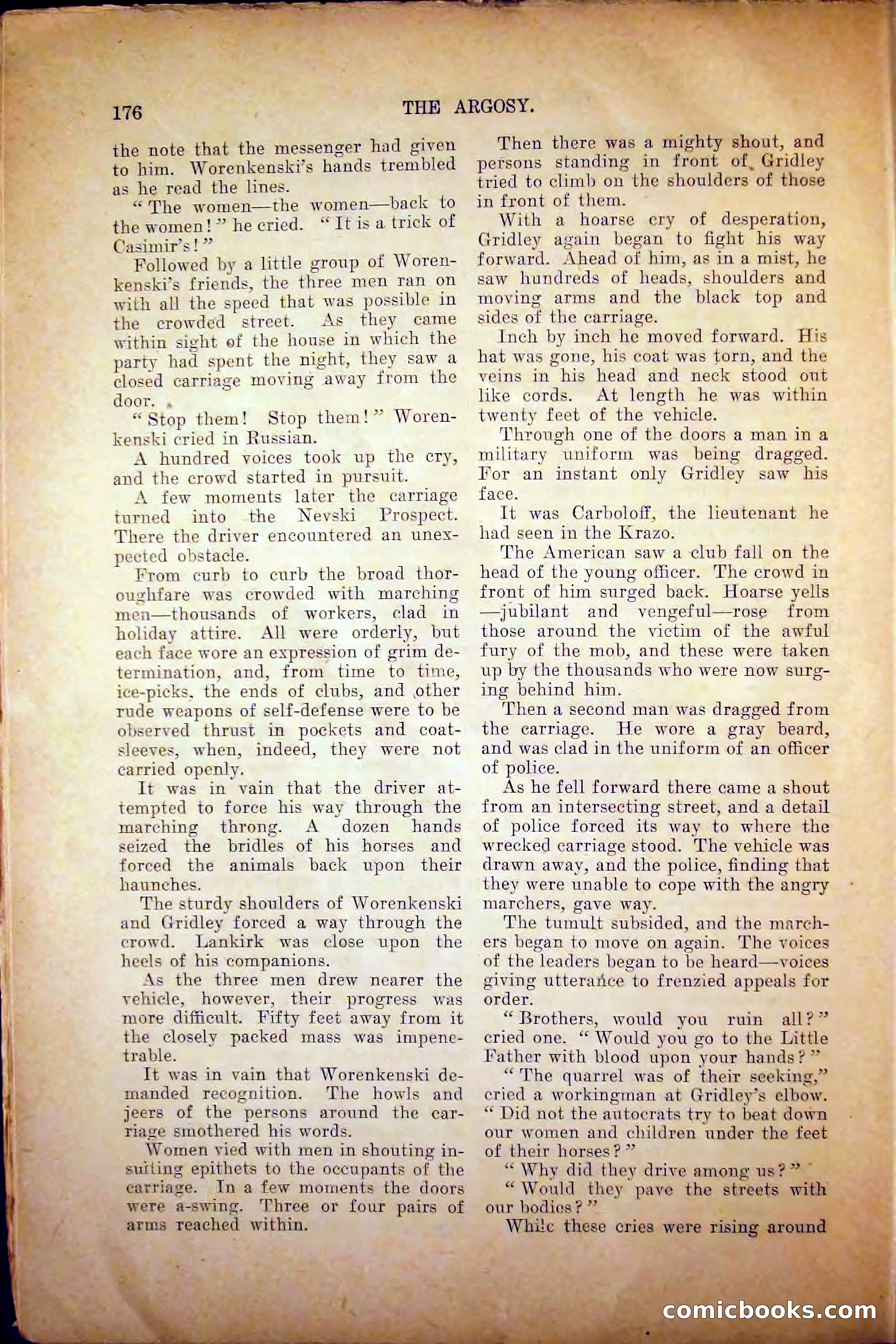
A restored page from Pulp Fiction, 1905. Page through the whole issue in the reader above.
📄 Transcribed text from this page (OCR, searchable)
Machine-transcribed from the original scan — historical spelling and the odd misread are preserved.
176 | the note that the messenger had given to him. Worenkenski’s hands trembled as he read the lines. “The women—the women—back to the women!” he cried. “It is a trick of Casimir’s!” Followed by a little group of Woren- kenski’s friends, the three men Tan on wilh all the speed that was possible in the crowded street. As they came within sight ef the house in which the party had spent the night, they saw a closed carriage moving away from the door. , “Stop them! Stop them!” Woren- kenski cried in Russian. A hundred yoices took up the cry, and the crowd started in pursuit. A few moments later the carriage turned into the Nevski_ Prospect. There the driver encountered an unex- peeted obstacle. From curb to curb the broad thor- ouzhfare was crowded with marching men—thousands of workers, clad in holiday attire. All were orderly, but each face wore an expression of grim de- termination, and, from time to time, ice-picks, the ends of clubs, and other rude weapons of self-defense were to be observed thrust in pockets and coat- sleeves, when, indeed, they were not carried openly. It was in vain that the driver at- tempted to force his way through the marching throng. A dozen hands seized the bridles of his horses and forced the animals back upon their haunches. The sturdy shoulders of Worenkenski and Gridley forced a way through the erowd. lLankirk was close upon the heels of his companions. As the three men drew nearer the yehicle, however, their progress was more difficult. Witty feet away from it the closely packed mass was impene- trable. It was in vain that Worenkenski de- manded recognition. The howls and jeers of the persons around the ear- Tiagze smothered his words. Women vied with men in shouting in- suiting epithets to the occupants of the carriage. In a few moments the doors re a-swing. Three or four pairs of THE ARGOSY. Then there was a mighty shout, and petsons standing in front of, Gridley tried to climb on the shoulders of those in front of them. With a hoarse cry of desperation, Gridley again began to fight his way forward. Ahead of him, as in a mist, he saw hundreds of heads, shoulders and moying arms and the black top and sides of the carriage. Inch by inch he moved forward. His hat was gone, his coat was torn, and the veins in his head and neck stood out like cords. At length he was within twenty feet of the vehicle. Through one of the doors a man in a military uniform was being dragged. For an instant only Gridley saw his face. It was Carboloff, the Heutenant he had seen in the Krazo. The American saw a club fall on the head of the young officer. The crowd in front of him surged back. Hoarse yells —jubilant and vengeful—rose from those around the victim of the awful fury of the mob, and these were taken up by the thousands who were now surg- ing behind him. Then a second man was dragged from the carriage. He wore a gray beard, and was clad in the uniform of an officer of police. As he fell forward there came a shout from an intersecting street, and a detail of police forced its way to where the wrecked carriage stood. The vehicle was drawn away, and the police, finding that they were unable to cope with the angry marchers, gave way. The tumult subsided, and the march- ers began to move on again. The voices of the leaders began to be heard—voices giving utterance to frenzied appeals for order. “ Brothers, would you ruin all?” cried one. “ Would you go to the Little Father with blood upon your hands?” “The quarrel was of their seeking,” cried a workingman at Gridley’s elbow. “ Did not the autocrats try to beat down our women and children under the feet of their horses? ” “ Why did they drive among us?” “Would they pave the j our bodies?” we ‘ = + we 4 Re comicbooks.com