
Pulp Fiction, 1905 · page 183 of 224
The Argosy, August 1905 — page 183: what you’re looking at
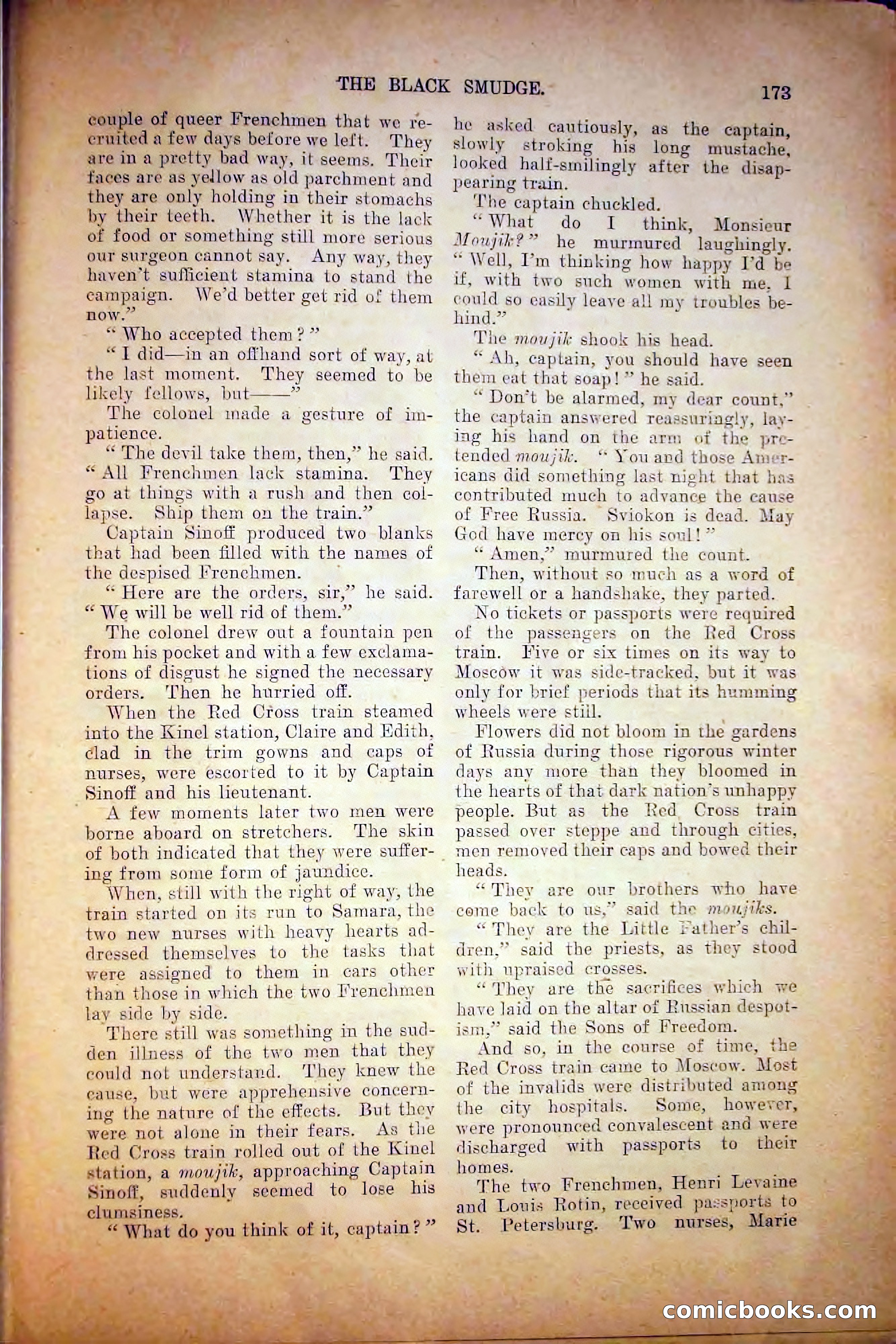
A restored page from Pulp Fiction, 1905. Page through the whole issue in the reader above.
📄 Transcribed text from this page (OCR, searchable)
Machine-transcribed from the original scan — historical spelling and the odd misread are preserved.
¥ Frenchmen that we re- s before we left. They , it seems. Their faces are as yellow as old parchment and they are only holding in their stomachs y their teeth. Whether it is the lack of food or something still more serious our surgeon cannot say. Any way, they haven't sufficient stamina to stand the campaign. We'd better get rid of them now.” * Who accepted them ? ” “I did—in an offhand sort of way, at the last moment. They seemed to be likely fellows, but———” The colonel inade a gesture of im- patience. “ The devil take them, then,” he said. “All Frenehmen lack stamina. They go at things with a rush and then col- lapse. Ship them on the train.” Captain Sinoff produced two blanks that had been filled with the names of the despised Frenchmen. “ Here are the orders, sir,” he said. * We will be well rid of them.” 7 The colonel drew out a fountain pen from his pocket and with a few exclama- tions of disgust he signed the necessary orders. ‘Then he hurried off. When the Red Cross train steamed into the Kinel station, Claire and Edith, clad in the trim gowns and caps of nurses, were escorted to it by Captain Sinoff and his lieutenant. ' A few moments later two men were borne aboard on stretchers. The skin of both indicated that they were suffer- _ ing from some form of jaundice. When, still with the right of way, the train started on its run to Samara, the two new nurses with heavy hearts ad- dressed themselves to the tasks that were assigned to them in cars other than those in which the two I’'renchmen lay side by side. There still was something in the sud- den illness of the two men that they could not understand. ‘They knew the cause, but were apprehensive concern- ing the nature of the effects. But they were not alone in their fears. As the Red Cross train rolled out of the Kinel station, a moujik, approaching Captain Sinoff, suddenly seemed to lose his -elvmsiness. S; “i What do you think of it, captain? ” “aS r a, ee 4 et Lon al a = | = pe a ee ?* Ly | ‘THE BLACK SMUDGE.- "a hw @ Pa he asked cautiously, as the « slowly stroking his long mustache, — looked hali-smilingly after the disap- pearing train. The captain chuckled. “What do I _ think, Monsieur Moujik?” he murmured laughingly. * Well, I'm thinking how happy I'd be if, with two such women with me. I could so easily leave all my troubles be- hind.” The moujik shook his head. “ Ah, captain, you should have seen them eat that soap!” he said. “ Don’t be alarmed, my dear count,” the captain answered reaasurinagly, lay- ing his hand on the arm of the pre- ” tended moujik. ‘ You and those Amer- , icans did something last night that has * contributed much to advance the cause ‘ of Free Russia. Sviokon is dead. May 7 God have mercy on his sonl!” “ Amen,” murmured the count. Then, without so much as a word of farewell or a handshake, they parted. No tickets or passports were required of the passengers on the Red Cross train. JT ive or six times on its way to Moscow it was side-tracked, but it was only for brief periods that its humming wheels were stiil. . Flowers did not bloom in the gardens ; of Russia during those rigorous winter days any more than they bloomed in the hearts of that dark nation’s unhappy people. But as the Red Cross train passed over steppe and through Cities, : men remoyed their caps and bowed their * heads. “They are our brothers who have come back to us,” said the moujiks. “They are the Little Fathers chil- dren,” said the priests, as they stood with upraised crosses. “hey are the sacrifices which we have laid on the altar of Russian despot- ism,” said the Sons of Freedom. And so, in the course of time, the Red Cross train came to Moscow. Most of the invalids were distributed among the city hospitals. Some, however, were pronounced convalescent and Were discharged with passports to their “=m homes. The two Frenchmen, Henri Levaine = and Louis Rotin, received passports to St. Petersburg. Two nurses, 1 2 cy a - = . ee -_— Of a .; ne C4 vail comicbooks.com —— *