
Pulp Fiction, 1905 · page 174 of 224
The Argosy, August 1905 — page 174: what you’re looking at
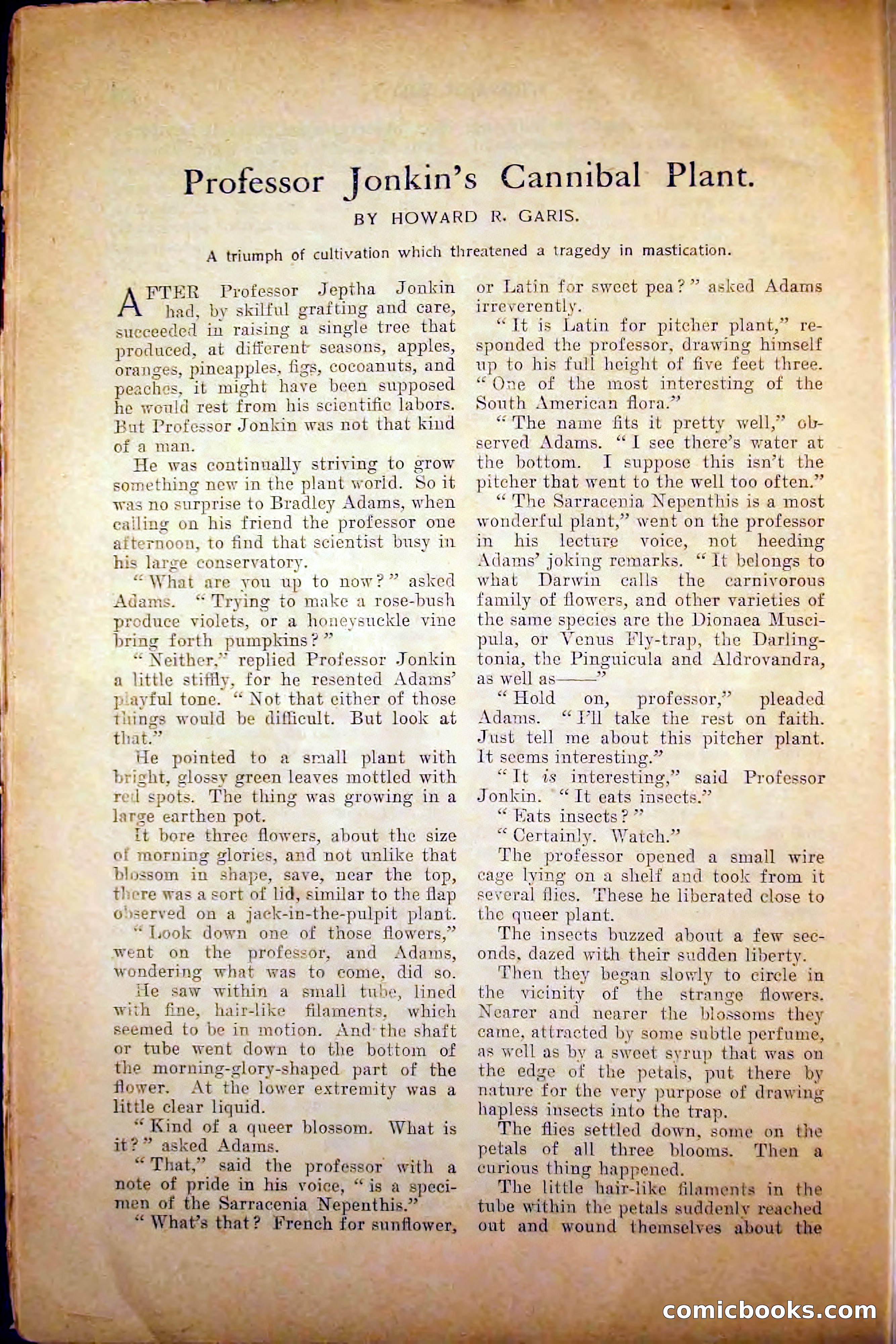
A restored page from Pulp Fiction, 1905. Page through the whole issue in the reader above.
📄 Transcribed text from this page (OCR, searchable)
Machine-transcribed from the original scan — historical spelling and the odd misread are preserved.
“ee Professor Jonkin’s Cannibal Plant. BY HOWARD R. GARIS. A triumph of cultivation which threatened a tragedy in mastication. FTER Professor Jeptha Jonkin had, by skilful grafting and care, sueceeded in raising a single tree that produced, at different seasons, apples, oranges, pineapples, figs, cocoanuts, and peaches, it might have been supposed he would rest from his scientific labors. But Professor Jonkin was not that kind of a man. He was continually striving to grow something new in the plant world. So it was no surprise to Bradley Adams, when calling on his friend the professor one afternoon, to find that scientist busy in his large conservatory. “What are you up to now?” asked Adams. “ Trying to make a rose-bush produce violets, or a honeysuckle vine bring forth pumpkins?” “ Neither,” replied Professor Jonkin a little stiffly, for he resented Adams’ playful tone. “ Not that either of those things would be difficult. But look at that.” He pointed to a small plant with bright, glossy green leaves mottled with rel spots. The thing was growing in a large earthen pot. it bere three flowers, about the size of morning glories, and not unlike that blossom in shape, save, near the top, there was a sort of lid, similar to the flap observed on a jack-in-the-pulpit plant. “Look down one of those flowers,” went on the professor, and Adams, wondering what was to come, did so. tle saw within a small tube, lined with fine, hair-like filaments. which seemed to be in motion. And the shaft or tube went down to the bottom of the morning-glory-shaped part of the flower. At the lower extremity was a little clear liquid. “Kind of a queer blossom. What is “That,” said the professor with a te of n his voice, “ is e epecie or Latin for sweet pea?” asked Adams irreverently. “It is Latin for pitcher plant,” re- sponded the professor, drawing himself up to his full height of five feet three. “One of the most interesting of the South American flora.” “The name fits it pretty well,” ob- served Adams. “I see there’s water at the bottom. I suppose this isn’t the pitcher that went to the well too often.” “The Sarracenia Nepenthis is a most wonderful plant,” went on the professor in his lecture voice, not heeding Adams’ joking remarks. “It belongs to what Darwin calls the carnivorous family of flowers, and other varieties of the same species are the Dionaea Musci- pula, or Venus Fly-trap, the Darling- tonia, the Pinguicula and Aldrovandra, as well as “Hold on, professor,” pleaded Adams. “Tl take the rest on faith. Just tell me about this pitcher plant. 1t seems interesting.” “Tt is interesting,” said Professor Jonkin. “It eats insects.” “Kats insects?” “ Certainly. Watch.” The professor opened a small wire cage lying on a shelf and took from it several flies. These he liberated close to the queer plant. The insects buzzed about a few sec- onds, dazed with their sudden liberty. Then they began slowly to cirele in the vicinity of the strange flowers. Nearer and nearer the blossoms they came, attracted by some subtle perfume, as well as by a sweet syrup that was on the edge of the petals, put there by nature for the very purpose of drawing hapless insects into the trap. The flies settled down, some on the petals of all three blooms. Then a curious thing happened. So gs ale - Say comicbooks.com —