
Pulp Fiction, 1905 · page 147 of 224
The Argosy, August 1905 — page 147: what you’re looking at
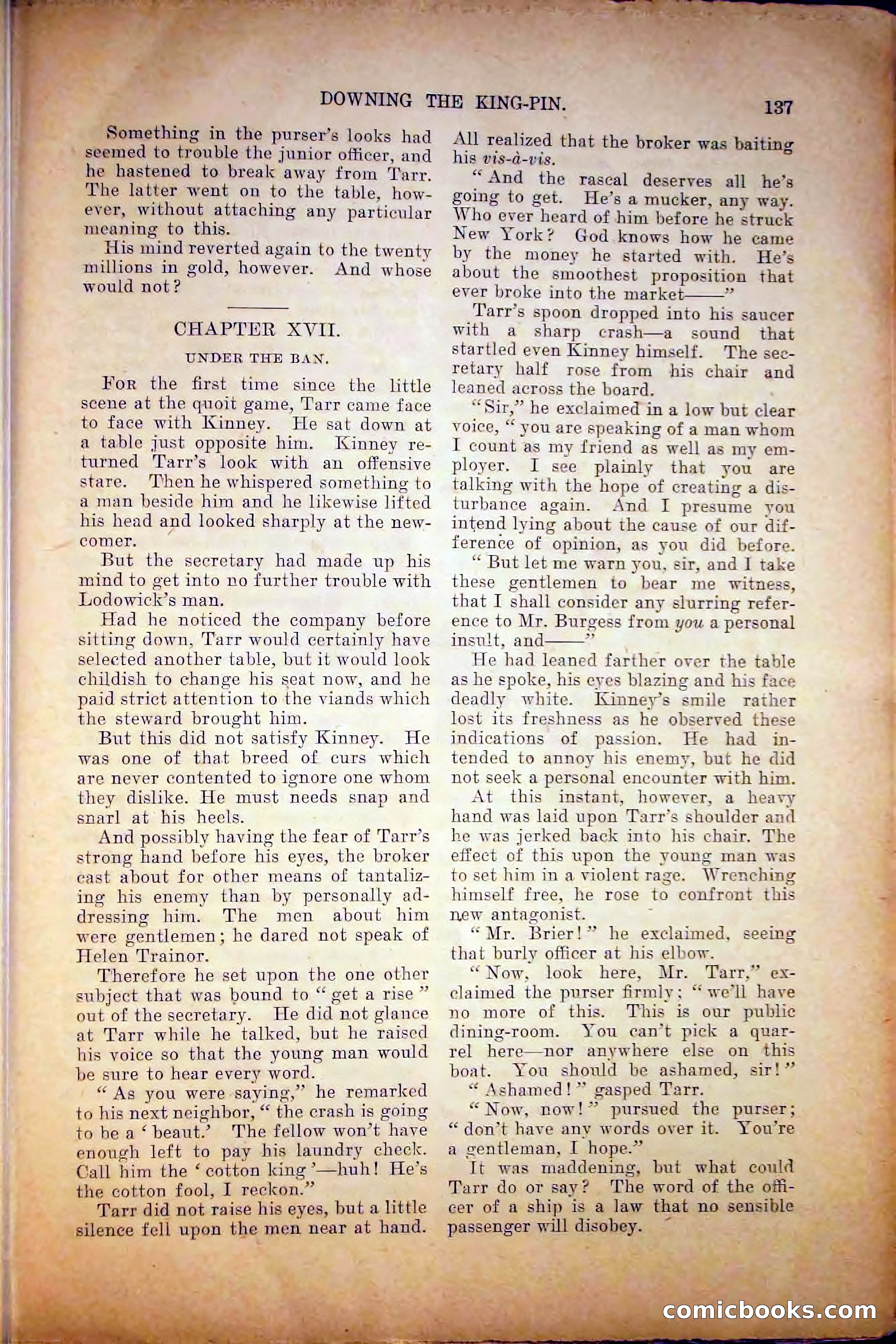
A restored page from Pulp Fiction, 1905. Page through the whole issue in the reader above.
📄 Transcribed text from this page (OCR, searchable)
Machine-transcribed from the original scan — historical spelling and the odd misread are preserved.
EE oo —— | DOWNING THE KING-PIN. 137 > iil thing in the purser’s looks had » seemed to trouble the junior officer, and he hastened to break away from Tarr. The latter went on to the table, how- ever, without attaching any particular meaning to this. His mind reverted again to the twenty millions in gold, however. And whose would not? CHAPTER XVII. UNDER THE BAN. For the first time since the little seene at the quoit game, Tarr came face to face with Kinney. He sat down at a table just opposite him. Kinney re- turned Tarr’s look with an offensive stare. Then he whispered something to a man beside him and he likewise lifted his head and looked sharply at the new- comer. — But the secretary had made up his mind to get into no further trouble with Lodowick’s man. Had he noticed the company before sitting down, Tarr would certainly have selected another table, but it would look childish to change his seat now, and he paid strict attention to the viands which the steward brought him. But this did not satisfy Kinney. He was one of that breed of curs which are never contented to ignore one whom they dislike. He must needs snap and snarl at his heels. And possibly having the fear of Tarr’s strong hand before his eyes, the broker east about for other means of tantaliz- ing his enemy than by personally ad- dressing him. The men about him were gentlemen; he dared not speak of Helen Trainor. Therefore he set upon the one other subject that was bound to “ get a rise ” out of the secretary. He did not glance at Tarr while he talked, but he raised his voice so that the young man would be sure to hear every word. “ As you were saying,” he remarked to his next neighbor, “ the crash is going to be a ‘ beaut.’ The fellow won’t have enough left to pay his laundry check. Call him the ‘ cotton king ’—huh! He’s the cotton fool, I reckon.” Tarr did not raise his eyes, but a little silence fell wpon the men near at hand. All realized that the broker was baiting his vis-a-vis. “And the rascal deserves all he’s going to get. He’s a mucker, any way. Who ever heard of him before he struck New York? God knows how he came by the money he started with. He’s about the smoothest proposition that ever broke into the market——” Tarr’s spoon dropped into his saucer with a sharp crash—a sound that startled even Kinney himself. The sec- retary half rose from his chair and leaned across the board. “Sir,” he exclaimed in a low but clear voice, “ you are speaking of a man whom I count as my friend as well as my em- ployer. I see plainly that you are talking with the hope of creating a dis- turbance again. And I presume you intend lying about the cause of our dif- ference of opinion, as you did before. ‘ But let me warn you, sir, and I take these gentlemen to bear me witness, that I shall consider any slurring refer- ence to Mr. Burgess from you a personal insult, and + He had leaned farther over the table as he spoke, his eyes blazing and his face deadly white. Kinney’s smile rather lost its freshness as he observed these indications of passion. He had in- tended to annoy his enemy, but he did not seek a personal encounter with him. At this instant, however, a heavy hand was laid upon Tarr’s shoulder and he was jerked back into his chair. The effect of this upon the young man was to set him in a violent rage. Wrenching himself free, he rose to confront this new antagonist. . “Mr. Brier!” he exclaimed, seeing that burly officer at his elbow. “Now, look here, Mr. Tarr,” ex- claimed the purser firmly; “we'll have no more of this. This is our publie dining-room. You can’t pick a quar- rel here—nor anywhere else on this boat. You should be ashamed, sir!” “ Ashamed!” gasped Tarr. “Now, now!” pursued the purser; “ don’t have any words over it. You're a gentleman, I hope.” It was maddening, but what could Tarr do or say? The word of the offi- cer of a ship is a law that no sensible =t passenger will disobey, © — or a ie i er comicbooks.com