
Pulp Fiction, 1905 · page 121 of 224
The Argosy, August 1905 — page 121: what you’re looking at
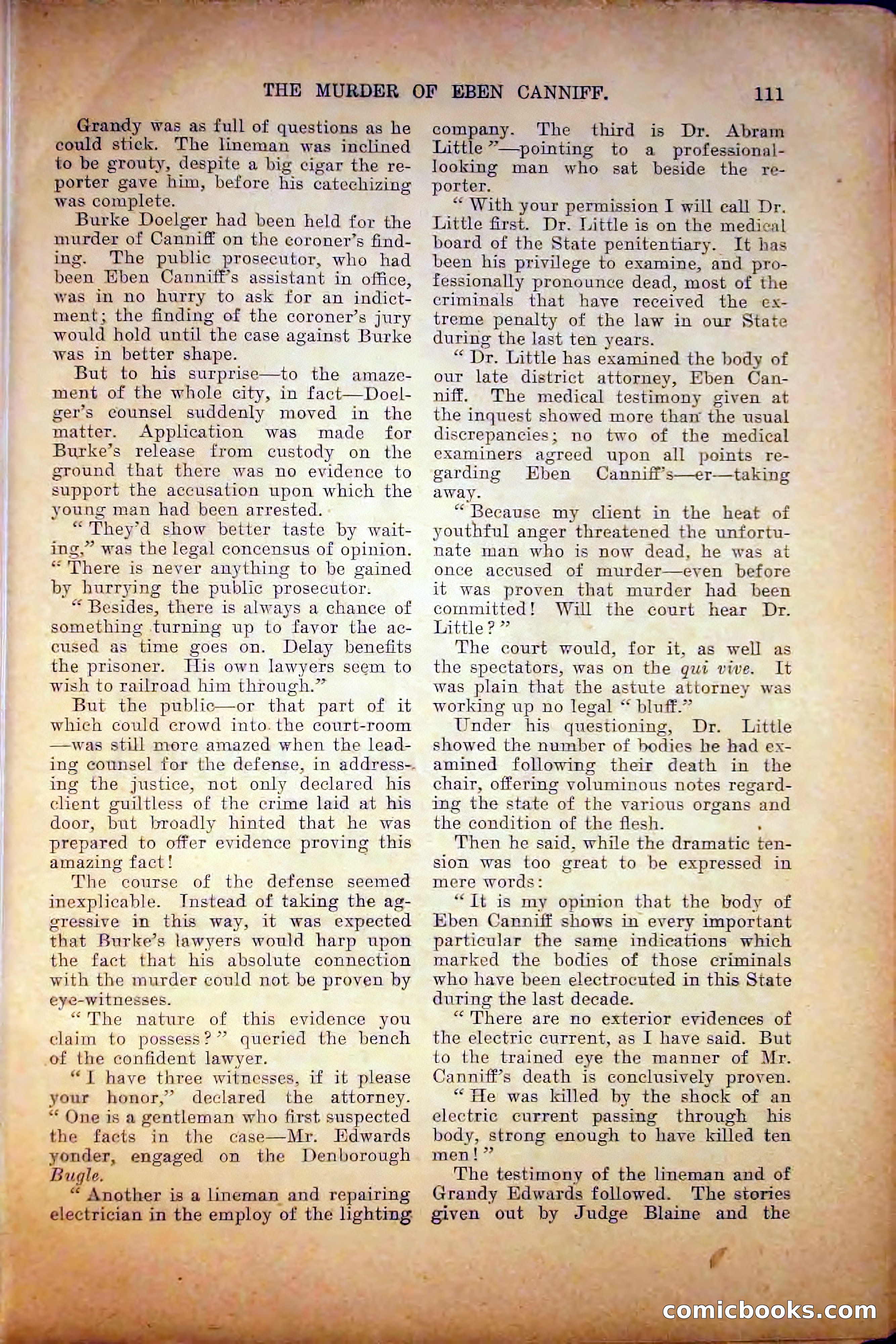
A restored page from Pulp Fiction, 1905. Page through the whole issue in the reader above.
📄 Transcribed text from this page (OCR, searchable)
Machine-transcribed from the original scan — historical spelling and the odd misread are preserved.
was as full of questions as he : stick. The lineman was inclined Yo be grouty, despite a big cigar the re- porter gave him, before his catechizing was complete. Burke Doelger had been held for the murder of Canniff on the coroner’s find- ing. The public proseeutor, who had been Eben Canniff’s assistant in office, was in no hurry to ask for an indict- ment; the finding of the coroner’s jury would hold until the case against Burke was in better shape. But to his surprise—to the amaze- ment of the whole city, in fact—Doel- gers counsel suddenly moved in the matter. Application was made for Burke’s release from custody on the ground that there was no evidence to support the accusation upon which the young man had been arrested. “They'd show better taste by wait- ing,” was the legal concensus of opinion. “There is never anything to be gained by hurrying the public prosecutor. *“ Besides, there is always a chance of something turning up to favor the ac- cused as time goes on. Delay benefits the prisoner. His own lawyers seem to wish to railroad him through.” But the public—or that part of it which could crowd into. the court-room —was still more amazed when the lead- ing counsel for the defense, in address— ing the justice, not only declared his client guiltless of the crime laid at his door, but broadly hinted that he was prepared to offer evidence proving this amazing fact! The course of the defense seemed inexplicable. Instead of taking the ag- eressive in this way, it was expected that Burke’s lawyers would harp upon the fact that his absolute connection with the murder could not be proven by eye-witnesses. “The nature of this evidence you claim to possess?” queried the bench of the confident lawyer. “| have three witnesses, if it please your honor,’ declared the attorney. “ One is a gentleman who first suspected the facets in the case—Mr. Hdwards yonder, engaged on the Denborough Bugle. Another is a lineman and repairing trician in the employ of the lighting a # : y fi . + % fe ’ oe. ‘ 4 ™ b > > baa 3 . 7 x: * ) ae . Se ee a iY x . . YA KI . p ‘a 2 5 - i fates t " e iad coe: The third is Dr. Abram Little ”—pointing to a _professional- looking man who sat beside the re- porter. “With your permission I will eall Dr. Little first. Dr. Little is on the medical board of the State penitentiary. It has been his privilege to examine, and pro- fessionally pronounce dead, most of the criminals that have received the ex- treme penalty of the law in our State during the last ten years. “ Dr. Little has examined the body of our late district attorney, Eben Can- niff. The medical testimony given at the inquest showed more than the usual discrepancies; no two of the medical examiners agreed upon all points re- garding Eben Canniff’s—er—taking away. “Because my client in the heat of youthful anger threatened the unfortu- nate man who is now dead, he was at once accused of murder—eyen before it was proven that murder had been committed! Will the court hear Dr. Little? ” The court would, for it, as well as the spectators, was on the gut vive. It was plain that the astute attorney was working up no legal “ bluff.” Under his questioning, Dr. Little showed the number of bodies he had ex- amined following their death in the chair, offering voluminous notes regard- ing the state of the various organs and the condition of the flesh. : Then he said. while the dramatic ten- sion was too great to be expressed in mere words: “It is my opinion that the body of Eben Canniff shows in every important particular the same indications which marked the bodies of those criminals who have heen electrocuted in this State during the last decade. “There are no exterior evidences of the electric current, as I have said. But to the trained eye the manner of Mr. Canniff’s death is conclusively proven. “ He was killed by the shock of an electric current passing through his body, strong enough to have killed ten men!” The testimony of the lineman and of Grandy Edwards followed. The stories given out by Judge Blaine and the a