
Pulp Fiction, 1905 · page 119 of 224
The Argosy, August 1905 — page 119: what you’re looking at
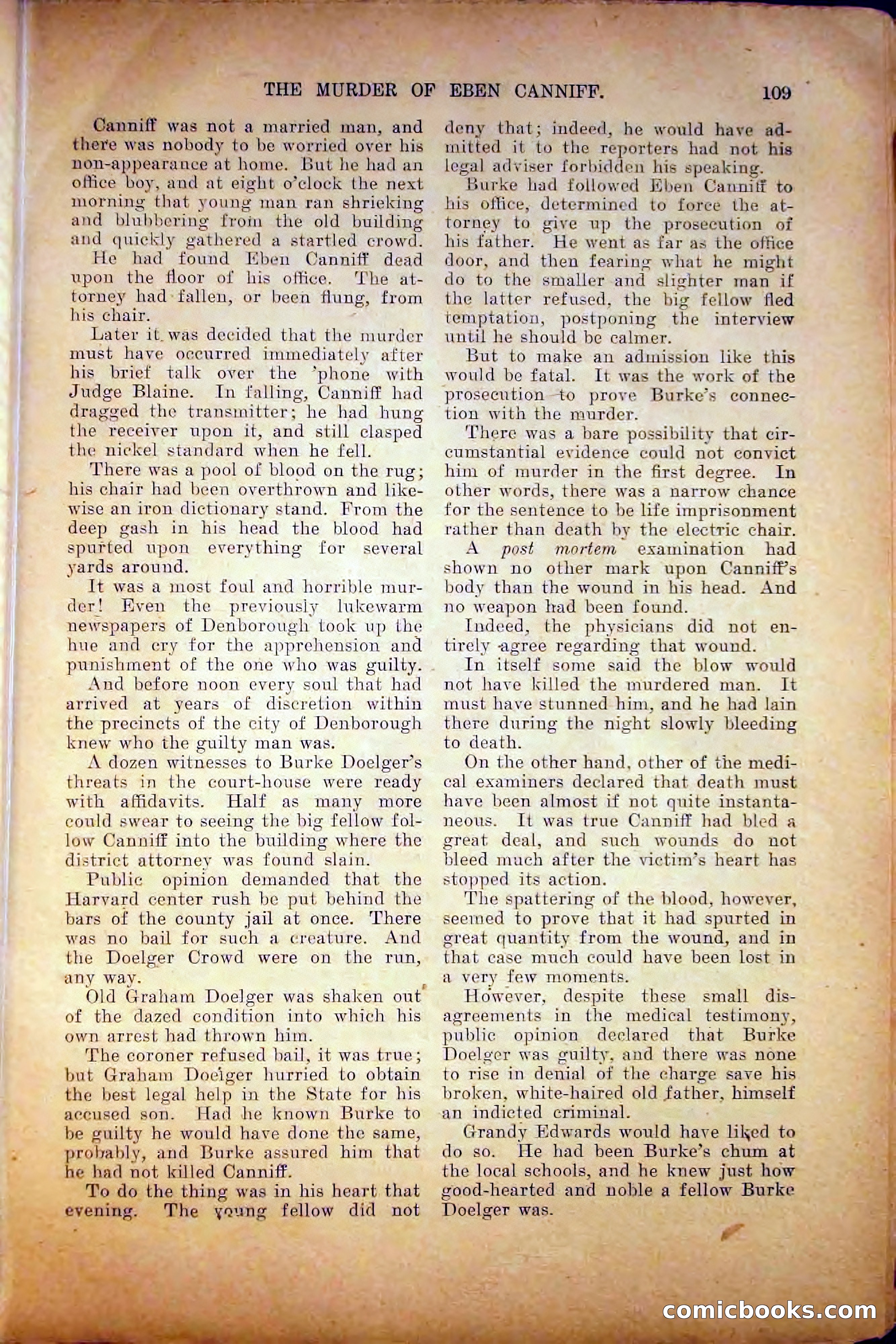
A restored page from Pulp Fiction, 1905. Page through the whole issue in the reader above.
📄 Transcribed text from this page (OCR, searchable)
Machine-transcribed from the original scan — historical spelling and the odd misread are preserved.
_ Canniff was not a married man, and there was nobody to be worried oyer his non-appearance at home. But he had an office boy, and at eight o’clock the next morning that young man ran shrieking and blubbering froin the old building and quickly gathered a startled crowd. He had found Eben Canniff dead upon the floor of his office. The at- torney had-fallen, or been flung, from his chair. Later it. was decided that the murder must have oceurred immediately after his brief talk over the *phone with Judge Blaine. In falling, Canniff had dragged the transmitter; he had hung the receiver upon it, and still clasped the nickel standard when he fell. There was a pool of blood on the rug; his chair had been overthrown and like- wise an iron dictionary stand. From the deep gash in his head the blood had spurted upon everything for several yards around. It was a most foul and horrible mur- der! Even the previousiy lukewarm newspapers of Denborough took up the hue and ery for the apprehension and punishment of the one who was guilty. And before noon every soul that had arrived at years of discretion within the precinets of the city of Denborough knew who the guilty man was. A dozen witnesses to Burke Doelger’s threats in the court-house were ready with affidavits. Half as many more could swear to seeing the big fellow fol- low Canniff into the building where the district attorney was found slain. Public opinion demanded that the Harvard center rush be put behind the bars of the county jail at once. There was no bail for such a creature. And the Doelger Crowd were on the run, any way. 3 Old Graham Doelger was shaken out of the dazed condition into which his own arrest had thrown him. The coroner refused hail, it was true; but Graham Doeiger hurried to obtain the best legal help in the State for his accused son. Had he known Burke to be guilty he would have done the same, probably, and Burke assured him that he had not killed Canniff. To do the thing was in his heart that at al g i * ia. ’ - See : \ , . , we YC SRE a. "4 “ ae Gy NIN i. ee 7 4 -*| = Ne J ~- a deny that; indeed, he would have ad- mitted it to the reporters had not his legal adviser forbidden his speaking. Burke had followed Eben Cannitf to his office, determined to foree the at- torney to give up the prosecution of his father. He went as far as the office door, and then fearing what he might do to the smaller and slighter man if the latter refused, the big fellow fled temptation, postponing the interview until he should be calmer. But to make an admission like this would be fatal. It was the work of the prosecution to prove Burke’s connec- tion with the murder. here was a bare possibility that eir- cumstantial evidence could not convict him of murder in the first degree. In other words, there was a narrow chance for the sentence to be life imprisonment rather than death by the electric chair. A post mortem examination had shown no other mark upon Canniif’s body than the wound in his head. And no weapon had been found. Indeed, the physicians did not en- tirely agree regarding that wound. In itself some said the blow would not have killed the murdered man. It must have stunned him, and he had lain there during the night slowly bleeding to death. On the other hand, other of the medi- cal examiners declared that death must have been almost if not quite instanta- neous. It was true Canniff had bled a great deal, and such wounds do not bleed much after the victim’s heart has stopped its action. The spattering of the blood, however, seeined to prove that it had spurted in great quantity from the wound, and in that case much could have been lost in a very few moments. However, despite these small dis- agreements in the medical testimony, public opinion declared that Burke Doelger was guilty, and there was none to rise in denial of the charge save his broken, white-haired old father, himself an indicted criminal. Grandy Edwards would have liked to do so. He had been Burke’s chum at the local schools, and he knew just how good-hearted and noble a fellow Burke ‘ es ee — ——— a 7 PY ee Doelger was. ! ib evening. The young fellow did not > ered er y" ' : Cems . —— q *