
Pulp Fiction, 1905 · page 11 of 224
The Argosy, August 1905 — page 11: what you’re looking at
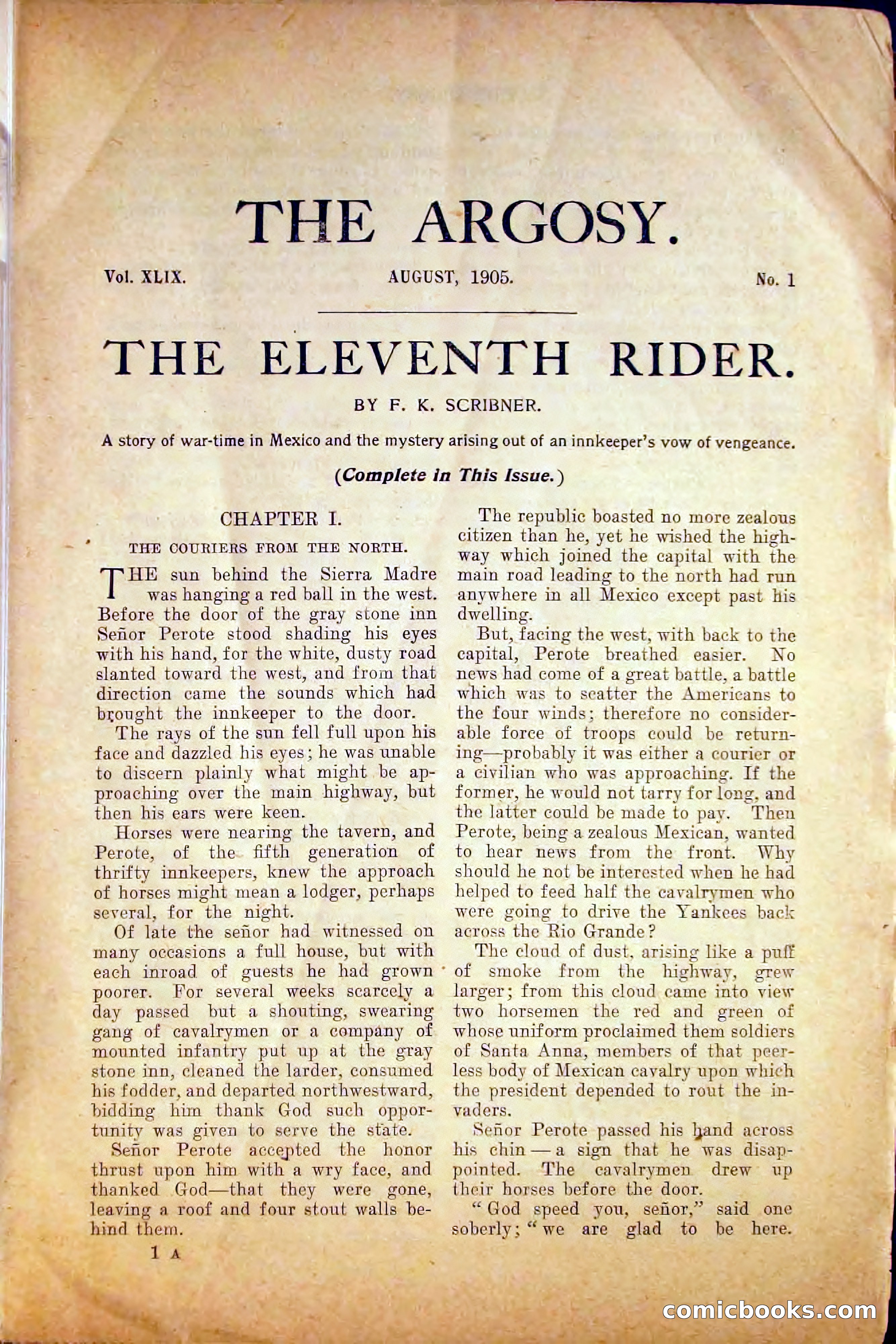
A restored page from Pulp Fiction, 1905. Page through the whole issue in the reader above.
📄 Transcribed text from this page (OCR, searchable)
Machine-transcribed from the original scan — historical spelling and the odd misread are preserved.
THE ARGOSY. AUGUST, 1905. No. 1 Vol. XLIX. THE ELEVENTH RIDER. BY F. K. SCRIBNER. A story of war-time in Mexico and the mystery arising out of an innkeeper’s vow of vengeance. (Complete in This Issue. ) CHAPTER I. THE COURIERS FROM THE NORTH. HE sun behind the Sierra Madre was hanging a red ball in the west. Before the door of the gray stone inn Senor Perote stood shading his eyes with his hand, for the white, dusty road slanted toward the west, and from that direction came the sounds which had brought the innkeeper to the door. The rays of the sun fell full upon his face and dazzled his eyes; he was unable to discern plainly what might be ap- proaching over the main highway, but then his ears were keen. Horses were nearing the tavern, and Perote, of the fifth generation of thrifty innkeepers, knew the approach of horses might mean a lodger, perhaps several, for the night. Of late the senor had witnessed on many occasions a full house, but with each inroad of guests he had grown poorer. For several weeks scarcely a day passed but a shouting, swearing gang of cavalrymen or a company of mounted infantry put up at the gray stone inn, cleaned the larder, consumed his fodder, and departed northwestward, bidding him thank God such oppor- tunity was given to serve the state. Senor Perote accepted the honor thrust upon him with a wry face, and thanked God—that they were gone, leaving a roof and four stout walls be- hind them. *of smoke from The republic boasted no more zealous citizen than he, yet he wished the high- way which joined the capital with the main road leading to the north had run anywhere in all Mexico except past His dwelling. But, facing the west, with back to the capital, Perote breathed easier. No news had come of a great battle, a battle which was to seatter the Americans to the four winds; therefore no consider- able force of troops could be return- ing—probably it was either a courier or a civilian who was approaching. If the former, he would not tarry for long, and the latter could be made to pay. Then Perote, being a zealous Mexican, wanted to hear news from the front. Why should he not be interested when he had helped to feed half the cavalrymen who were going to drive the Yankees back across the Rio Grande ? The cloud of dust, arising like a puff the highway, grew larger; from this cloud came into view two horsemen the red and green of whose uniform proclaimed them soldiers of Santa Anna, members of that peer- less body of Mexican cayalry upon which the president depended to rout the in- vaders. Senor Perote passed his hand across his chin—a sign that he was disap- pointed. The cavalrymen drew up their horses before the door. “God speed you, senor,” said one soberly; “we are glad to he here.