
Pulp Fiction, 1919 · page 60 of 196
Argosy and Railroad Man's Magazine, Vol. 107 No. 3 — page 60: what you’re looking at
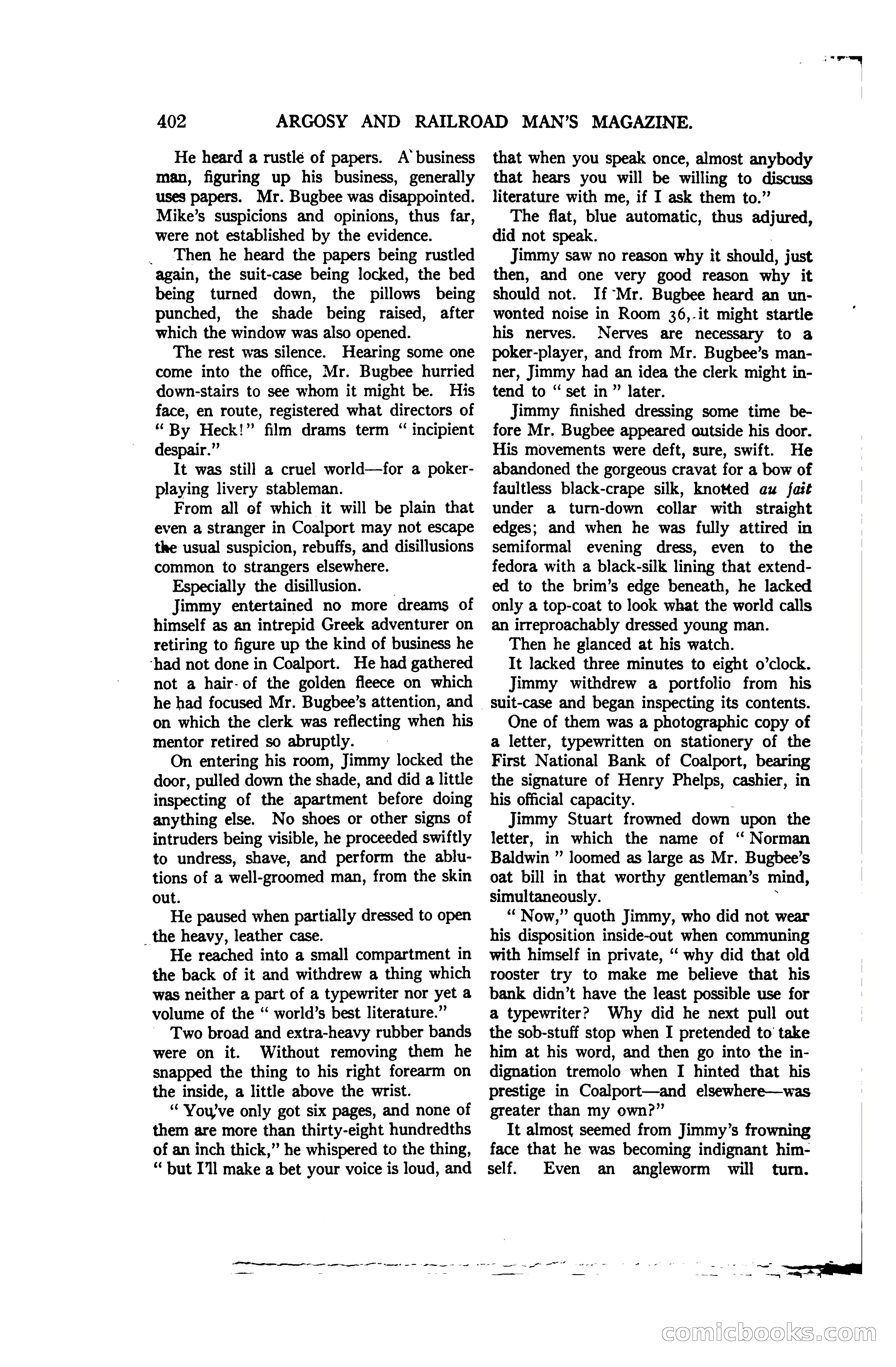
A restored page from Pulp Fiction, 1919. Page through the whole issue in the reader above.
📄 Transcribed text from this page (OCR, searchable)
Machine-transcribed from the original scan — historical spelling and the odd misread are preserved.
402 He heard a rustle of papers. A’ business man, figuring up his business, generally uses papers. Mr. Bugbee was disappointed. Mike’s suspicions and opinions, thus far, were not established by the evidence. _ Then he heard the papers being rustled again, the suit-case being locked, the bed being turned down, the pillows being punched, the shade being raised, after which the window was also opened. The rest was silence. Hearing some one come into the office, Mr. Bugbee hurried down-stairs to see whom it might be. His face, en route, registered what directors of “ By Heck!” film drams term “ incipient despair.” It was still a cruel world—for a poker- playing livery stableman. From all of which it will be plain that even a stranger in Coalport may not escape the usual suspicion, rebuffs, and disillusions common to strangers elsewhere. Especially the disillusion. Jimmy entertained no more dreams of himself as an intrepid Greek adventurer on retiring to figure up the kind of business he ‘had not done in Coalport. He had gathered not a hair- of the golden fleece on which he had focused Mr. Bugbee’s attention, and _ on which the clerk was reflecting when his mentor retired so abruptly. On entering his room, Jimmy locked the door, pulled down the shade, and did a little inspecting of the apartment before doing anything else. No shoes or other signs of intruders being visible, he proceeded swiftly to undress, shave, and perform the ablu- tions of a well-groomed man, from the skin out. He paused when partially dressed to open _the heavy, leather case. He reached into a small compartment in the back of it and withdrew a thing which was neither a part of a typewriter nor yet a volume of the ‘“ world’s best literature.” - Two broad and extra-heavy rubber bands were on it. Without removing them he snapped the thing to his right forearm on the inside, a little above the wrist. “ You've only got six pages, and none of them are more than thirty-eight hundredths of an inch thick,” he whispered to the thing, “ but I'll make a bet your voice is loud, and ARGOSY AND RAILROAD MAN’S MAGAZINE. that when you speak once, almost anybody that hears you will be willing to discuss literature with me, if I ask them to.” The flat, blue automatic, thus adjured, did not speak. Jimmy saw no reason why it should, just then, and one very good reason why it should not. If-Mr. Bugbee heard an un- wonted noise in Room 36,-it might startle his nerves. Nerves are necessary to a poker-player, and from Mr. Bugbee’s man- ner, Jimmy had an idea the clerk might in- tend to ‘set in”? later. Jimmy finished dressing some time be- fore Mr. Bugbee appeared outside his door. His movements were deft, sure, swift. He abandoned the gorgeous cravat for a bow of faultless black-crape silk, knotted au faté under a turn-down collar with straight edges; and when he was fully attired in semiformal evening dress, even to the fedora with a black-silk lining that extend- ed to the brim’s edge beneath, he lacked only a top-coat to look what the world calls an irreproachably dressed young man. Then he glanced at his watch. It lacked three minutes to eight o’clock. Jimmy withdrew a portfolio from his Suit-case and began inspecting its contents. One of them was a photographic copy of a letter, typewritten on stationery of the First National Bank of Coalport, bearing the signature of Henry Phelps, cashier, in his official capacity. Jimmy Stuart frowned down. upon the letter, in which the name of ‘“ Norman Baldwin ”” loomed as large as Mr. Bugbee’s oat bill in that worthy gentleman’s mind, simultaneously. ‘“* Now,” quoth Jimmy, who did not wear his disposition inside-out when communing with himself in private, ‘‘ why did that old rooster try to make me believe that his bank didn’t have the least possible use for a typewriter? Why did he next pull out the sob-stuff stop when I pretended to take him at his word, and then go into the in- dignation tremolo when I hinted that his prestige in Coalport—and elsewhere—was greater than my own?” It almost seemed from Jimmy’s frowning face that he was becoming indignant him- self. Even an angleworm will turn. — oa — eee eee CELDOO© = O) S (C(O) Co mM