
Pulp Fiction, 1919 · page 29 of 196
Argosy and Railroad Man's Magazine, Vol. 107 No. 3 — page 29: what you’re looking at
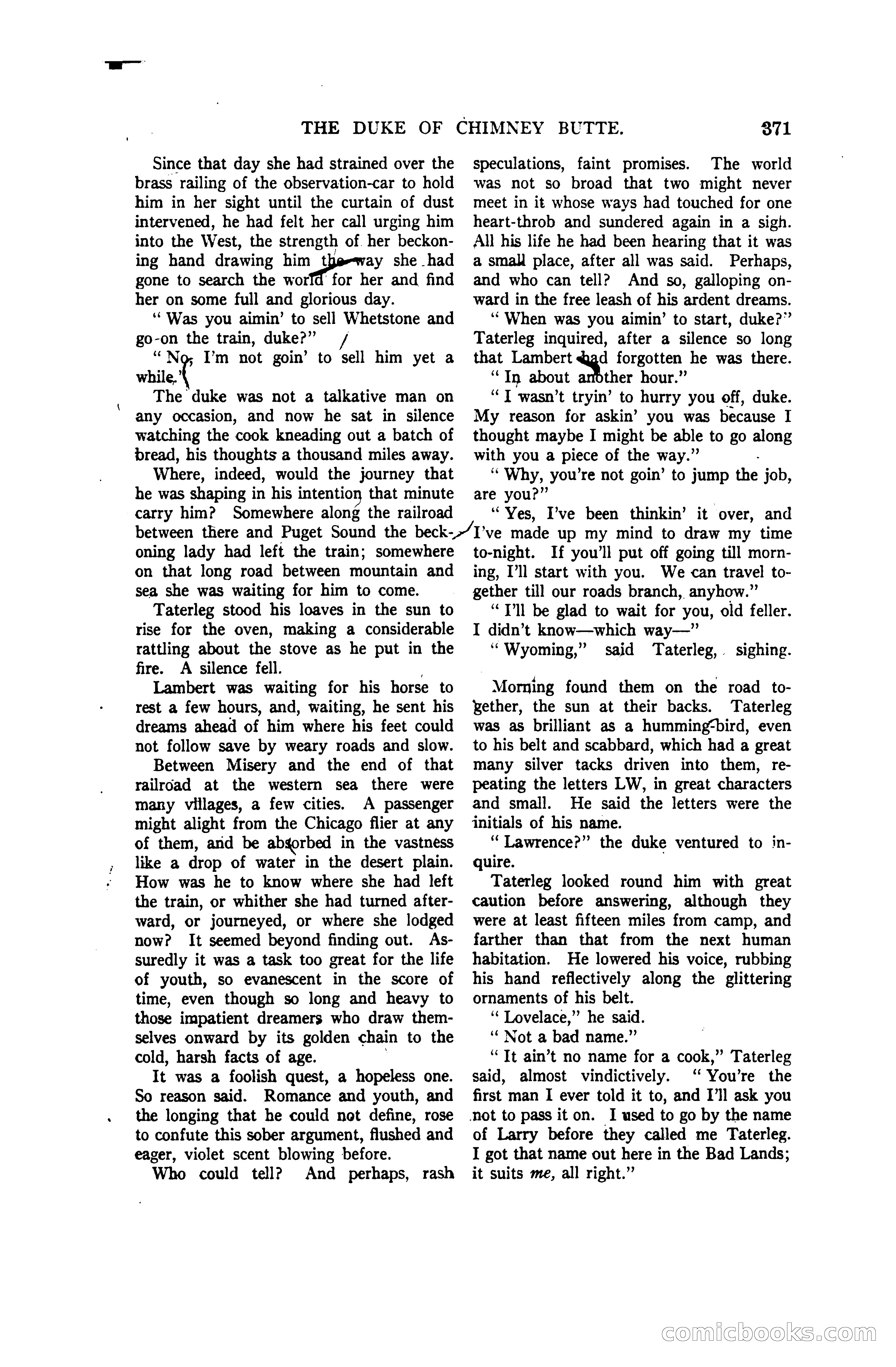
A restored page from Pulp Fiction, 1919. Page through the whole issue in the reader above.
📄 Transcribed text from this page (OCR, searchable)
Machine-transcribed from the original scan — historical spelling and the odd misread are preserved.
THE DUKE OF CHIMNEY BUTTE. Since that day she had strained over the brass railing of the observation-car to hold him in her sight until the curtain of dust intervened, he had felt her call urging him into the West, the strength of. her beckon- ing hand drawing him t ay she_had gone to search the worfd for her and find her on some full and glorious day. ‘Was you aimin’ to sell Whetstone and go-on the train, duke?”’ ‘““No; I’m not goin’ to sell him yet a while.’ The duke was not a talkative man on any occasion, and now he sat in silence watching the cook kneading out a batch of bread, his thoughts a thousand miles away. Where, indeed, would the journey that he was shaping in his intention that minute carry him? Somewhere along the railroad pyel speculations, faint promises. The world was not so broad that two might never meet in it whose ways had touched for one heart-throb and sundered again in a sigh. All his life he had been hearing that it was a smal place, after all was said. Perhaps, and who can tell? And so, galloping on- ward in the free leash of his ardent dreams. ‘When was you aimin’ to start, duke?” Taterleg inquired, after a silence so long that Lambert &gd forgotten he was there. “In about andther hour.” ‘I wasn’t tryin’ to hurry you off, duke. My reason for askin’ you was because I thought maybe I might be able to go along with you a piece of the way. < ‘Why, you’re not goin’ to jump the job, are you?” “Yes, I’ve been thinkin’ it over, and between there and Puget Sound the beck -»/T’ve made up my mind to draw my time oning lady had left the train; somewhere on that long road between mountain and sea she was waiting for him to come. Taterleg stood his loaves in the sun to rise for the oven, making a considerable rattling about the stove as he put in the fire. A silence fell. Lambert was waiting for his horse to rest a few hours, and, waiting, he sent his dreams ahead of him where his feet could not follow save by weary roads and slow. Between Misery and the end of that railroad at the western sea there were many villages, a few cities. A passenger might alight from the Chicago flier at any of them, and be absorbed in the vastness like a drop of water in the desert plain. How was he to know where she had left the train, or whither she had turned after- ward, or journeyed, or where she lodged now? It seemed beyond finding out. As- suredly it was a task too great for the life of youth, so evanescent in the score of time, even though so long and heavy to those impatient dreamers who draw them- selves onward by its golden chain to the cold, harsh facts of age. It was a foolish quest, a hopeless one. So reason said. Romance and youth, and the longing that he could not define, rose to confute this sober argument, flushed and eager, violet scent blowing before. Who could tell? And perhaps, rash to-night. If you'll put off going till morn- ing, I'll start with you. We can travel to- gether till our roads branch, anyhow.” “Tl be glad to wait for you, old feller. I didn’t know—which way—”’ “Wyoming,” said Taterleg, sighing. Morning found them on the road to- gether, the sun at their backs. Taterleg was as brilliant as a hummingbird, even to his belt and scabbard, which had a great many silver tacks driven into them, re- peating the letters LW, in great characters and small. He said the letters were the initials of his name. ‘‘ Lawrence?” the duke ventured to in- quire. Taterleg looked round him with great caution before answering, although they were at least fifteen miles from camp, and farther than that from the next human habitation. He lowered his voice, rubbing his hand reflectively along the glittering ornaments of his belt. “Lovelace,” he said. ‘Not a bad name.” ‘Tt ain’t no name for a cook,” Taterleg said, almost vindictively. ‘“ You’re the first man I ever told it to, and I'll ask you not to pass it on. I used to go by the name of Larry before they called me Taterleg. I got that name out here in the Bad Lands; it suits me, all right.” NOO Co S Co mM