
Pulp Fiction, 1919 · page 168 of 196
Argosy and Railroad Man's Magazine, Vol. 107 No. 3 — page 168: what you’re looking at
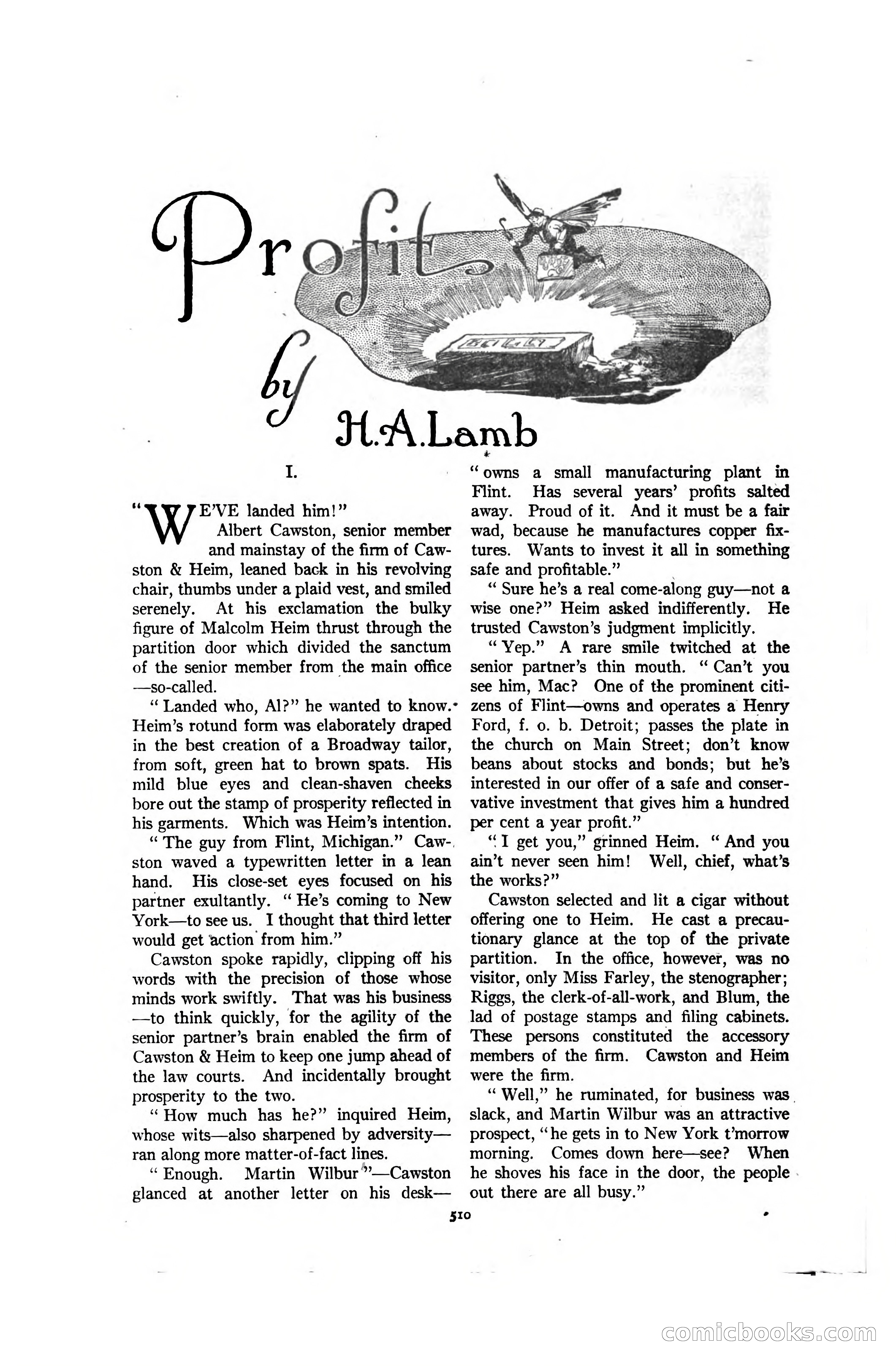
A restored page from Pulp Fiction, 1919. Page through the whole issue in the reader above.
📄 Transcribed text from this page (OCR, searchable)
Machine-transcribed from the original scan — historical spelling and the odd misread are preserved.
i y E’VE landed him!” Albert Cawston, senior member and mainstay of the firm of Caw- ston & Heim, leaned back in his revolving chair, thumbs under a plaid vest, and smiled serenely. At his exclamation the bulky figure of Malcolm Heim thrust through the partition door which divided the sanctum of the senior member from the main office —so-called. ‘Landed who, Al?” he wanted to know.- Heim’s rotund form was elaborately draped in the best creation of a Broadway tailor, from soft, green hat to brown spats. His mild blue eyes and clean-shaven cheeks bore out the stamp of prosperity reflected in his garments. Which was Heim’s intention. “The guy from Flint, Michigan.” Caw-. ston waved a typewritten letter in a lean hand. His close-set eyes focused on his partner exultantly. ‘“ He’s coming to New York—to see us. I thought that third letter would get action from him.” Cawston spoke rapidly, clipping off his words with the precision of those whose minds work swiftly. That was his business —to think quickly, for the agility of the senior partner’s brain enabled the firm of Cawston & Heim to keep one jump ahead of the law courts. And incidentally brought prosperity to the two. “How much has he?” inquired Heim, whose wits—also sharpened by adversity— ran along more matter-of-fact lines. “Enough. Martin Wilbur”—Cawston glanced at another letter on his desk— “owns a small manufacturing plant in Flint. Has several years’ profits salted away. Proud of it. And it must be a fair wad, because he manufactures copper fix- tures. Wants to invest it all in something safe and profitable.” “ Sure he’s a real come-along guy—not a wise one?” Heim asked indifferently. He trusted Cawston’s judgment implicitly. “Yep.” A rare smile twitched at the senior partner’s thin mouth. “ Can’t you see him, Mac? One of the prominent citi- zens of Flint—owns and operates a Henry Ford, f. o. b. Detroit; passes the plate in the church on Main Street; don’t know beans about stocks and bonds; but he’s interested in our offer of a safe and conser- vative investment that gives him a hundred per cent a year profit.” “I get you,” grinned Heim. “ And you ain’t never seen him! Well, chief, what’s the works?” Cawston selected and lit a cigar without offering one to Heim. He cast a precau- tionary glance at the top of the private partition. In the office, however, was no visitor, only Miss Farley, the stenographer; Riggs, the clerk-of-all-work, and Blum, the lad of postage stamps and filing cabinets. These persons constituted the accessory members of the firm. Cawston and Heim were the firm. ‘““ Well,” he ruminated, for business was. slack, and Martin Wilbur was an attractive prospect, ‘“‘he gets in to New York t’morrow morning. Comes down here—see? When he shoves his face in the door, the people out there are all busy.” 510 ° LAOO S (C(O) in