
Pulp Fiction, 1919 · page 148 of 196
Argosy and Railroad Man's Magazine, Vol. 107 No. 3 — page 148: what you’re looking at
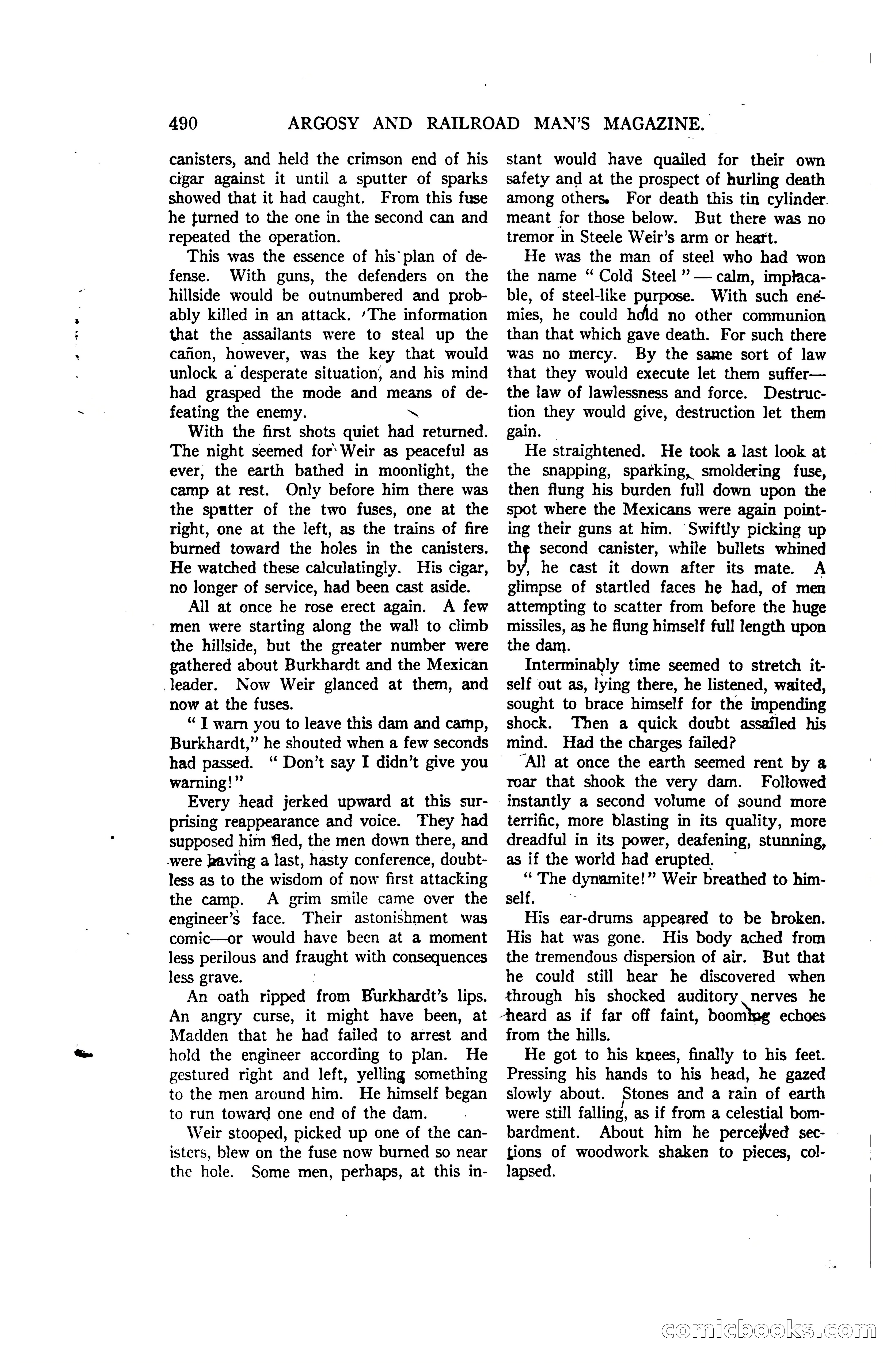
A restored page from Pulp Fiction, 1919. Page through the whole issue in the reader above.
📄 Transcribed text from this page (OCR, searchable)
Machine-transcribed from the original scan — historical spelling and the odd misread are preserved.
490 canisters, and held the crimson end of his cigar against it until a sputter of sparks showed that it had caught. From this fuse he turned to the one in the second can and repeated the operation. This was the essence of his’ plan of de- fense. With guns, the defenders on the hillside would be outnumbered and prob- ably killed in an attack. ‘The information that the assailants were to steal up the canon, however, was the key that would unlock a desperate situation, and his mind had grasped the mode and means of de- feating the enemy. ~ With the first shots quiet had returned. The night seemed for’ Weir as peaceful as ever, the earth bathed in moonlight, the camp at rest. Only before him there was the spatter of the two fuses, one at the right, one at the left, as the trains of fire burned toward the holes in the canisters. He watched these calculatingly. His cigar, no longer of service, had been cast aside. All at once he rose erect again. A few men were starting along the wall to climb the hillside, but the greater number were gathered about Burkhardt and the Mexican _leader. Now Weir glanced at them, and now at the fuses. “I warn you to leave this dam and camp, Burkhardt,” he shouted when a few seconds had passed. warning!”’ Every head jerked upward at this sur- prising reappearance and voice. They had supposed him fied, the men down there, and were paving a last, hasty conference, doubt- less as to the wisdom of now first attacking the camp. A grim smile came over the engineer’s face. Their astonishment was comic—or would have been at a moment less perilous and fraught with consequences less grave. An oath ripped from Burkhardt’s lips. An angry curse, it might have been, at Madden that he had failed to arrest and hold the engineer according to plan. He gestured right and left, yelling something to the men around him. He himself began to run toward one end of the dam. Weir stooped, picked up one of the can- isters, blew on the fuse now burned so near the hole. Some men, perhaps, at this in- “Don’t say I didn’t give you © -heard as if far off faint, boom ARGOSY AND RAILROAD MAN’S MAGAZINE. stant would have quailed for their own safety and at the prospect of hurling death among others. meant for those below. But there was no tremor in Steele Weir’s arm or heart. He was the man of steel who had won the name “ Cold Steel” — calm, impkaca- ble, of steel-like purpose. With such ene- mies, he could hold no other communion than that which gave death. For such there was no mercy. By the same sort of law that they would execute let them suffer— the law of lawlessness and force. Destruc- tion they would give, destruction let them gain. He straightened. He took a last look at the snapping, sparking, smoldering fuse, then flung his burden full down upon the spot where the Mexicans were again point- ing their guns at him. Swiftly picking up the second canister, while bullets whined by, he cast it down after its mate. A glimpse of startled faces he had, of men attempting to scatter from before the huge missiles, as he flung himself full length upon the dam. Interminably time seemed to stretch it- self out as, lying there, he listened, waited, sought to brace himself for the impending shock. Then a quick doubt assailed his mind. Had the charges failed? “All at once the earth seemed rent by a roar that shook the very dam. Followed instantly a second volume of sound more terrific, more blasting in its quality, more dreadful in its power, deafening, stunning, as if the world had erupted. ~ “The dynamite!” Weir breathed to-him- self. ~ His ear-drums appeared to be broken. His hat was gone. His body ached from the tremendous dispersion of air. But that he could still hear he discovered when through his shocked auditory. nerves he echoes from the hills. He got to his knees, finally to his feet. Pressing his hands to his head, he gazed slowly about. Stones and a rain of earth were still falling, as if from a celestial bom- bardment. tions of woodwork shaken to pieces, col- lapsed. For death this tin cylinder. About him he percejed sec- © COMmiCcoookS.€© mM