
Pulp Fiction, 1919 · page 144 of 196
Argosy and Railroad Man's Magazine, Vol. 107 No. 3 — page 144: what you’re looking at
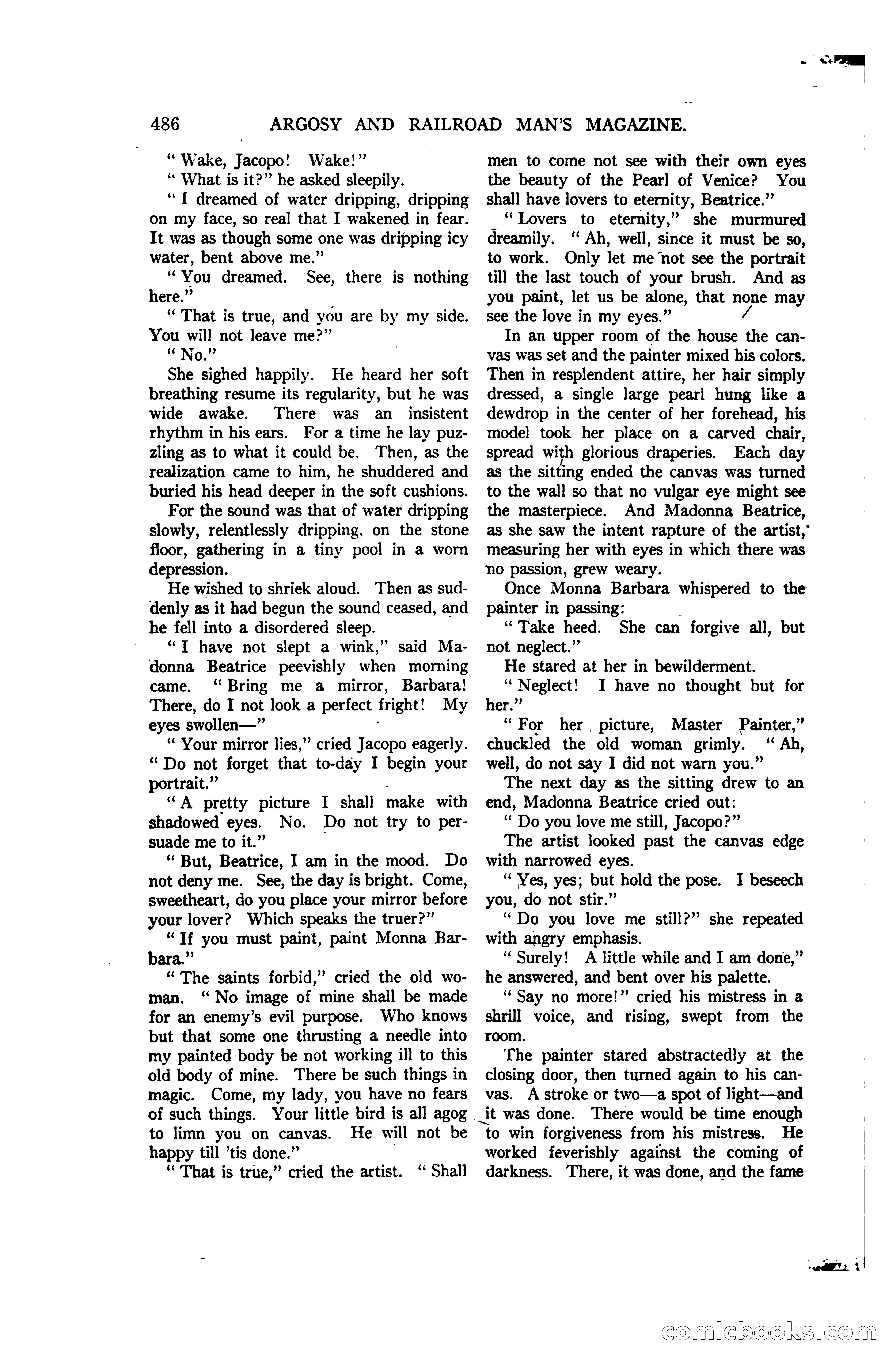
A restored page from Pulp Fiction, 1919. Page through the whole issue in the reader above.
📄 Transcribed text from this page (OCR, searchable)
Machine-transcribed from the original scan — historical spelling and the odd misread are preserved.
486 “ Wake, Facopot Wake!” ‘* What is it?” he asked sleepily. “IT dreamed of water dripping, dripping on my face, so real that I wakened in fear. It was as though some one was dripping icy water, bent above me.” “You dreamed. See, there is nothing here.” “ That is true, and you are by my side. You will not leave me?”’ £9 No.”’ She sighed happily. He heard her soft breathing resume its regularity, but he was wide awake. There was an_ insistent rhythm in his ears. For a time he lay puz- zling as to what it could be. Then, as the realization came to him, he shuddered and buried his head deeper in the soft cushions. For the sound was that of water dripping slowly, relentlessly dripping, on the stone floor, gathering in a tiny pool in a worn depression. He wished to shriek aloud. Then as sud- denly as it had begun the sound ceased, and he fell into a disordered sleep. “TIT have not slept a wink,” said Ma- donna Beatrice peevishly when morning came. ‘“ Bring me a mirror, Barbara! There, do I not look a perfect fright: My eyes swollen—” “ Your mirror lies,” cried Jacopo eagerly. “Do not forget that to-day I begin your portrait.” “A pretty picture I shall make with shadowed eyes. No. Do not try to per- suade me to it.” “ But, Beatrice, I am in the mood. Do not deny me. See, the day is bright. Come, sweetheart, do you place your mirror before your lover? Which speaks the truer?” “Tf you must paint, paint Monna Bar- bara.” “ The saints forbid,” cried the old wo- man. ‘No image of mine shall be made for an enemy’s evil purpose. Who knows but that some one thrusting a needle into my painted body be not working ill to this old body of mine. There be such things in magic. Come, my lady, you have no fears of such things. to limn you on canvas. He will not be happy till ’tis done.” | “‘ That is true,” cried the artist. “Shall Your little bird is all agog _it was done. ARGOSY AND RAILROAD MAN’S MAGAZINE. men to come not see with their own eyes the beauty of the Pearl of Venice? You shall have lovers to eternity, Beatrice.”’ _ “Lovers to eternity,” she murmured dreamily. ‘ Ah, well, since it must be so, to work. Only let me not see the portrait till the last touch of your brush. And as you paint, let us be alone, that none may see the love in my eyes.” f In an upper room of the house the can- vas was set and the painter mixed his colors. Then in resplendent attire, her hair simply dressed, a single large pearl hung like a dewdrop in the center of her forehead, his model took her place on a carved chair, spread with glorious draperies. Each day as the sitting ended the canvas was turned to the wall so that no vulgar eye might see the masterpiece. And Madonna Beatrice, as she saw the intent rapture of the artist," measuring her with eyes in which there was no passion, grew weary. Once Monna Barbara whispered to the painter in passing: “Take heed. She can forgive all, but not neglect.”’ He stared at her in bewilderment. “Neglect! I have no thought but for her.” | “For her , picture, chuckled the old woman grimly. well, do not say I did not warn you.” The next day as the sitting drew to an end, Madonna Beatrice cried out: ‘“* Do you love me still, Jacopo?” The artist looked past the canvas edge with narrowed eyes. “* Yes, yes; but hold the pose. J beseech you, do not stir.” ‘““Do you love me still?” she repeated with angry emphasis. ‘Surely! A little while and I am done,” he answered, and bent over his palette. ‘‘ Say no more!” cried his mistress in a shrill voice, and rising, swept from the room. The painter stared abstractedly at the closing door, then turned again to his can- vas. A stroke or two—a spot of light—and There would be time enough to win forgiveness from his mistress. He worked feverishly against the coming of darkness. There, it was done, and the fame Master Painter,” c Ah, NOO (C(O) S (C(O) mM