
Pulp Fiction, 1919 · page 140 of 196
Argosy and Railroad Man's Magazine, Vol. 107 No. 3 — page 140: what you’re looking at
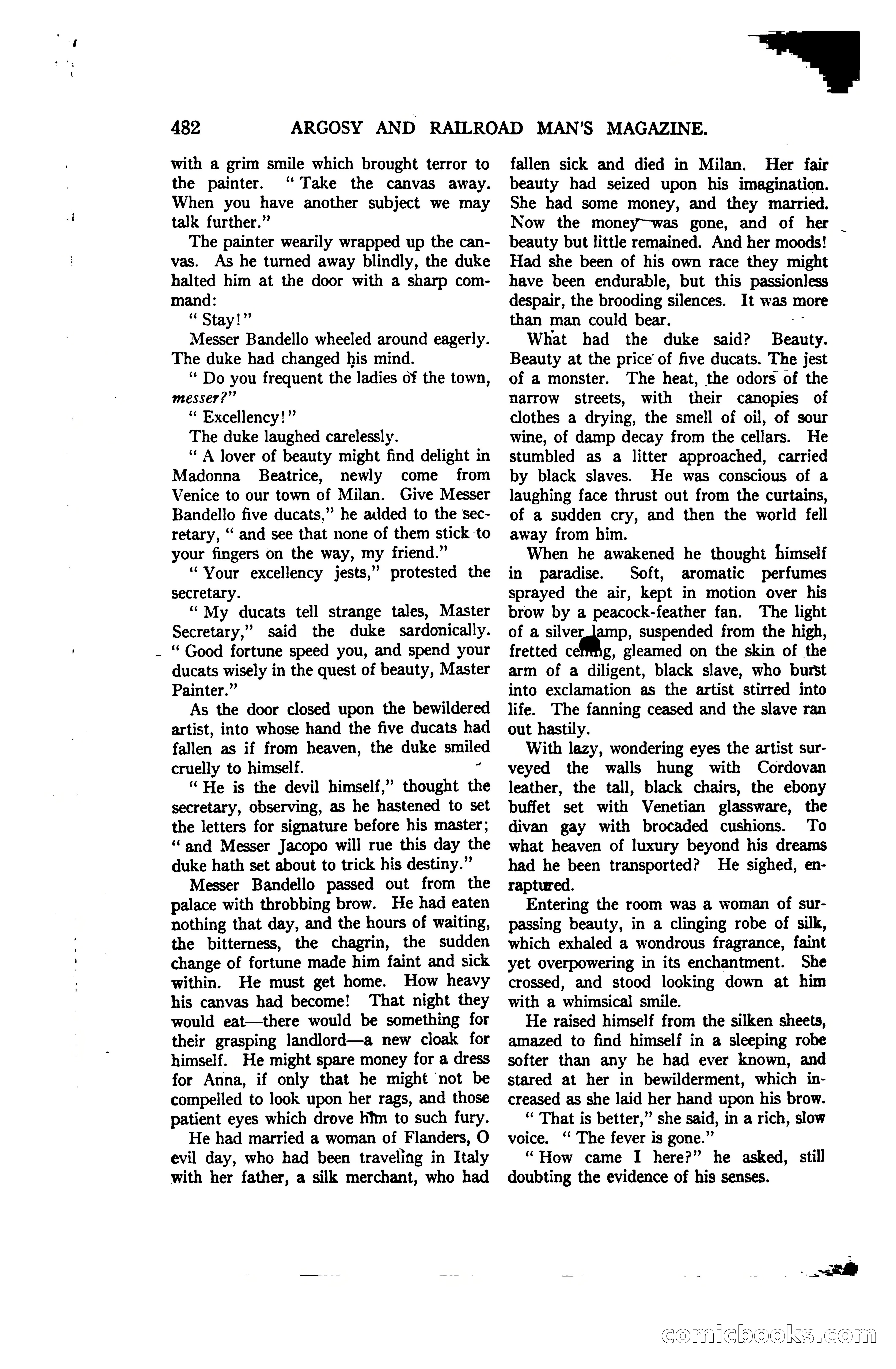
A restored page from Pulp Fiction, 1919. Page through the whole issue in the reader above.
📄 Transcribed text from this page (OCR, searchable)
Machine-transcribed from the original scan — historical spelling and the odd misread are preserved.
482 with a grim smile which brought terror to the painter. ‘‘ Take the canvas away. When you have another subject we may talk further.” The painter wearily wrapped up the can- vas. As he turned away blindly, the duke halted him at the door with a sharp com- mand: ce Stay! ”? Messer Bandello wheeled around eagerly. The duke had changed his mind. ‘Do you frequent the ladies of the town, messer?”’ ‘* Excellency The duke laughed carelessly. ‘A lover of beauty might find delight in Madonna Beatrice, newly come _ from Venice to our town of Milan. Give Messer Bandello five ducats,” he added to the sec- retary, ‘‘ and see that none of them stick to your fingers on the way, my friend.” “Your excellency jests,” protested the secretary. “My ducats tell strange tales, Master Secretary,” said the duke sardonically. ‘Good fortune speed you, and spend your ducats wisely in the quest of beauty, Master Painter.” As the door closed upon the bewildered artist, into whose hand the five ducats had fallen as if from heaven, the duke smiled cruelly to himself. . “He is the devil himself,” thought the secretary, observing, as he hastened to set the letters for signature before his master; ‘and Messer Jacopo will rue this day the duke hath set about to trick his destiny.” Messer Bandello passed out from the palace with throbbing brow. He had eaten nothing that day, and the hours of waiting, the bitterness, the chagrin, the sudden change of fortune made him faint and sick within. He must get home. How heavy his canvas had become! That night they would eat—there would be something for their grasping landlord—a new cloak for himself. He might spare money for a dress for Anna, if only that he might not be compelled to look upon her rags, and those patient eyes which drove him to such fury. He had married a woman of Flanders, O evil day, who had been traveling in Italy with her father, a silk merchant, who had !» ™? ARGOSY AND RAILROAD MAN’S MAGAZINE. fallen sick and died in Milan. Her fair beauty had seized upon his imagination. She had some money, and they married. Now the money—was gone, and of her beauty but little remained. And her moods! Had she been of his own race they might have been endurable, but this passionless despair, the brooding silences. It was more than man could bear. a “What had the duke said? Beauty. Beauty at the price’ of five ducats. The jest of a monster. The heat, the odors of the narrow streets, with their canopies of clothes a drying, the smell of oil, of sour wine, of damp decay from the cellars. He stumbled as a litter approached, carried by black slaves. He was conscious of a laughing face thrust out from the curtains, of a sudden cry, and then the world fell away from him. When he awakened he thought himself in paradise. Soft, aromatic perfumes sprayed the air, kept in motion over his brow by a peacock-feather fan. The light of a silverlamp, suspended from the high, fretted cefymg, gleamed on the skin of the arm of a diligent, black slave, who burst into exclamation as the artist stirred into life. The fanning ceased and the slave ran out hastily. With lazy, wondering eyes the artist sur- veyed the walls hung with Cordovan leather, the tall, black chairs, the ebony buffet set with Venetian glassware, the divan gay with brocaded cushions. To what heaven of luxury beyond his dreams had he been transported? He sighed, en- raptured. Entering the room was a woman of sur- passing beauty, in a clinging robe of silk, which exhaled a wondrous fragrance, faint yet overpowering in its enchantment. She crossed, and stood looking down at him with a whimsical smile. He raised himself from the silken sheets, amazed to find himself in a sleeping robe softer than any he had ever known, and stared at her in bewilderment, which in- creased as she laid her hand upon his brow. “ That is better,” she said, in a rich, slow voice. ‘‘ The fever is gone.” “ How came I here?” he asked, still doubting the evidence of his senses. ~ ElOOOkKS Co (C(O) mM