
Pulp Fiction, 1919 · page 119 of 196
Argosy and Railroad Man's Magazine, Vol. 107 No. 3 — page 119: what you’re looking at
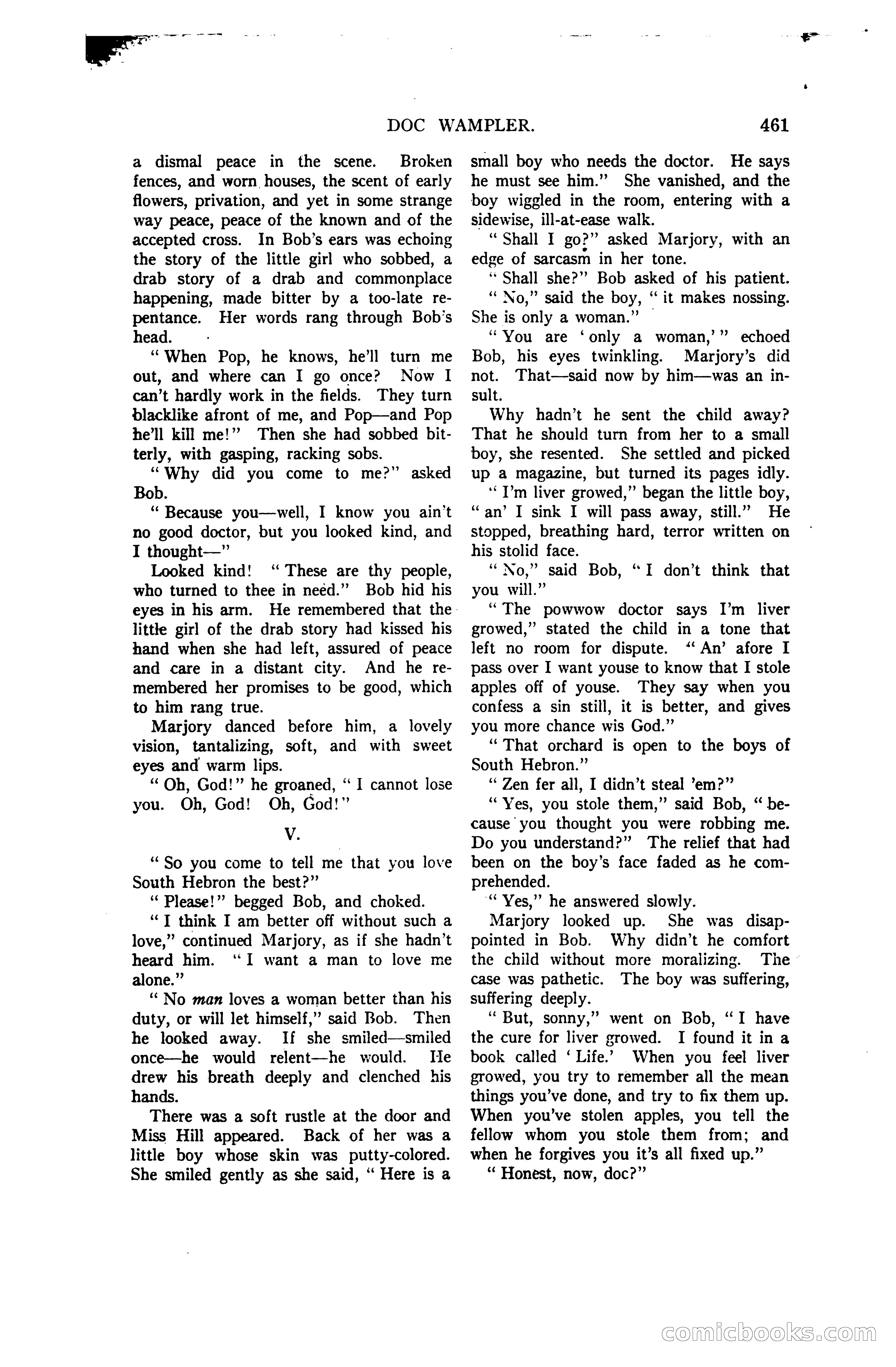
A restored page from Pulp Fiction, 1919. Page through the whole issue in the reader above.
📄 Transcribed text from this page (OCR, searchable)
Machine-transcribed from the original scan — historical spelling and the odd misread are preserved.
DOC WAMPLER. a dismal peace in the scene. Broken fences, and worn houses, the scent of early flowers, privation, and yet in some strange way peace, peace of the known and of the accepted cross. In Bob’s ears was echoing the story of the little girl who sobbed, a drab story of a drab and commonplace happening, made bitter by a too-late re- pentance. Her words rang through Bob’s head. ‘“When Pop, he knows, he’ll turn me out, and where can I go once? Now I can’t hardly work in the fields. They turn blacklike afront of me, and Pop—and Pop he’ll kill me!”” Then she had sobbed bit- terly, with gasping, racking sobs. ‘Why did you come to me?” asked Bob. ‘“‘ Because you—well, I know you ain't no good doctor, but you looked kind, and I thought—”’ Looked kind! who turned to thee in need.” “These are thy people, Bob hid his eyes in his arm. He remembered that the little girl of the drab story had kissed his hand when she had left, assured of peace and care in a distant city. And he re- membered her promises to be good, which to him rang true. Marjory danced before him, a lovely vision, tantalizing, soft, and with sweet eyes and warm lips. “Oh, God!” he groaned, “I cannot lose you. Oh, God! Oh, God!” V. “So you come to tell me that you love South Hebron the best?” ‘“‘ Please!”’ begged Bob, and choked. “TY think I am better off without such a love,” continued Marjory, as if she hadn’t heard him. ‘‘I want a man to love me alone.” ‘‘ No man loves a woman better than his duty, or will let himself,” said Bob. Then he looked away. If she smiled—smiled once—he would relent—he would. Te drew his breath deeply and clenched his hands. There was a soft rustle at the door and Miss Hill appeared. Back of her was a little boy whose skin was putty-colored. She smiled gently as she said, “ Here is a 461 small boy who needs the doctor. He says he must see him.” She vanished, and the boy wiggled in the room, entering with a sidewise, ill-at-ease walk. “Shall I go?” asked Marjory, with an edge of sarcasm in her tone. ‘‘ Shall she?” Bob asked of his patient. ‘““ No,” said the boy, “‘ it makes nossing. She is only a woman.” — ‘You are ‘only a woman,’” echoed Bob, his eyes twinkling. Marjory’s did not. That—said now by him—was an in- sult. Why hadn’t he sent the child away? That he should turn from her to a small boy, she resented. She settled and picked up a magazine, but turned its pages idly. ‘‘T’m liver growed,” began the little boy, ‘an’ I sink I will pass away, still.”” He stopped, breathing hard, terror written on his stolid face. ‘“No,” said Bob, “I don’t think that you will.” ‘The powwow doctor says I’m liver growed,” stated the child in a tone that left no room for dispute. “‘ An’ afore I pass over I want youse to know that I stole apples off of youse. They say when you confess a sin still, it is better, and gives you more chance wis God.” “That orchard is open to the boys of South Hebron.” ‘“* Zen fer all, I didn’t steal ’em?” “Yes, you stole them,” said Bob, “ be- cause you thought you were robbing me. Do you understand?” The relief that had been on the boy’s face faded as he com- prehended. “Yes,” he answered slowly. Marjory looked up. She was disap- pointed in Bob. Why didn’t he comfort the child without more moralizing. case was pathetic. The boy was suffering, suffering deeply. ‘But, sonny,” went on Bob, “I have the cure for liver growed. I found it in a book called ‘ Life.” When you feel liver growed, you try to remember all the mean things you’ve done, and try to fix them up. When you’ve stolen apples, you tell the fellow whom you stole them from; and when he forgives you it’s all fixed up.” ‘“‘ Honest, now, doc?” 7») The © NOO (C(O) S Co mM