
Pulp Fiction, 1919 · page 117 of 196
Argosy and Railroad Man's Magazine, Vol. 107 No. 3 — page 117: what you’re looking at
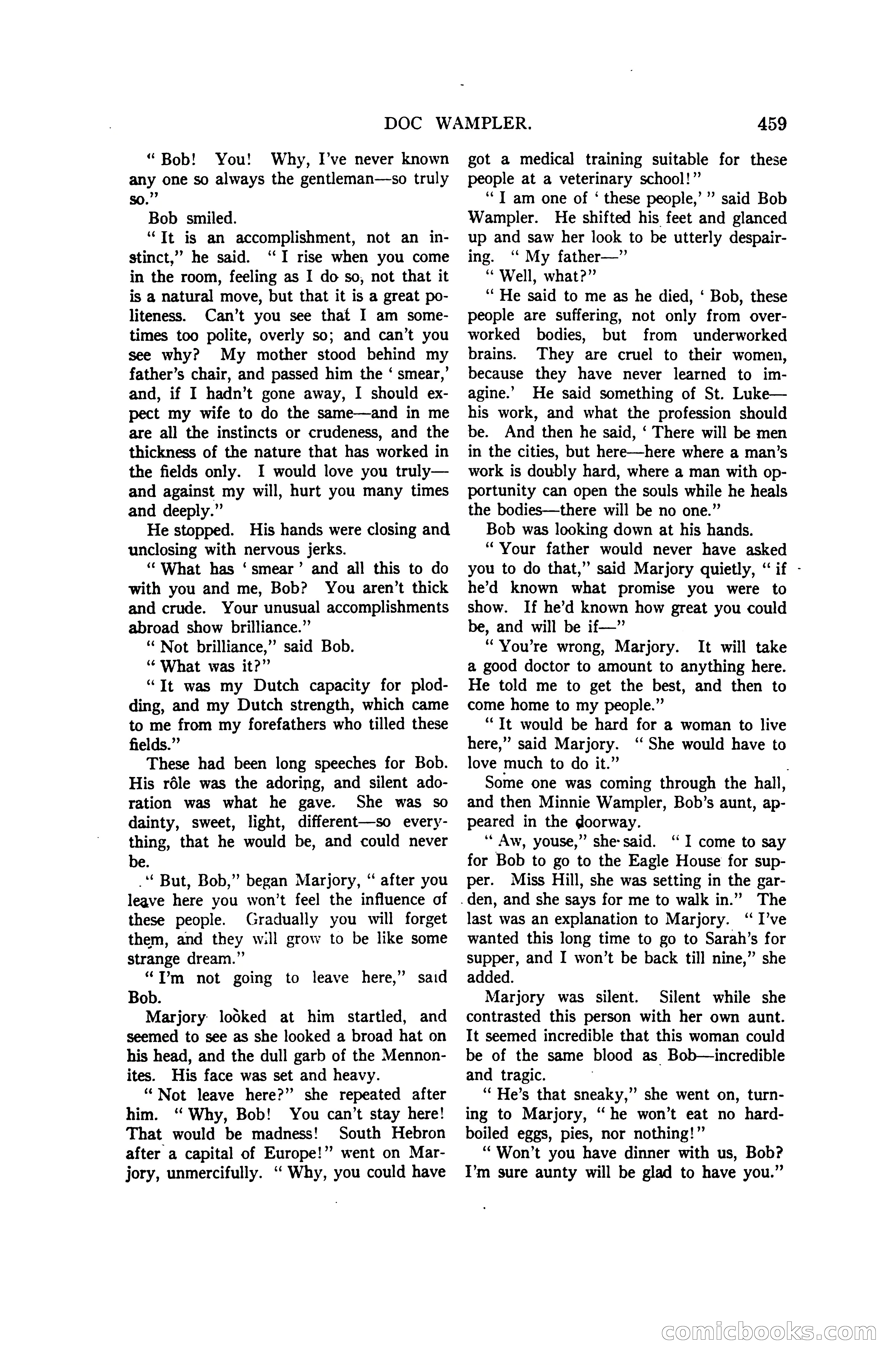
A restored page from Pulp Fiction, 1919. Page through the whole issue in the reader above.
📄 Transcribed text from this page (OCR, searchable)
Machine-transcribed from the original scan — historical spelling and the odd misread are preserved.
DOC WAMPLER. “ Bob! You! Why, I’ve never known any one so always the gentleman—so truly so.”’ Bob smiled. “Tt is an accomplishment, not an in- stinct,” he said. ‘I rise when you come in the room, feeling as I do so, not that it is a natural move, but that it is a great po- liteness. Can’t you see that I am some- times too polite, overly so; and can’t you see why? My mother stood behind my father’s chair, and passed him the ‘ smear,’ and, if I hadn’t gone away, I should ex- pect my wife to do the same—and in me are all the instincts or crudeness, and the thickness of the nature that has worked in the fields only. I would love you truly— and against my will, hurt you many times and deeply.” He stopped. His hands were closing and unclosing with nervous jerks. “What has ‘smear’ and all this to do with you and me, Bob? You aren’t thick and crude. Your unusual accomplishments abroad show brilliance.” “ Not brilliance,” said Bob. ‘“¢ What was it?” “It was my Dutch capacity for plod- ding, and my Dutch strength, which came to me from my forefathers who tilled these fields.”’ These had been long speeches for Bob. His réle was the adoring, and silent ado- ration was what he gave. She was so dainty, sweet, light, different—so every- thing, that he would be, and could never be. .““ But, Bob,” began Marjory, “ after you leave here you won't feel the influence of these people. Gradually you will forget them, and they will grow to be like some strange dream.” “Tm not going to leave here,” said Bob. Marjory: looked at him startled, and seemed to see as she looked a broad hat on his head, and the dull garb of the Mennon- ites. His face was set and heavy. ‘“* Not leave here?” she repeated after him. ‘“ Why, Bob! You can’t stay here! That would be madness! South Hebron after a capital of Europe!” went on Mar- jory, unmercifully. ‘“‘ Why, you could have 459 got a medical training suitable for these people at a veterinary school!” ‘“T am one of ‘ these people,’ ” said Bob Wampler. He shifted his feet and glanced up and saw her look to be utterly despair- ing. “ My father—” ‘Well, what?” ‘He said to me as he died, ‘ Bob, these people are suffering, not only from over- worked bodies, but from underworked brains. They are cruel to their women, because they have never learned to im- agine.’ He said something of St. Luke— his work, and what the profession should be. And then he said, ‘ There will be men in the cities, but here—here where a man’s work is doubly hard, where a man with op- portunity can open the souls while he heals the bodies—there will be no one.” Bob was looking down at his hands. “Your father would never have asked you to do that,” said Marjory quietly, “if - he’d known what promise you were to show. If he’d known how great you could be, and will be if—” ‘You're wrong, Marjory. It will take a good doctor to amount to anything here. He told me to get the best, and then to come home to my people.” ““It would be hard for a woman to live here,” said Marjory. ‘‘ She would have to love much to do it.” Some one was coming through the hall, and then Minnie Wampler, Bob’s aunt, ap- peared in the doorway. ‘‘ Aw, youse,” she-said. ‘I come to say for Bob to go to the Eagle House for sup- per. Miss Hill, she was setting in the gar- .den, and she says for me to walk in.”” The last was an explanation to Marjory. ‘I’ve wanted this long time to go to Sarah’s for supper, and I won’t be back till nine,” she added. Marjory was silent. Silent while she contrasted this person with her own aunt. It seemed incredible that this woman could be of the same blood as Bob—incredible and tragic. ‘* He’s that sneaky,” she went on, turn- ing to Marjory, ‘“ he won’t eat no hard- boiled eggs, pies, nor nothing!” ‘“‘Won’t you have dinner with us, Bob? I’m sure aunty will be glad to have you.” NOO (C(O) S (C(O) mM