
Pulp Fiction, 1920 · page 9 of 200
Argosy All-Story Weekly, Vol. 123, No. 4 — page 9: what you’re looking at
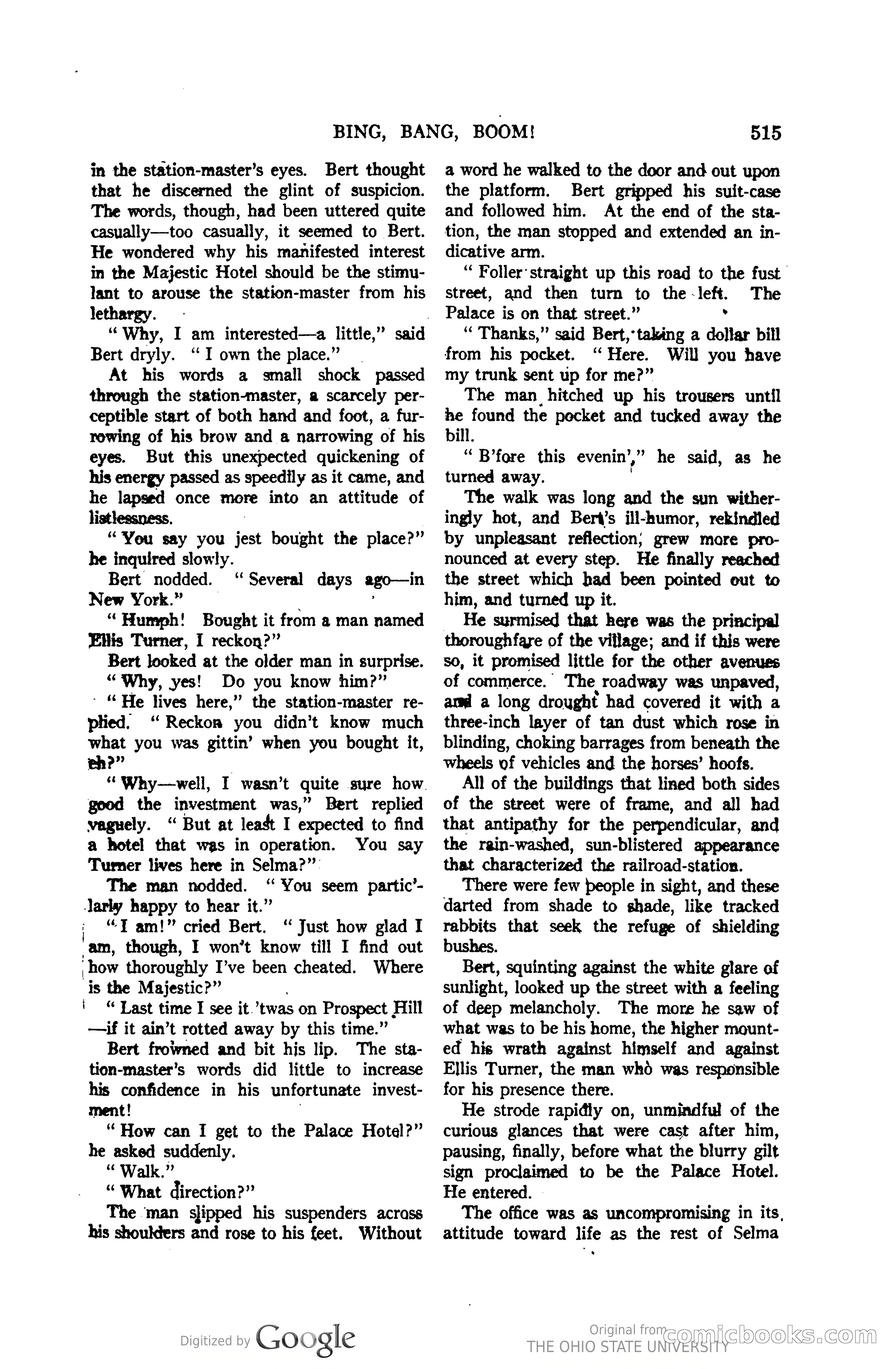
A restored page from Pulp Fiction, 1920. Page through the whole issue in the reader above.
📄 Transcribed text from this page (OCR, searchable)
Machine-transcribed from the original scan — historical spelling and the odd misread are preserved.
BING, BANG, BOOM! in the station-master’s eyes. Bert thought that he discerned the glint of suspicion. The words, though, had been uttered quite casually—too casually, it seemed to Bert. He wondered why his manifested interest in the Majestic Hotel should be the stimu- lant to arouse the station-master from his lethargy. “Why, I am interested—a little,” said Bert dryly. ‘I own the place.” At his words a small shock passed through the station-master, a scarcely per- ceptible start of both hand and foot, a fur- rowing of his brow and a narrowing of his eyes. But this unexpected quickening of his energy passed as speedily as it came, and he lapsed once more into an attitude of listlessness. “You say you jest bought the place?” he inquired slowly. Bert nodded. New York. . “Humph! Bought it from a man named Eliis Turner, I reckon?”’ Bert looked at the older man in surprise. “Why, yes! Do you know him?” ' “ He lives here,” the station-master re- plied. “Reckon you didn’t know much what you was gittin’ when you bought it, eh?” “Several days ago—in “ Why—well, I wasn’t quite sure how. good the investment was,” Bert replied vaguely. “ But at leadt I expected to find a hotel that was in operation. You say Turner lives here in Selma?” The man nodded. ‘“ You seem partic’- larly happy to hear it.” | “Yam!” cried Bert. ‘ Just how glad I am, though, I won’t know till I find out how thoroughly I’ve been cheated. Where is the Majestic?” |“ Last time I see it.’twas on Prospect Hill —if it ain’t rotted away by this time.” Bert frowned and bit his lip. The sta- tion-master’s words did little to increase his confidence in his unfortunate invest- ment! “How can I get to the Palace Hotel?” he asked suddenly. rT ¢ Walk.” “What direction?” The man slipped his suspenders across his shoulders and rose to his feet. Without 515 a word he walked to the door and out upon the platform. Bert gripped his suit-case and followed him. At the end of the sta- tion, the man stopped and extended an in- dicative arm. “ Foller'straight up this road to the fust street, and then turn to the-left. The _ Palace is on that street.” . ‘ Thanks,” said Bert,*taking a dollar bill from his pocket. ‘Here. Will you have my trunk sent up for me?” The man _ hitched up his trousers until he found the pocket and tucked away the bill. ‘ B’fore this evenin’, ” he said, as he turned away. The walk was long and the sun wither- ingly hot, and Bert’s ill-humor, rekindled by unpleasant reflection; grew mare pro- nounced at every step. He finally reached the street which had been pointed out to him, and turned up it. He surmised that here was the principal thoroughfare of the village; and if this were So, it promised little for the other avenues of commerce. The roadway was unpaved, amd a long drought had covered it with a three-inch layer of tan dust which rose in blinding, choking barrages from beneath the wheels of vehicles and the horses’ hoofs. All of the buildings that lined both sides of the street were of frame, and all had that antipathy for the perpendicular, and the rain-washed, sun-blistered appearance that characterized the railroad-station. There were few people in sight, and these darted from shade to shade, like tracked rabbits that seek the refuge of shielding bushes. Bert, squinting against the white glare of sunlight, looked up the street with a feeling of deep melancholy. The more he saw of what was to be his home, the higher mount- ed his wrath against himself and against E]lis Turner, the man who was responsible for his presence there. He strode rapidly on, unmindful of the curious glances that were cast after him, pausing, finally, before what the blurry gilt sign proclaimed to be the Palace Hotel. He entered. — The office was as uncompromising in its, attitude toward life as the rest of Selma Original fro mn : lODOOLKK CO