
Pulp Fiction, 1920 · page 63 of 200
Argosy All-Story Weekly, Vol. 123, No. 4 — page 63: what you’re looking at
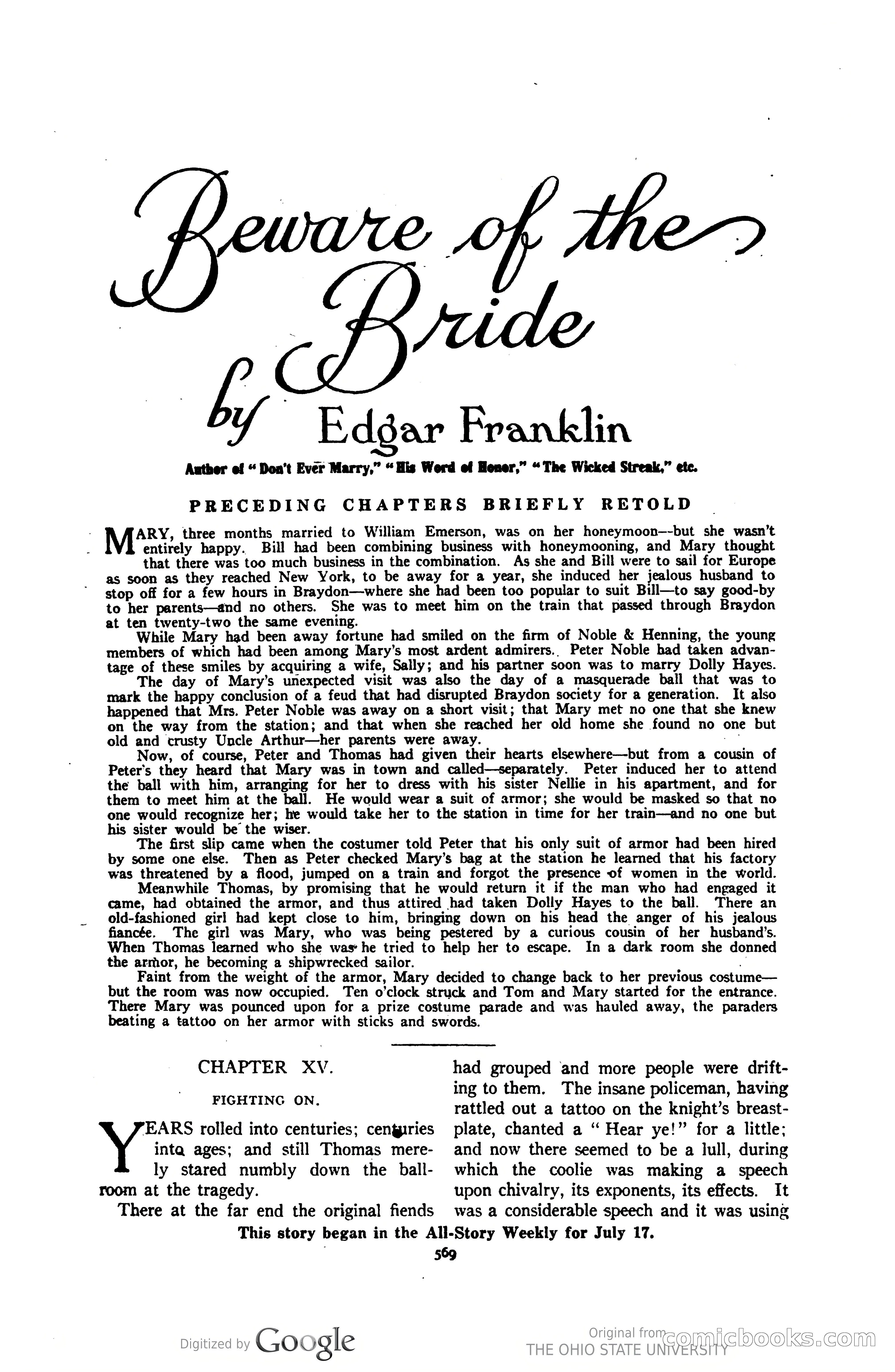
A restored page from Pulp Fiction, 1920. Page through the whole issue in the reader above.
📄 Transcribed text from this page (OCR, searchable)
Machine-transcribed from the original scan — historical spelling and the odd misread are preserved.
i by | Edgar Franklin PRECEDING CHAPTERS BRIEFLY RETOLD ARY, three months married to William Emerson, was on her honeymoon—-but she wasn’t entirely happy. Bill had been combining business with honeymooning, and Mary thought that there was too much business in the combination. As she and Bill were to sail for Europe as soon as they reached New York, to be away for a year, she induced her jealous husband to stop off for a few hours in Braydon—where she had been too popular to suit Bill—to say good-by to her parents—and no others. She was to meet him on the train that passed through Braydon at ten twenty-two the same evening. While Mary had been away fortune had smiled on the firm of Noble & Henning, the young members of which had been among Mary’s most ardent admirers.. Peter Noble had taken advan- tage of these smiles by acquiring a wife, Sally; and his partner soon was to marry Dolly Hayes. The day of Mary’s unexpected visit was also the day of a masquerade ball that was to mark the happy conclusion of a feud that had disrupted Braydon society for a generation. It also happened that Mrs. Peter Noble was away on a short visit; that Mary met no one that she knew on the way from the station; and that when she reached her old home she found no one but old and crusty Uncle Arthur—her parents were away. - Now, of course, Peter and Thomas had given their hearts elsewhere—but from a cousin of Peter's they heard that Mary was in town and called—separately. Peter induced her to attend the ball with him, arranging for her to dress with his sister Nellie in his apartment, and for them to meet him at the ball. He would wear a suit of armor; she would be masked so that no one would recognize her; he would take her to the station in time for her train—and no one but his sister would be the wiser. The first slip came when the costumer told Peter that his only suit of armor had been hired by some one else. Then as Peter checked Mary’s bag at the station he learned that his factory was threatened by a flood, jumped on a train and forgot the presence of women in the world. Meanwhile Thomas, by promising that he would return it if the man who had engaged it came, had obtained the armor, and thus attired had taken Dolly Hayes to the ball. There an old-fashioned girl had kept close to him, bringing down on his head the anger of his jealous fiancée. The girl was Mary, who was being pestered by a curious cousin of her husband's. When Thomas learned who she was he tried to help her to escape. In a dark room she donned the armor, he becoming a shipwrecked sailor. i Faint from the weight of the armor, Mary decided to change back to her previous costume— but the room was now occupied. Ten o'clock struck and Tom and Mary started for the entrance. There Mary was pounced upon for a prize costume parade and was hauled away, the paraders beating a tattoo on her armor with sticks and swords. CHAPTER XV. FIGHTING ON. Yin rolled into centuries; cengiries inta ages; and still Thomas mere- ly stared numbly down the ball- room at the tragedy. There at the far end the original fiends had grouped and more people were drift- ing to them. The insane policeman, having rattled out a tattoo on the knight’s breast- plate, chanted a ‘“ Hear ye!” for a little; and now there seemed to be a lull, during which the coolie was making a speech upon chivalry, its exponents, its effects. It was a considerable speech and it was using This story began in the All-Story Weekly for July 17. 569 Original frome) G 6)(0)6) < =) CO nin ) mm Vi