
Pulp Fiction, 1920 · page 24 of 200
Argosy All-Story Weekly, Vol. 123, No. 4 — page 24: what you’re looking at
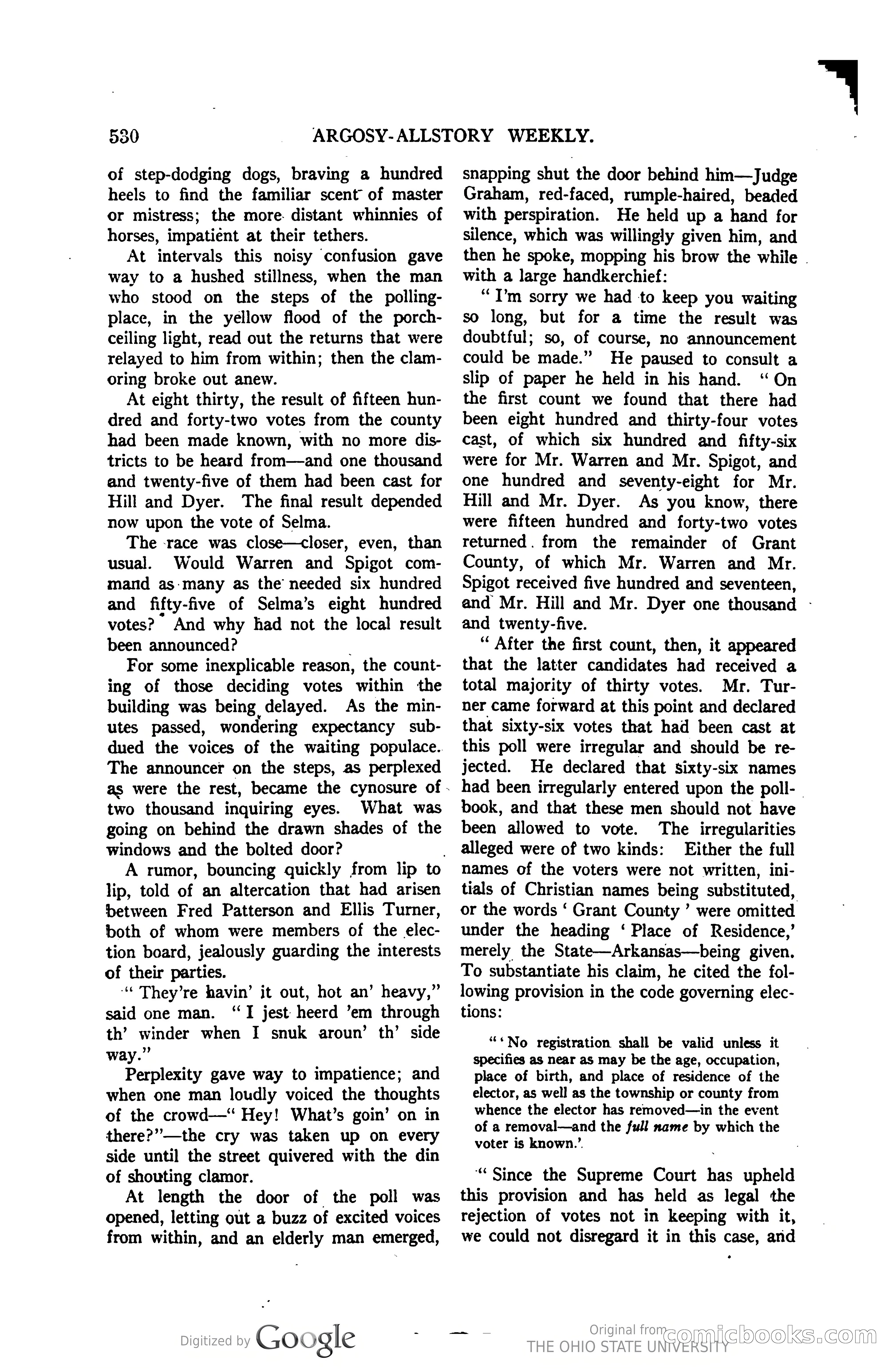
A restored page from Pulp Fiction, 1920. Page through the whole issue in the reader above.
📄 Transcribed text from this page (OCR, searchable)
Machine-transcribed from the original scan — historical spelling and the odd misread are preserved.
530 of step-dodging dogs, braving a hundred heels to find the familiar scent of master or mistress; the more. distant whinnies of horses, impatient at their tethers. At intervals this noisy confusion gave way to a hushed stillness, when the man who stood on the steps of the polling- place, in the yellow flood of the porch- ceiling light, read out the returns that were relayed to him from within; then the clam- oring broke out anew. At eight thirty, the result of fifteen hun- dred and forty-two votes from the county had been made known, with no more dis- tricts to be heard from—and one thousand and twenty-five of them had been cast for Hill and Dyer. The final result depended now upon the vote of Selma. The -race was close—closer, even, than usual. Would Warren and Spigot com- mand as-many as the’ needed six hundred and fifty-five of Selma’s eight hundred votes? And why had not the local result been announced? For some inexplicable reason, the count- ing of those deciding votes within the building was being delayed. As the min- utes passed, wondering expectancy sub- dued the voices of the waiting populace.. The announcer on the steps, as perplexed as were the rest, became the cynosure of - two thousand inquiring eyes. What was going on behind the drawn shades of the windows and the bolted door? A rumor, bouncing quickly from lip to lip, told of an altercation that had arisen between Fred Patterson and Ellis Turner, both of whom were members of the elec- tion board, jealously guarding the interests of their parties. “* They’re havin’ it out, hot an’ heavy,” said one man. “I jest heerd ’em through th’ winder when I snuk aroun’ th’ side way.” Perplexity gave way to impatience; and when one man loudly voiced the thoughts of the crowd—‘ Hey! What’s goin’ on in there?”’—the cry was taken up on every side until the street quivered with the din of shouting clamor. At length the door of the poll was opened, letting out a buzz of excited voices from within, and an elderly man emerged, atized by GOOgle _ alleged were of two kinds: i ARGOSY-ALLSTORY WEEKLY. snapping shut the door behind him—Judge Graham, red-faced, rumple-haired, beaded with perspiration. He held up a hand for silence, which was willingly given him, and then he spoke, mopping his brow the while . with a large handkerchief: “I’m sorry we had to keep you waiting so long, but for a time the result was doubtful; so, of course, no announcement could be made.” He paused to consult a slip of paper he held in his hand. ‘On the first count we found that there had been eight hundred and thirty-four votes cast, of which six hundred and fifty-six were for Mr. Warren and Mr. Spigot, and one hundred and seventy-eight for Mr. Hill and Mr. Dyer. As you know, there were fifteen hundred and forty-two votes returned. from the remainder of Grant County, of which Mr. Warren and Mr. Spigot received five hundred and seventeen, and Mr. Hill and Mr. Dyer one thousand - and twenty-five. “ After the first count, then, it appeared that the latter candidates had received a total majority of thirty votes. Mr. Tur- ner came forward at this point and declared that sixty-six votes that had been cast at this poll were irregular and should be re- jected. He declared that sixty-six names had been irregularly entered upon the poll-— book, and that these men should not have been allowed to vote. The irregularities Either the full names of the voters were not written, ini- tials of Christian names being substituted, or the words ‘ Grant County ’ were omitted under the heading ‘ Place of Residence,’ merely the State—Arkansas—being given. To substantiate his claim, he cited the fol- lowing provision in the code governing elec- tions: “*No registration shall be valid unless it specifies as near as may be the age, occupation, place of birth, and place of residence of the elector, as well as the township or county from whence the elector has removed—in the event of a removal—and the full name by which the voter is known.’. “Since the Supreme Court has upheld this provision and has held as legal the rejection of votes not in keeping with it, we could not disregard it in this case, and DATE URGE aS HYKE|DOO CO THE OF 10 STATE UN