
Pulp Fiction, 1920 · page 178 of 200
Argosy All-Story Weekly, Vol. 123, No. 4 — page 178: what you’re looking at
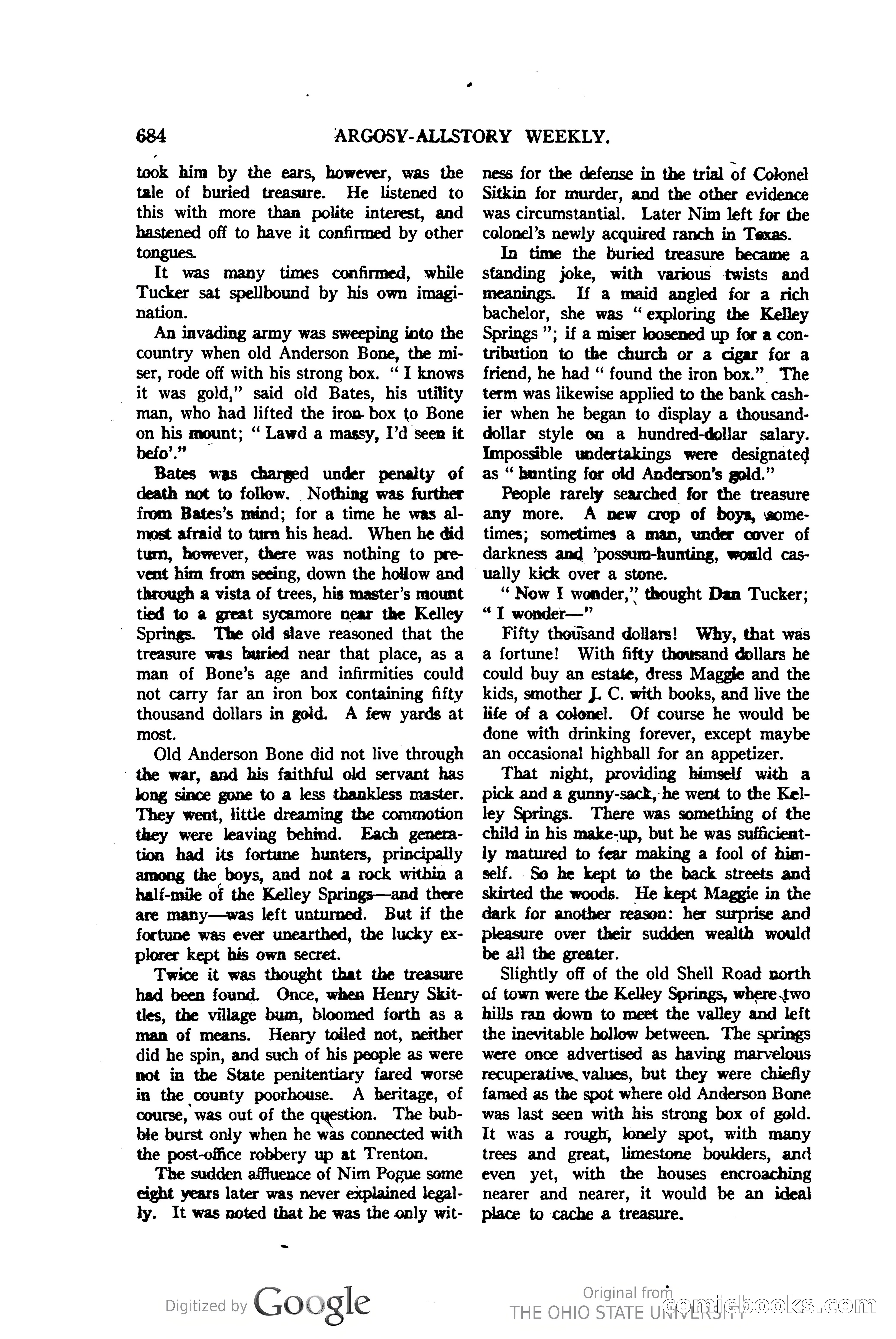
A restored page from Pulp Fiction, 1920. Page through the whole issue in the reader above.
📄 Transcribed text from this page (OCR, searchable)
Machine-transcribed from the original scan — historical spelling and the odd misread are preserved.
684 took him by the ears, however, was the tale of buried treasure. He listened to this with more than polite interest, and hastened off to have it confirmed by other tongues. It was many times confirmed, while Tucker sat spellbound by his own imagi- nation. An invading army was sweeping into the country when old Anderson Bone, the mi- ser, rode off with his strong box. ‘‘ I knows It was gold,” said old Bates, his utility man, who had lifted the iron box to Bone on his mount; ‘“ Lawd a massy, I’d seen it befo’.” . Bates was charged under penalty of death not to follow. Nothing was further from Bates’s mind; for a time he was al- most afraid to turn his head. When he did turn, however, there was nothing to pre- vent him from seeing, down the hollow and through a vista of trees, his master’s mount tied to a great sycamore near the Kelley | Springs. The old slave reasoned that the treasure was buried near that place, as a man of Bone’s age and infirmities could not carry far an iron box containing fifty thousand dollars in gold. A few yards at most. Old Anderson Bone did not live through ' the war, and his faithful old servant has long since gone to a less thankless master. They went, little dreaming the commotion they were leaving behind. Each genera- tion had its fortune hunters, principally among the boys, and not a rock within a half-mile of the Kelley Springs—and there are many—was left unturned. But if the fortune was ever unearthed, the lucky ex- plorer kept his own secret. Twice it was thought that the treasure had been found. Once, when Henry Skit- tles, the village bum, bloomed forth as a man of means. Henry toiled not, netther did he spin, and such of his people as were not in the State penitentiary fared worse in the county poorhouse. A heritage, of course, was out of the question. The bub- ble burst only when he was connected with _ the post-office robbery up at Trenton. The sudden affluence of Nim Pogue some eight years later was never explained legal- ly. It was noted that he was the only wit- => ARGOSY-ALLSTORY WEEKLY. ness for the defense in the trial of Colonel Sitkin for murder, and the other evidence was circumstantial. Later Nim left for the colonel’s newly acquired ranch in Texas. In time the buried treasure became a standing joke, with various twists and meanings. If a maid angled for a rich bachelor, she was “exploring the Kelley Springs ”: if a miser loosened up for a con- tribution to the church or a cgar for a friend, he had “ found the iron box.” The term was likewise applied to the bank cash- ier when he began to display a thousand- dollar style on a hundred-dollar salary. Impossible undertakings were designated as “ bunting for old Anderson’s gold.” People rarely searched for the treasure any more. A new crop of boys, some- times; sometimes a man, under cover of darkness and ’possum-hunting, would cas- ually kick over a stone. ‘““ Now I wonder,” thought Dan Tucker; “JT wonder—” Fifty thousand dollars! Why, that was a fortune! With fifty thousand dollars he could buy an estate, dress Maggie and the kids, smother J. C. with books, and live the life of a colonel. Of course he would be done with drinking forever, except maybe an occasional highball for an appetizer. That night, providing himself with a pick and a gunny-sack,-he went to the Kel- ley Springs. There was something of the child in his make-up, but he was sufficient- ly matured to fear making a fool of him- self. .So he kept to the back streets and skirted the woods. He kept Maggie in the dark for another reason: her surprise and pleasure over their sudden wealth would be all the greater. Slightly off of the old Shell Road north of town were the Kelley Springs, where .two hills ran down to meet the valley and left the inevitable hollow between. The springs were once advertised as having marvelous recuperative, values, but they were chiefly famed as the spot where old Anderson Bone was last seen with his strong box of gold. It was a rough, lonely spot, with many trees and great, limestone boulders, and even yet, with the houses encroaching nearer and nearer, it would be an ideal place to cache a treasure. | has | —_ q - ROME Doo COM