
Pulp Fiction, 1920 · page 131 of 200
Argosy All-Story Weekly, Vol. 123, No. 4 — page 131: what you’re looking at
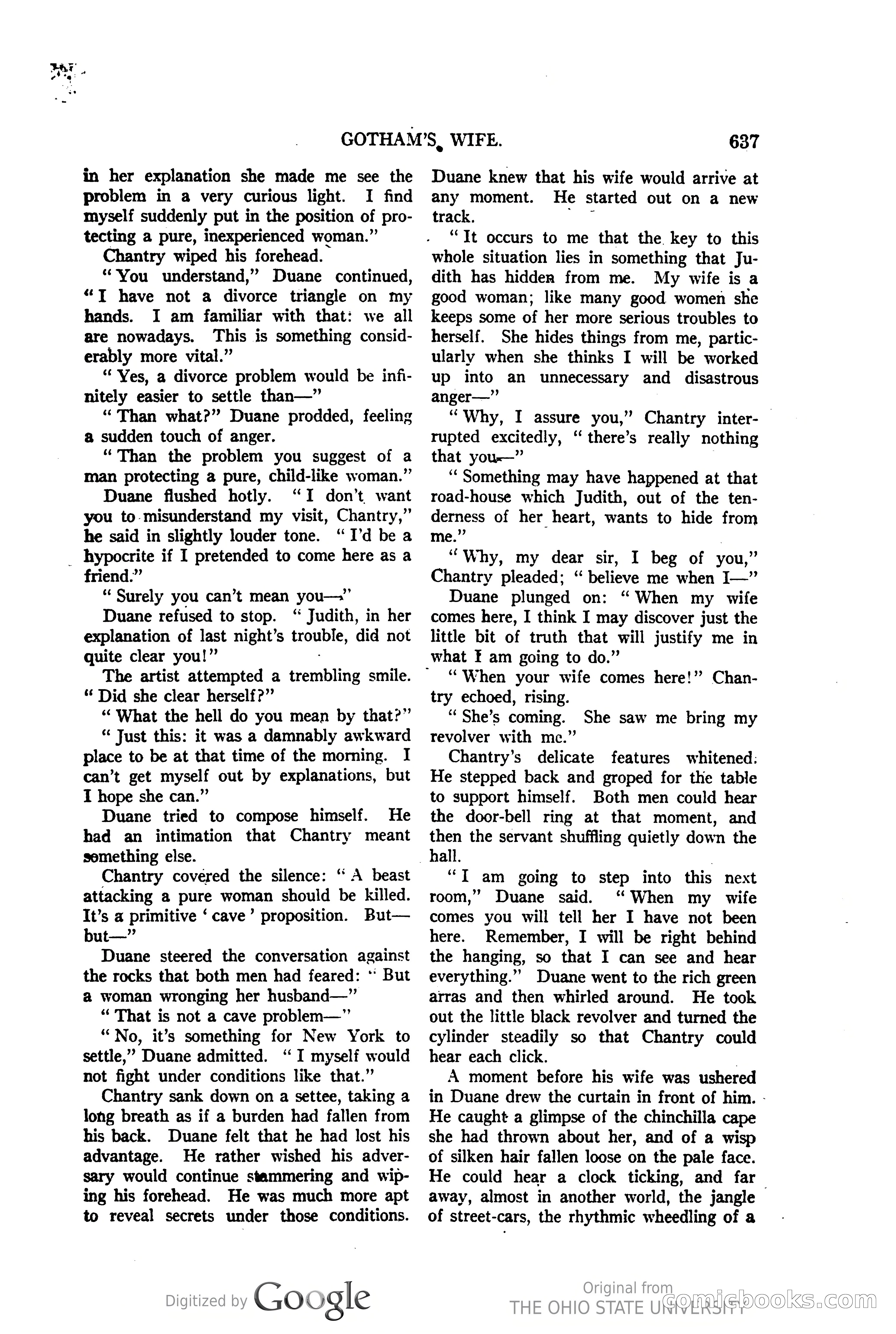
A restored page from Pulp Fiction, 1920. Page through the whole issue in the reader above.
📄 Transcribed text from this page (OCR, searchable)
Machine-transcribed from the original scan — historical spelling and the odd misread are preserved.
. 7 ¥ it «.,.8 at GOTHAM’, WIFE. in her explanation she made me see the problem in a very curious light. I find myself suddenly put in the position of pro- tecting a pure, inexperienced woman.” Chantry wiped his forehead. “You understand,” Duane continued, “T have not a divorce triangle on my hands. I am familiar with that: we all are nowadays. This is something consid- erably more vital.” “Yes, a divorce problem would be inf- nitely easier to settle than—” ‘Than what?” Duane prodded, feeling a sudden touch of anger. “Than the problem you suggest of a man protecting a pure, child-like woman.” Duane flushed hotly. “I don’t, want you to-misunderstand my visit, Chantry,” he said in slightly louder tone. “I'd be a _ hypocrite if I pretended to come here as a friend.” “ Surely you can’t mean you—” Duane refused to stop. “ Judith, in her explanation of last night’s mmouble, did not quite clear you!” The artist attempted a trembling smile. ** Did she clear herself?” ‘“‘ What the hell do you mean by that?” “ Just this: it was a damnably awkward place to be at that time of the morning. I can’t get myself out by explanations, but I hope she can.” Duane tried to compose himself. He had an intimation that Chantry meant semething else. Chantry covered the silence: ‘‘ A beast attacking a pure woman should be killed. It’s a primitive ‘cave’ proposition. But— but—”’ Duane steered the conversation against the rocks that both men had feared: ** But @ woman wronging her husband—”’ “That is not a cave problen—”’ ““No, it’s something for New York to settle,” Duane admitted. ‘“‘ I myself would not fight under conditions like that.” Chantry sank down on a settee, taking a long breath as if a burden had fallen from his back. Duane felt that he had lost his advantage. He rather wished his adver- sary would continue stammering and wip- ing his forehead. He was much more apt to reveal secrets under those conditions. 637 Duane knew that his wife would arrive at any moment. He started out on a new track. ‘It occurs to me that the. key to this whole situation lies in something that Ju- dith has hidden from me. My wife is a good woman; like many good women she keeps some of her more serious troubles to herself. She hides things from me, partic- ularly when she thinks I will be worked up into an unnecessary and disastrous anger—”’ “Why, I assure you,” Chantry inter-_ rupted excitedly, “there’s really nothing that you—” ‘‘ Something may have happened at that road-house which Judith, out of the ten- derness of her heart, wants to hide from me.” | “Why, my dear sir, I beg of you,” Chantry pleaded; “ believe me when I—” Duane plunged on: “ When my wife comes here, I think I may discover just the little bit of truth that will justify me in what ¥F am going to do.” ‘When your wife comes here!” Chan- try echoed, rising. “She’s coming. She saw me bring my revolver with me.” Chantry’s delicate features whitened: He stepped back and groped for the table to support himself. Both men could hear the door-bell ring at that moment, and then the servant shuffling quietly down the hall. “I am going to step into this next room,” Duane said. ‘When my wife comes you will tell her I have not been here. Remember, I will be right behind the hanging, so that I can see and hear everything.” Duane went to the rich green arras and then whirled around. He took out the little black revolver and turned the cylinder steadily so that Chantry could hear each click. | A moment before his wife was ushered in Duane drew the curtain in front of him. - He caught a glimpse of the chinchilla cape she had thrown about her, and of a wisp of silken hair fallen loose on the pale face. He could hear a clock ticking, and far away, almost in another world, the jangle — of street-cars, the rhythmic wheedling of a “HE OHIO STATE GORE book