
Pulp Fiction, 1920 · page 115 of 200
Argosy All-Story Weekly, Vol. 123, No. 4 — page 115: what you’re looking at
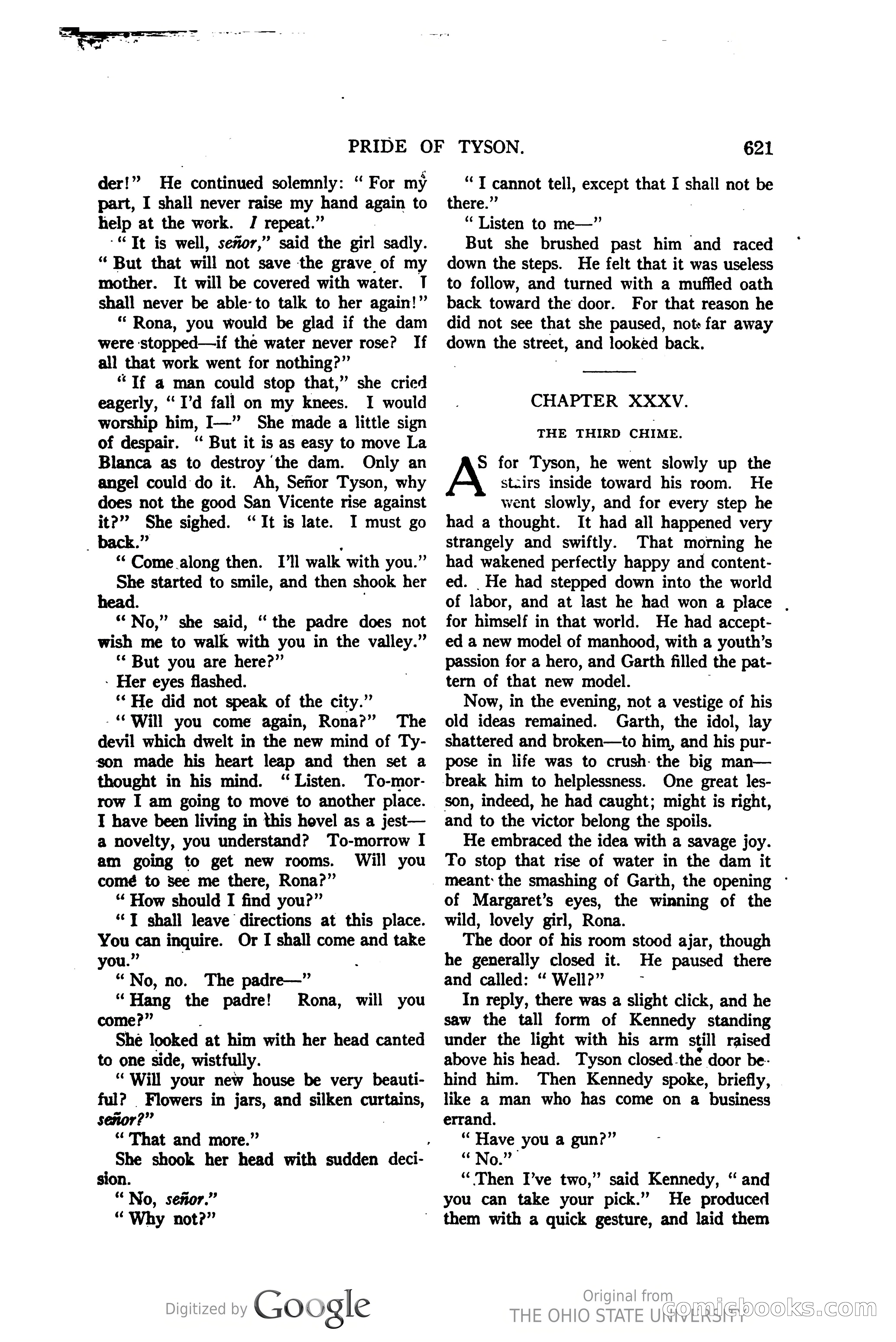
A restored page from Pulp Fiction, 1920. Page through the whole issue in the reader above.
📄 Transcribed text from this page (OCR, searchable)
Machine-transcribed from the original scan — historical spelling and the odd misread are preserved.
PRIDE OF TYSON. 621 der!” He continued solemnly: “ For my part, I shall never raise my hand again to help at the work. / Tepeat. ” ““Tt is well, sewor,” said the girl sadly. “ But that will not save the grave of my mother. It will be covered with water. IT shall never be able-to talk to her again!” “Rona, you would be glad if the dam were stopped—if the water never rose? If all that work went for nothing?”’ “Tf a man could stop that,” she cried eagerly, “I’d fall on my knees. I would worship him, I—’’ She made a little sign of despair. “ But it is as easy to move La Blanca as to destroy the dam. Only an angel could do it. Ah, Senor Tyson, why does not the good San Vicente rise against it?’? She sighed. “It is late. I must go _ back.” *“ Come along then. Ill walk with you.” She started to smile, and then shook her head. “No,” she said, ‘‘ the padre does not wish me to walk with you in the valley.” ‘** But you are here?” - Her eyes flashed. ‘“* He did not speak of the city.” - “© Will you come again, Rona?” The devil which dwelt in the new mind of Ty- son made his heart leap and then set a thought in his mind. “Listen. To-mor- row I am going to move to another place. I have been living in this hevel as a jest— a novelty, you understand? To-morrow I am going to get new rooms. Will you comé to see me there, Rona?” ‘“‘ How should I find your” ‘J shall leave directions at this place. You can inquire. Or I shall come and take you.” . . “No, no. The padre—”’ “Hang the padre! Rona, will you come?” She looked at him with her head canted to one side, wistfully. “ Will your new house be very beauti- ful? Flowers in jars, and silken curtains, senor?” , “That and more.” She shook her head with sudden deci- sion. “No, senor.” “ ‘Why not?” gitized by (S00 gle “‘T cannot tell, except that I shall not be there.” “ Listen to me—”’ But she brushed past him and raced down the steps. He felt that it was useless to follow, and turned with a muffled oath back toward the door. For that reason he did not see that she paused, not: far away down the street, and looked back. CHAPTER XXXV. THE THIRD CHIME. S for Tyson, he went slowly up the stcirs inside toward his room. He went slowly, and for every step he had a thought. It had all happened very strangely and swiftly. That morning he had wakened perfectly happy and content- ed. He had stepped down into the world of labor, and at last he had won a place . for himself in that world. He had accept- ed a new model of manhood, with a youth’s passion for a hero, and Garth filled the pat- tern of that new ‘model. Now, in the evening, not a vestige of his old ideas remained. Garth, the idol, lay shattered and broken—to him, and his pur- pose in life was to crush- the big man— break him to helplessness. One great les- son, indeed, he had caught; might is right, and to the victor belong the spoils. He embraced the idea with a savage joy. To stop that rise of water in the dam it _ Meant: the smashing of Garth, the opening - of Margaret’s eyes, the winning of the wild, lovely girl, Rona. The door of his room stood ajar, though he generally closed it. He paused there and called: ‘“ Well?” : In reply, there was a slight click, and he saw the tall form of Kennedy standing under the light with his arm still raised above his head. Tyson closed. the door be- hind him. Then Kennedy spoke, briefly, © like a man who has come on a business errand. “Have you a gun?”’ rT No.” ; “‘ Then I’ve two,” said Kennedy, “ and you can take your pick.” He produced them with a quick gesture, and laid them Origin GOOO[K