
Pulp Fiction, 1920 · page 92 of 232
Argosy All-Story Weekly, Vol. 123, No. 3 — page 92: what you’re looking at
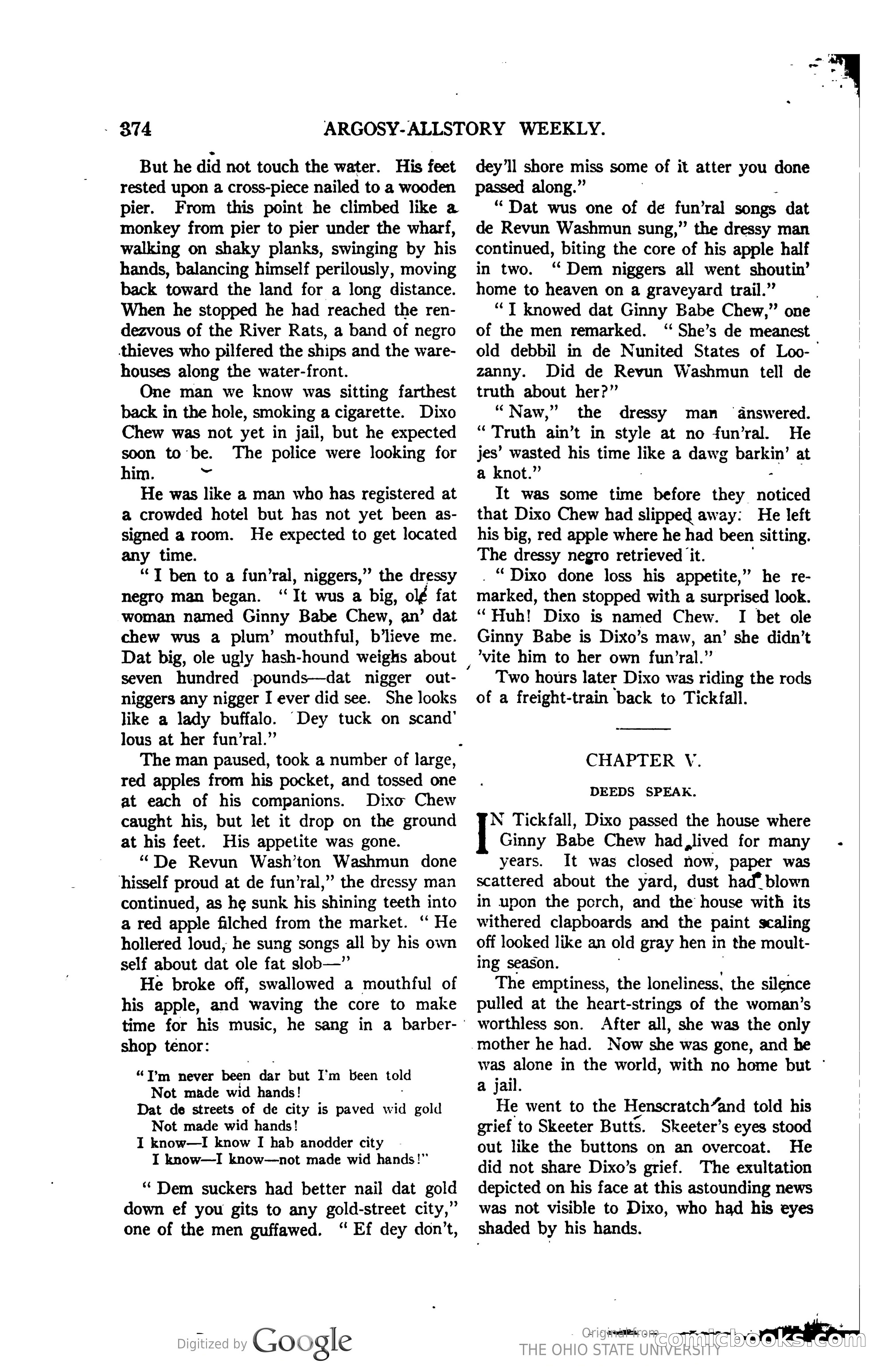
A restored page from Pulp Fiction, 1920. Page through the whole issue in the reader above.
📄 Transcribed text from this page (OCR, searchable)
Machine-transcribed from the original scan — historical spelling and the odd misread are preserved.
- $74 But he did not touch the water. His feet rested upon a cross-piece nailed to a wooden pier. From this point he climbed like a monkey from pier to pier under the wharf, walking on shaky planks, swinging by his hands, balancing himself perilously, moving back toward the land for a long distance. When he stopped he had reached the ren- dezvous of the River Rats, a band of negro thieves who pilfered the ships and the ware- houses along the water-front. One man we know was sitting farthest back in the hole, smoking a cigarette. Dixo Chew was not yet in jail, but he expected soon to be. The police were looking for him. ~ He was like a man who has registered at a crowded hotel but has not yet been as- signed a room. He expected to get located any time. ‘“‘I ben to a fun’ral, niggers,” the dressy negro man began. “It wus a big, olf fat woman named Ginny Babe Chew, an’ dat chew wus a plum’ mouthful, b’lieve me. Dat big, ole ugly hash-hound weighs about | seven hundred pounds—dat nigger out- niggers any nigger I ever did see. She looks like a lady buffalo. Dey tuck on scand’ lous at her fun’ral.” The man paused, took a number of large, red apples from his pocket, and tossed one at each of his companions. Dixo Chew caught his, but let it drop on the ground at his feet. His appetite was gone. “De Revun Wash’ton Washmun done hisself proud at de fun’ral,” the dressy man continued, as he sunk his shining teeth into a red apple filched from the market. ‘“ He hollered loud, he sung songs all by his own self about dat ole fat slob—”’ He broke off, swallowed a mouthful of his apple, and waving the core to make time for his music, he sang in a barber- shop tenor: “T’m never been dar but I'm been tala Not made wid hands! Dat de streets of de city is paved wid gold Not made wid hands! I know—I know I hab anodder city I know—I know—not made wid hands!” “Dem suckers had better nail dat gold down ef you gits to any gold-street city,” one of the men guffawed. “ Ef dey don’t, ARGOSY-ALLSTORY WEEKLY. dey’ll shore miss some € of it atter you done passed along.” ““Dat wus one of de fun’ral songs dat de Revun Washmun sung,” the dressy man continued, biting the core of his apple half in two. “ Dem niggers all went shoutin’ home to heaven on a graveyard trail.” “TI knowed dat Ginny Babe Chew,” one of the men remarked. ‘ She’s de meanest old debbil in de Nunited States of Loo-— zanny. Did de Revun Washmun tell de truth about her?”’ “Naw,” the dressy man answered. “Truth ain’t in style at no fun’ral. He jes’ wasted his time ike a dawg barkin’ at a knot.” : It was some time before they noticed that Dixo Chew had slipped away: He left his big, red apple where he had been sitting. The dressy negro retrieved it. ““Dixo done loss his appetite,” he re- marked, then stopped with a surprised look. ‘Huh! Dixo is named Chew. I bet ole Ginny Babe is Dixo’s maw, an’ she didn’t vite him to her own fun’ral.” Two hours later Dixo was riding the rods of a freight-train back to Tickfall. CHAPTER V. DEEDS SPEAK. N Tickfall, Dixo passed the house where | Ginny Babe Chew had,lived for many years. It was closed now, paper was scattered about the yard, dust had* blown in upon the perch, and the house with its withered clapboards and the paint scaling off looked like an old gray hen i in the moult- ing season. The emptiness, the loneliness, the silence pulled at the heart-strings of the woman’s worthless son. After all, she was the only -mother he had. Now she was gone, and he was alone in the world, with no home but ° a jail. He went to the Henscratch“and told his grief to Skeeter Butts. Skeeter’s eyes stood out like the buttons on an overcoat. He did not share Dixo’s grief. The exultation depicted on his face at this astounding news was not visible to Dixo, who had his eyes shaded by his hands. r~ ) ne —_— GOO] MK 30.0) vie OIm THE [_