
Pulp Fiction, 1920 · page 60 of 232
Argosy All-Story Weekly, Vol. 123, No. 3 — page 60: what you’re looking at
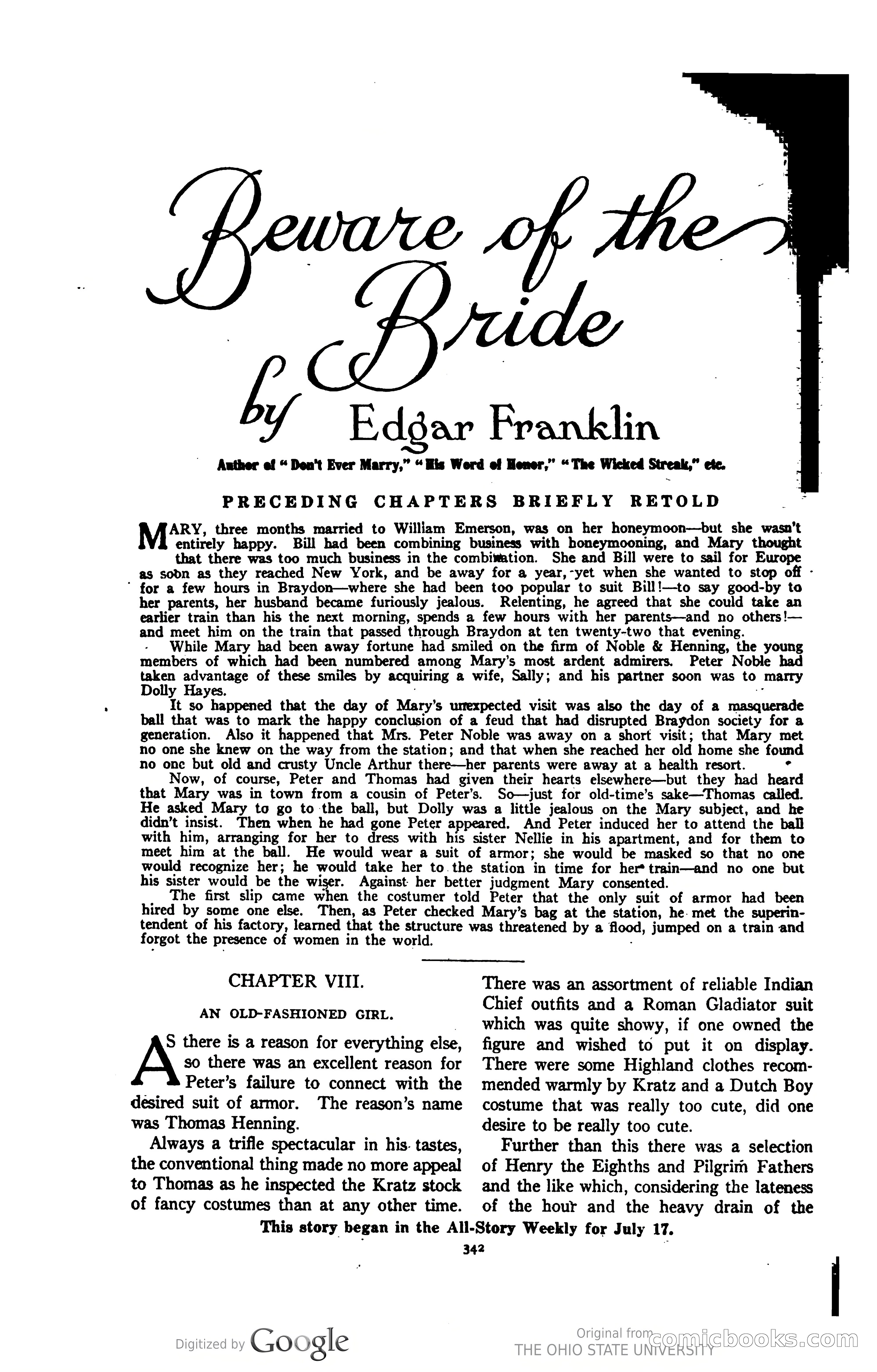
A restored page from Pulp Fiction, 1920. Page through the whole issue in the reader above.
📄 Transcribed text from this page (OCR, searchable)
Machine-transcribed from the original scan — historical spelling and the odd misread are preserved.
wae: ef by Edgar Franklin Auther ef “ Don't Ever Marry,” “His Word ef Hener,” “The Wicked Streak,” ete. PRECEDING CHAPTERS BRIEFLY RETOLD + ARY, three months married to William Emerson, was on her honeymoon—but she wasn’t entirely happy. Bill had been combining business with honeymooning, and Mary thought that there was too much business in the combiwation. She and Bill were to sail for Europe as sodn as they reached New York, and be away for a year,-yet when she wanted to stop off - ’ for a few hours in Braydon—where she had been too popular to suit Bill!—to say good-by to her parents, her husband became furiously jealous. Relenting, he agreed that she could take an earlier train than his the next morning, spends a few hours with her parents—and no others!— and meet him on the train that passed through Braydon at ten twenty-two that evening. While Mary had been away fortune had smiled on the firm of Noble & Henning, the young members of which had been numbered among Mary’s most ardent admirers. Peter Noble had taken advantage of these smiles by acquiring a wife, Sally; and his partner soon was to marry Dolly Hayes. It so happened that the day of Mary’s urrexpected visit was also the day of a masquerade ball that was to mark the happy conclusion of a feud that had disrupted Braydon society for a generation. Also it happened that Mrs. Peter Noble was away on a short visit; that Mary met no one she knew on the way from the station; and that when she reached her old home she found no onc but old and crusty Uncle Arthur there—her parents were away at a health resort. * Now, of course, Peter and Thomas had given their hearts elsewhere—but they had heard that Mary was in town from a cousin of Peter’s. So—just for old-time’s sake—Thomas called. He asked Mary to go to the ball, but Dolly was a little jealous on the Mary subject, and he didn’t insist. Then when he had gone Peter appeared. And Peter induced her to attend the ball with him, arranging for her to dress with his sister Nellie in his apartment, and for them to meet him at the ball. He would wear a suit of armor; she would be masked so that no one would recognize her; he would take her to. the station in time for her* train—and no one but his sister would be the wiser. Against: her better judgment Mary consented. _ The first slip came when the costumer told Peter that the only suit of armor had been hired by some one else. Then, as Peter checked Mary’s bag at the station, he. met the superin- tendent of his factory, learned that the structure was threatened by a flood, jumped on a train and forgot the presence of women in the world. CHAPTER VIII. AN OLD-FASHIONED GIRL. S there is a reason for everything else, A so there was an excellent reason for Peter’s failure to connect with the desired suit of armor. The reason’s name was Thomas Henning. Always a trifle spectacular in his. tastes, the conventional thing made no more appeal to Thomas as he inspected the Kratz stock of fancy costumes than at any other time. There was an assortment of reliable Indian Chief outfits and a Roman Gladiator suit which was quite showy, if one owned the figure and wished to put it on display. There were some Highland clothes recom- mended warmly by Kratz and a Dutch Boy costume that was really too cute, did one desire to be really too cute. Further than this there was a selection of Henry the Eighths and Pilgrim Fathers and the like which, considering the lateness of the hour and the heavy drain of the This story began in the All-Story Weekly for July 17. 342 : Digitized by (“Go ogle Original fro Ne 6) = 4 rn NC _ —- (JRMDS MIGIOO <SiG =)