
Pulp Fiction, 1920 · page 52 of 232
Argosy All-Story Weekly, Vol. 123, No. 3 — page 52: what you’re looking at
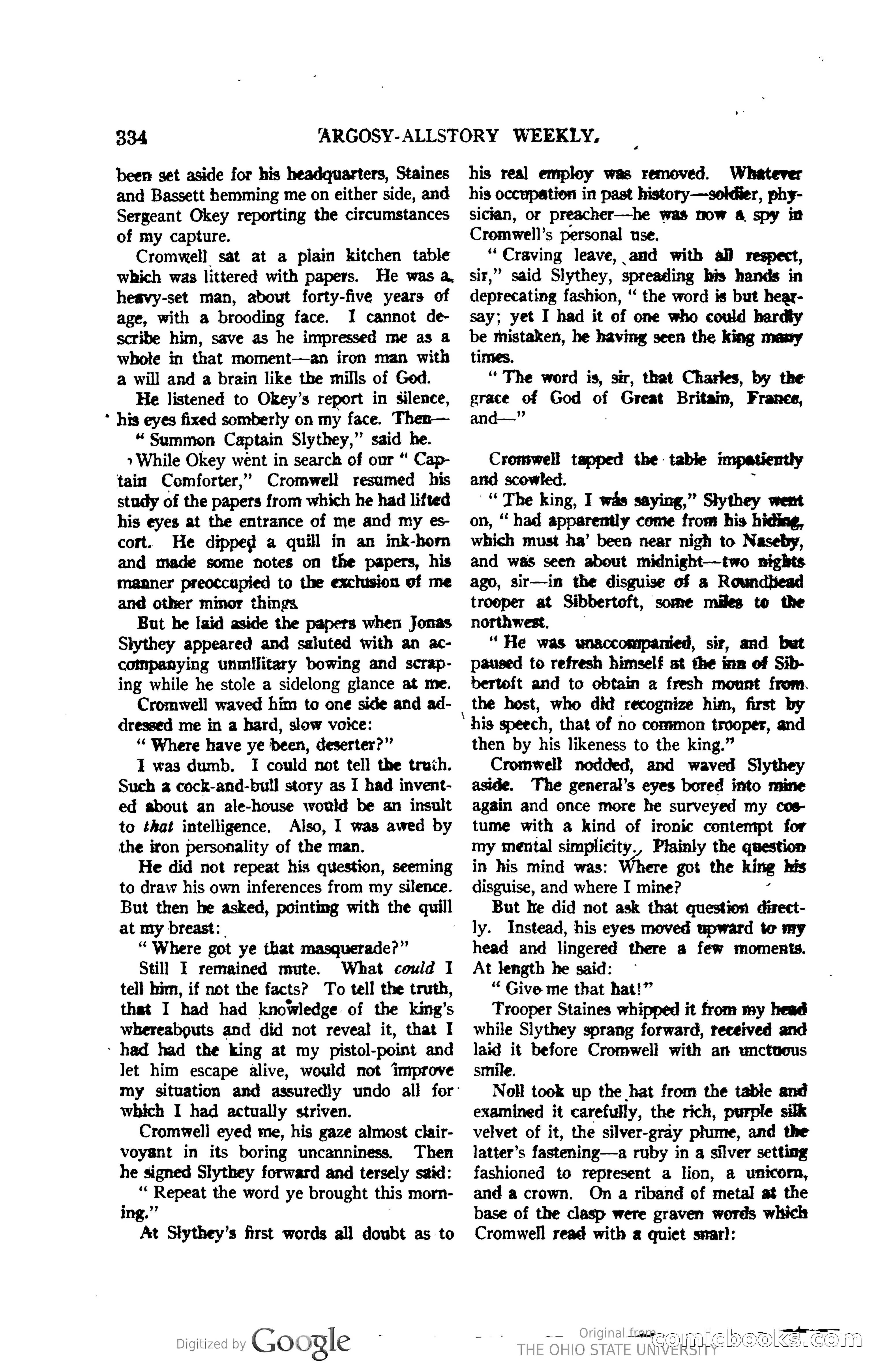
A restored page from Pulp Fiction, 1920. Page through the whole issue in the reader above.
📄 Transcribed text from this page (OCR, searchable)
Machine-transcribed from the original scan — historical spelling and the odd misread are preserved.
oo4 been set aside for his headquarters, Staines and Bassett hemming me on either side, and Sergeant Okey reporting the circumstances of my capture. Cromwell sat at a plain kitchen table which was littered with papers. He was a, heavy-set man, about forty-five years of age, with a brooding face. I cannot de- scribe him, save as he impressed me as a whole in that moment—an iron man with a will and a brain like the mills of Ged. He listened to Okey’s report in silence, * his eyes fixed somberly on my face. Then— “Summon Captain Slythey,” said he. » While Okey went in search of our “ Cap- tain Comforter,” Cromwell resumed his study of the papers from which he had lifted his eyes at the entrance of me and my es- cort. He dipped a quill in an ink-hom and made some notes on the papers, his manner preoccupied to the exchision of me and other mmor things But he laid aside the papers when Jonas Skythey appeared and saluted with an ac- companying unmilitary bowing and scrap- ing while he stole a sidelong glance at me. Cromwell waved him to one side and ad- dressed me in a hard, slow voice: “Where have ye been, deserter?”’ I was dumb. I could not tell the truth. Such a cock-and-bull story as I had invent- ed about an ale-house would be an insult to that intelligence. Also, I was awed by the iron personality of the man. He did not repeat his question, seeming to draw his own inferences from my silence. But then he asked, pointing with the quill at my breast: | “Where got ye that masquerade?”’ Still I remained mute. What could I tell him, if not the facts? To tell the truth, that I had had knowledge of the king’s whereabouts and did not reveal it, that I - had had the king at my pistol- point and let him escape alive, would not ‘improve my situation and assuredly undo all for: which I had actually striven. Cromwell eyed me, his gaze almost clair- voyant in its boring uncanniness. Then he signed Slythey forward and tersely said: “‘ Repeat the word ye brought this morn- ing. 9 At Stythey’s first words all doubt as to viatized by GOORle ARGOSY-ALLSTORY WEEKLY, his real employ was removed. Whatever his occupation in past history —solkdier, phy- sickan, or preacher—he was now & spy itt Cromwell’s personal use. “Craving leave, and with al? respect, sir,” said Slythey, spreading his hands in deprecating fashion, ‘“‘ the word is but hear- say; yet I had it of one who could hardly be mistaken, he having seen the king many times. “ The word is, sir, that Charles, by the orace of God of Great Britain, France, and— Cromwell tapped the - table impatiently and scowled. “ The king, I was saying,” Slythey went on, “ had apparently come from his hiding, which must ha’ been near nigh to Naseby, and was seen about midnight—two nights ago, sir—in the disguise of a Roundiiead trooper at Sibbertoft, some miles to the northwest. . “He was wnacconmpanied, sir, and but paused to refresh himself at the inn of Sib- bertoft and to obtain a fresh mount from. the host, who did recognize him, first by ‘his speech, that of no common trooper, and then by his likeness to the king.” Cromwell nodded, and waved Slythey aside. The general’s eyes bored into mine again and once more he surveyed my cose tume with a kind of ironic contentpt for my mental simplicity., Plainly the question in his mind was: Where got the king his disguise, and where I mine? But he did not ask that question direct- ly. Instead, his eyes moved upward te my head and lingered there a few moments. At length he said: ‘“‘ Give me that hat!” Trooper Staines whipped it from my head while Slythey sprang forward, received and laid it before Cromwell with an unctuous smile. Noll took up the hat from the table and examined it carefully, the rich, purple silk velvet of it, the silver-gray plume, and the latter’s fastening—a ruby in a silver setting fashioned to represent a lion, @ unicorn, and a crown. On a riband of metal at the base of the clasp were graven words which Cromwell read with a quiet snarl: oe Olen tcommiclbOOKS:CO