
Pulp Fiction, 1920 · page 45 of 232
Argosy All-Story Weekly, Vol. 123, No. 3 — page 45: what you’re looking at
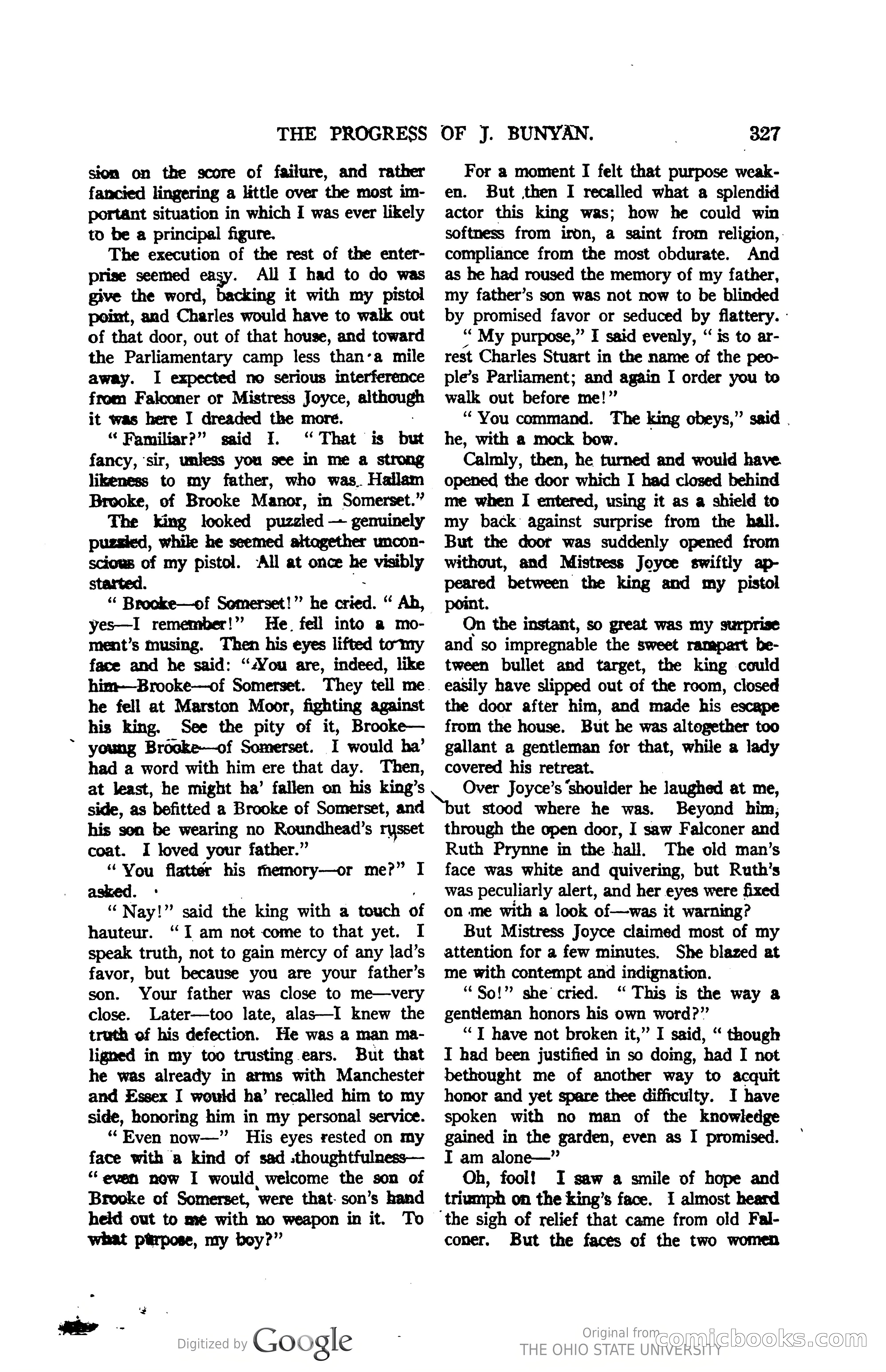
A restored page from Pulp Fiction, 1920. Page through the whole issue in the reader above.
📄 Transcribed text from this page (OCR, searchable)
Machine-transcribed from the original scan — historical spelling and the odd misread are preserved.
THE PROGRESS sion on the score of failure, and rather fancied lingering a little over the most im- portant situation in which I was ever likely to be a principal figure. The execution of the rest of the enter- prise seemed ea All I had to do was give the word, backing it with my pistol poimt, and Charles would have to walk out of that door, out of that house, and toward the Parliamentary camp less than’a mile away. I expected no serious interference from Falconer or Mistress Joyce, sithongs it was here I dreaded the more. ‘“ Familiar?” said I. ‘“ That is but fancy, sir, unless you see in me a strong likeness to my father, who was. Hallam Brooke, of Brooke Manor, in Somerset.” The king looked puzzled — genuinely puzsied, while he seemed altogether uncon- sciows of my pistol. <All at once he > visibly started. ‘“‘ Brooke—of Somerset!” he cried. yes—I remember!” He. fell into a mo- ment’s musing. Then his eyes lifted to-my face and he said: “ou are, indeed, like him—Brooke—of Somerset. They tell me. he fell at Marston Moor, fighting against his king. See the pity of it, Brooke— young Brooke—of Somerset. I would ha’ had a word with him ere that day. Then, at least, he might ha’ fallen on his king’s side, as befitted a Brooke of Somerset, and his son be wearing no Roundhead’s rysset coat. I loved your father.” “You flatter his memory—or me?” I “Nay!” said the king with a touch of hauteur. “I am not come to that yet. I speak truth, not to gain mercy of any lad’s favor, but because you are your father’s son. Your father was close to me—very close. Later—too late, alas—I knew the truth of his defection. He was a man ma- ligned in my too trusting ears. But that he was already in arms with Manchester and Essex I would ha’ recalled him to my side, honoring him in my personal service. “Even now—” His eyes rested on my face with a kind of sad .thoughtfulness— “even now I would welcome the son of Brooke of Somerset, ‘were that-son’s hand heid out to me with no weapon in it. To what pirpose, my boy?” “ Ab, | OF J. BUNYAN. BVA f For a moment I felt that purpose weak- en. But then I recalled what a splendid actor this king was; how he could win softness from iron, a saint from religion,. compliance from the most obdurate. And as he had roused the memory of my father, my father’s son was not now to be blinded by promised favor or seduced by flattery. - “ My purpose,” I said evenly, “is to ar- rest Charles Stuart in the name of the peo- ple’s Parliament; and again I order you to walk out before me!”’ “You command. The king obeys,” said . he, with a mock bow. Calmly, then, he turned and would have. opened the door which I had closed behind me when I entered, using it as a shield to my back against surprise from the hall. But the door was suddenly opened from without, and Mistress Joyce swiftly ap- peared between the king and my pistol point. On the instant, so great was my surprise and so impregnable the sweet rampart be- tween bullet and target, the king could easily have slipped out of the room, closed the door after him, and made his escape from the house. But he was altogether too gallant a gentleman for that, while a lady covered his retreat. Over Joyce’s ‘shoulder he laughed at me, “put stood where he was. Beyond him; through the open door, I saw Falconer and Ruth Prynne in the hall. The old man’s face was white and quivering, but Ruth's was peculiarly alert, and her eyes were fixed on me with a look of—was it warning? But Mistress Joyce claimed most of my attention for a few minutes. She blazed at me with contempt and indignation. _ “So!” she cried. ‘This is the way a gentleman honors his own word?”’ “‘T have not broken it,” I said, “ though I had been justified in so doing, had I not bethought me of another way to acquit honor and yet spare thee difficulty. I have spoken with no man of the knowledge gained in the garden, even as I promised. I am alone—” Qh, fool! I saw a smile of hope and triumph on the king’s face. I almost heard ‘the sigh of relief that came from old Fal- coner. But the faces of the two women Jriginal fr¢ ie JOO I S C@ ATE l