
Pulp Fiction, 1920 · page 204 of 232
Argosy All-Story Weekly, Vol. 123, No. 3 — page 204: what you’re looking at
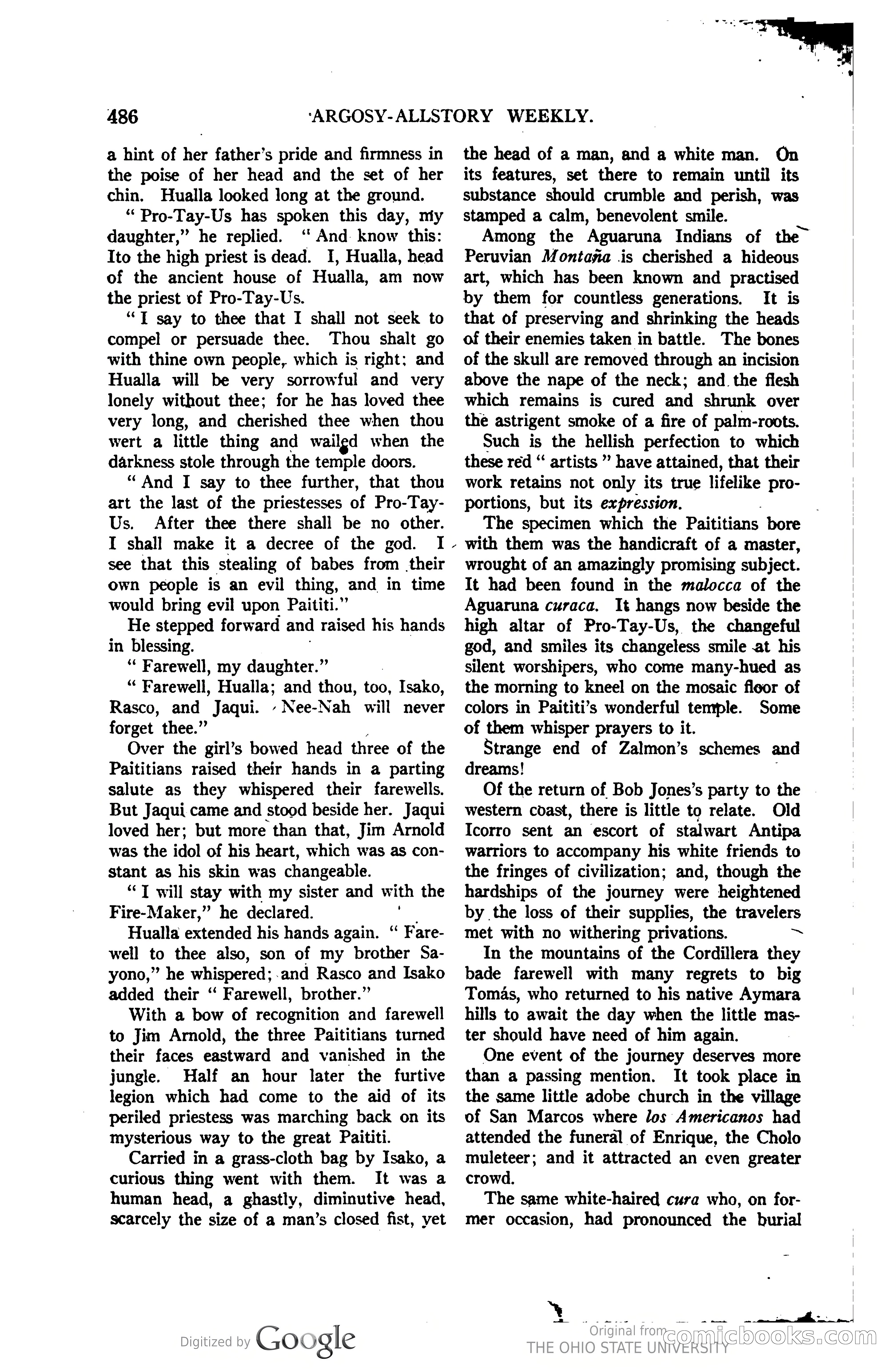
A restored page from Pulp Fiction, 1920. Page through the whole issue in the reader above.
📄 Transcribed text from this page (OCR, searchable)
Machine-transcribed from the original scan — historical spelling and the odd misread are preserved.
486 a hint of her father’s pride and firmness in the poise of her head and the set of her chin. Hualla looked long at the ground. ‘“‘ Pro-Tay-Us has spoken this day, miy daughter,” he replied. ‘‘ And: know this: Ito the high priest is dead. I, Hualla, head of the ancient house of Hualla, am now the priest of Pro-Tay-Us. ‘“‘I say to thee that I shall not seek to compel or persuade thee. Thou shalt go with thine own people, which is right; and Hualla will be very sorrowful and very lonely without thee; for he has loved thee very long, and cherished thee when thou wert a little thing and wailgd when the darkness stole through the temple doors. “And I say to thee further, that thou art the last of the priestesses of Pro-Tay- Us. After thee there shall be no other. I shall make it a decree of the god. I see that this stealing of babes from their own people is an evil thing, and in time would bring evil upon Paititi.” He stepped forward and raised his hands in blessing. ‘* Farewell, my daughter.” , “¢ Farewell, Hualla; and thou, too, Isako, Rasco, and Jaqui. -Nee-Nah will never forget thee.” Over the girl’s bowed head three of the Paititians raised their hands in a parting salute as they whispered their farewells. But Jaqui came and stood beside her. Jaqui loved her; but more than that, Jim Arnold was the idol of his heart, which was as con- stant as his skin was changeable. “I will stay with my sister and with the Fire-Maker,” he declared. Oo Hualla extended his hands again. “ Fare- well to thee also, son of my brother Sa- yono,” he whispered; .and Rasco and Isako added their “ Farewell, brother.” With a bow of recognition and farewell to Jim Arnold, the three Paititians turned their faces eastward and vanished in the jungle. Half an hour later the furtive legion which had come to the aid of its periled priestess was marching back on its mysterious way to the great Paititi. Carried in a grass-cloth bag by Isako, a curious thing went with them. It was a human head, a ghastly, diminutive head, scarcely the size of a man’s closed fist, vet Digitized by Google ‘ARGOSY-ALLSTORY WEEKLY. the head of a man, and a white man. On its features, set there to remain until its substance should crumble and perish, was stamped a calm, benevolent smile. Among the Aguaruna Indians of the Peruvian Montana .is cherished a hideous art, which has been known and practised by them for countless generations. It is that of preserving and shrinking the heads of their enemies taken in battle. The bones of the skull are removed through an incision above the nape of the neck; and _ the flesh which remains is cured and shrunk over the astrigent smoke of a fire of palm-roots. Such is the hellish perfection to which these red “‘ artists ” have attained, that their work retains not only its true lifelike pro- portions, but its expression. The specimen which the Paititians bore with them was the handicraft of a master, wrought of an amazingly promising subject. It had been found in the malocca of the Aguaruna curaca. It hangs now beside the high altar of Pro-Tay-Us, the changeful god, and smiles its changeless smile .at his silent worshipers, who come many-hued as the morning to kneel on the mosaic floor of colors in Paititi’s wonderful tenyple. Some of them whisper prayers to it. Strange end of Zalmon’s schemes and dreams! Of the return of Bob Jones’s party to the | western coast, there is little to relate. Old Icorro sent an escort of stalwart Antipa wattiors to accompany his white friends to the fringes of civilization; and, though the hardships of the journey were heightened by the loss of their supplies, the travelers met with no withering privations. = In the mountains of the Cordillera they bade farewell with many regrets to big Tomas, who returned to his native Aymara hills to await the day when the little mas- ter should have need of him again. One event of the journey deserves more than a passing mention. It took place in the same little adobe church in the village of San Marcos where los Americanos had attended the funeral of Enrique, the Cholo muleteer; and it attracted an even greater crowd. The same white-haired cura who, on for- mer occasion, had pronounced the burial [Hoo CO