
Pulp Fiction, 1920 · page 169 of 232
Argosy All-Story Weekly, Vol. 123, No. 3 — page 169: what you’re looking at
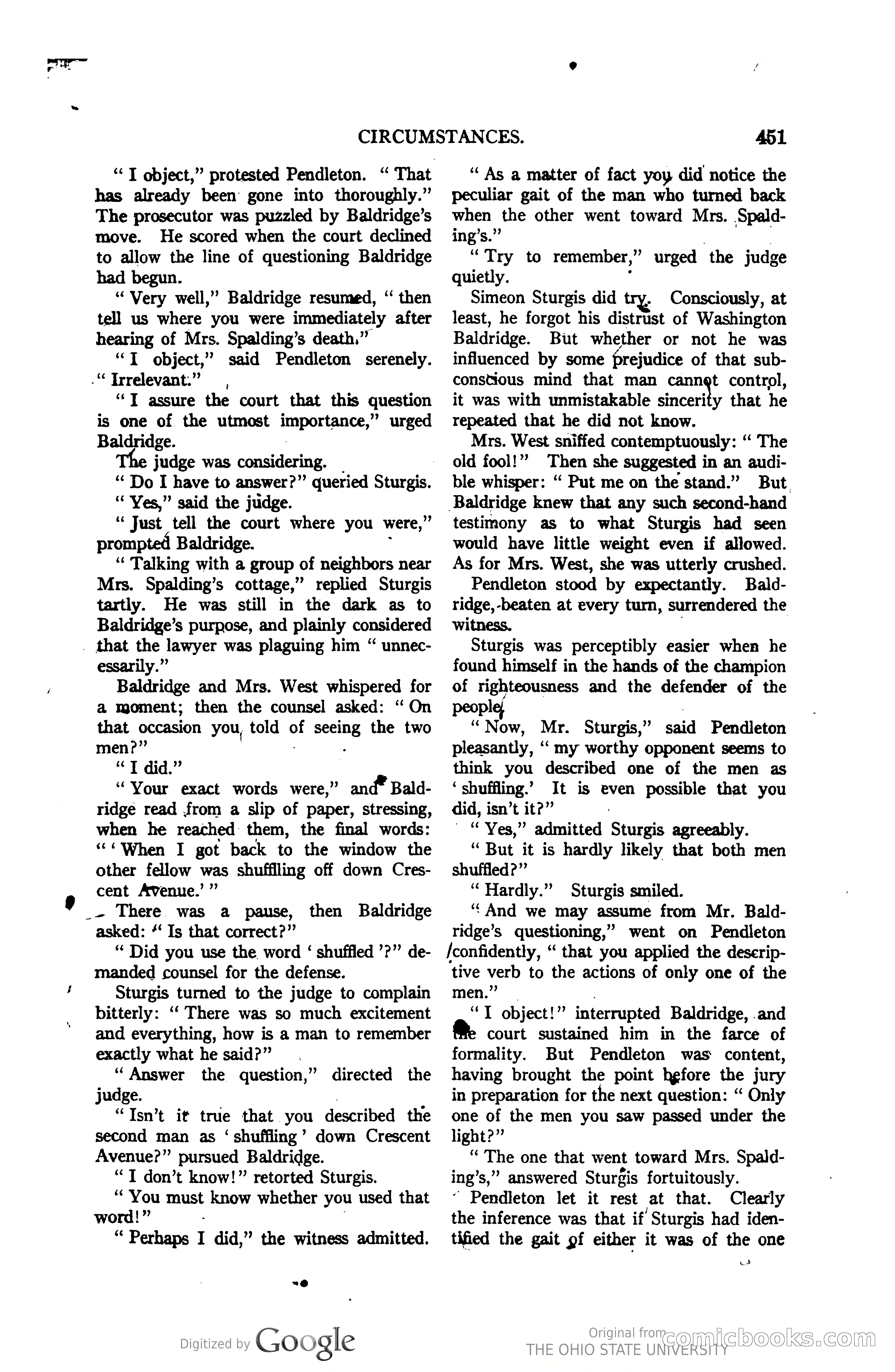
A restored page from Pulp Fiction, 1920. Page through the whole issue in the reader above.
📄 Transcribed text from this page (OCR, searchable)
Machine-transcribed from the original scan — historical spelling and the odd misread are preserved.
_ CIRCUMSTANCES. “I object,” protested Pendleton. has already been gone into thoroughly.” The prosecutor was puzzled by Baldridge’s move. He scored when the court declined to allow the line of questioning Baldridge had begun. ‘““ Very well,’’ Baldridge resumed, ‘‘ then tell us where you were immediately after hearing of Mrs. Spalding’s death,” “IT object,” said Pendleton serenely. .““Trrelevant.” ‘“‘T assure the court that this question is one of the utmost importance,” urged Baldridge. judge was considering. “Do I have to answer?” queried Sturgis. “ Ves,” said the judge. ‘“ Just tell the court where you were,’ prompted Baldridge. “‘ Talking with a group of neighbors near Mrs. Spalding’s cottage,’ replied Sturgis tartly. He was still in the dark as to Baldridge’s purpose, and plainly considered . that the lawyer was plaguing him “ unnec- essarily.” Baldridge and Mrs. West whispered for a moment; then the counsel asked: “ On that occasion you, told a seeing the two men?” ; iz 4 I did.”’ “Your exact words were,” and* Bald- ridge read from a slip of paper, stressing, when he reached them, the final words: ‘“‘< When I got back to the window the other fellow was shuffling off down Cres- cent Avenue.’ ” ~ There was a pause, then Baldridge asked: “Is that correct?” “ Did you use the word ‘ shuffled ’?” de- manded counsel for the defense. Sturgis turned to the judge to complain bitterly: ‘“‘ There was so much excitement and everything, how is a man to remember exactly what he said?” ‘“Answer the question,” directed the judge. “Tsn’t it true that you described the second man as ‘shuffling’ down Crescent Avenue?” pursued Baldridge. ‘“T don’t know!” retorted Sturgis. ‘You must know whether you used that word! ” “ Perhaps I did,” the witness admitted. ~@ “ That 451 “ As a matter of fact yoy did notice the peculiar gait of the man who tured back when the other went toward Mrs. Spald- ing’s. ”? “Try to remember, ” urged ‘the judge quietly. Simeon Sturgis did Consciously, at least, he forgot his distrust of Washington Baldridge. But whether or not he was influenced by some prejudice of that sub- constious mind that man cannet control, it was with unmistakable sincerity that he repeated that he did not know. Mrs. West sniffed contemptuously: “‘ The old fool!” Then she suggested in an audi- ble whisper: ‘‘ Put me on the stand.” _ -Baldridge Knew that any such second-hand testimony as to what Sturgis had seen would have little weight even if allowed. As for Mrs. West, she was utterly crushed. Pendleton stood by expectantly. Bald- ridge, -beaten at every turn, surrendered the witness. Sturgis was perceptibly easier when he found himself in the hands of the champion of righteousness and the defender of the people ‘“Now, Mr. Sturgis,” said Pendleton pleasantly, ‘“my worthy opponent seems to think you described one of the men as ‘ shuffling.’ It is even possible that you did, isn’t it?” ' “ Yes,” admitted Sturgis agreeably. “But it is hardly likely that both men shuffled?” “ Hardly.” Sturgis smiled. ‘‘ And we may assume from Mr. Bald- ridge’s questioning,” went on Pendleton /confidently, “‘ that you applied the deserip- tive verb to the actions of only one of the men.’ a | object!” interrupted Baldridge, and court sustained him in the farce of formality. But Pendleton was content, having brought the point hefore the jury in preparation for the next question: “ Only one of the men you saw passed under the light?” “The one that went toward Mrs. Spald- ing’s,” answered Sturgis fortuitously. Pendleton let it rest at that. Clearly the inference was that if Sturgis had iden- tified the gait pf either it was of the one Le Or a from YHIO STATE UNN COM KG DOO But, S CO